Episode Transcript
[00:00:00] Speaker A: Brownfield redevelopment is not for the weak. It can be very, very challenging and take a lot of work.
The height of the highs and the depth of the lows. There are going to be moments where you feel completely deflated and feel like giving up, and there are going to be moments that feel like euphoria. This is all part of your this
[00:00:25] Speaker B: podcast is for informational purposes only and does not constitute financial, legal or investment advice. Please consult a professional advisor before making any decision based on what you hear on the show. Hello everybody, I'm Brian Seidenstick. I'm your host here at Distress to Success.
Welcome to another episode where we talk with professionals who are helping reinvent blighted communities in a profitable way.
I would say I quite frankly, my team was lucky enough to snag our guest today.
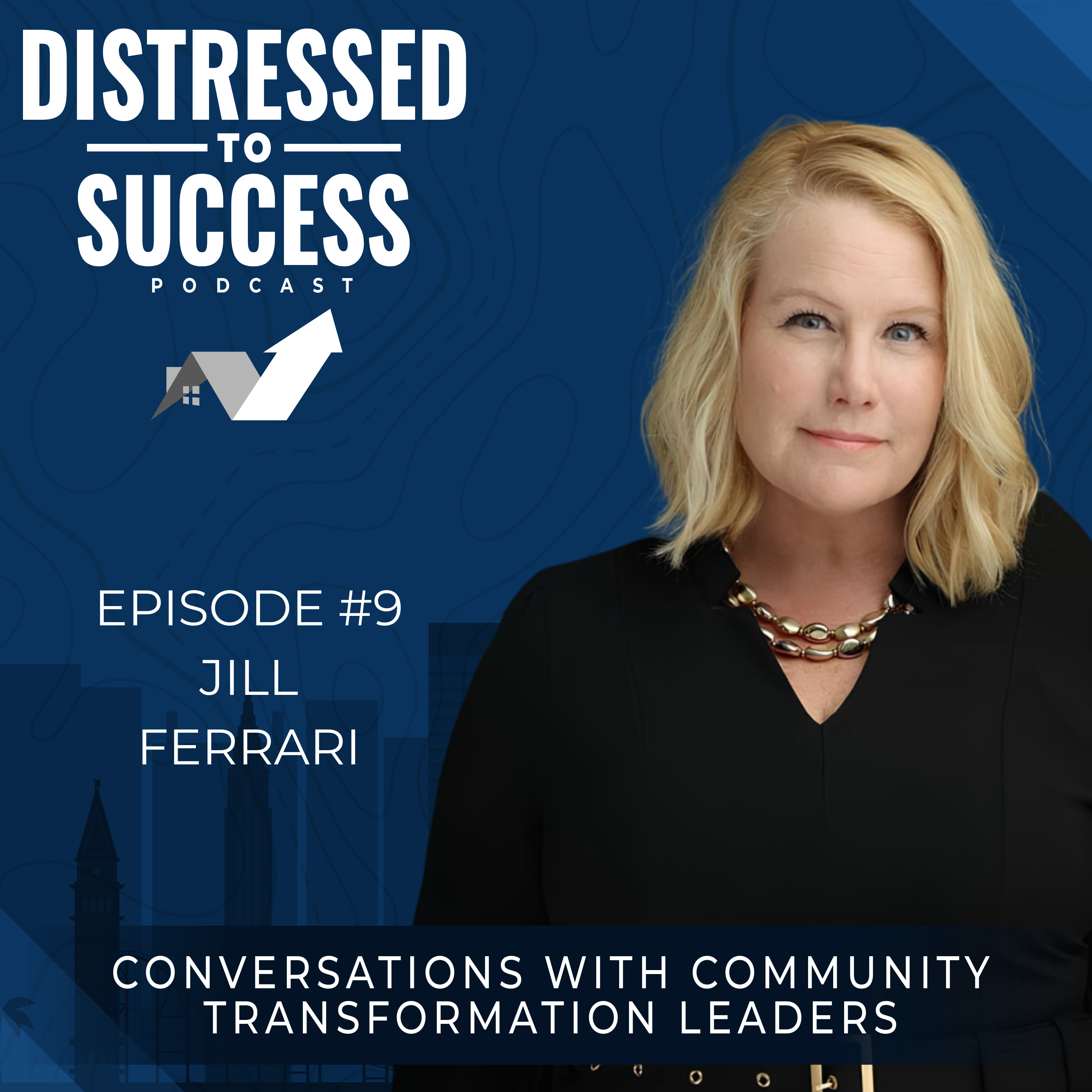
She is an absolute expert from so many different angles and I'll say the Distress to Success base. But Jill Ferrari, thank you and welcome.
[00:01:04] Speaker A: I'm so happy to be here. Thanks for having me.
[00:01:06] Speaker B: And Jill, I can't do this justice. Jill so I'm going to say she's a partner at Chenkin Bruch, which is an attorney firm, and not only that, she's got so much background and experience with everything that we talk about on the show, but can you just maybe start with giving us kind of a summary of all the things that you're involved in? Jill It's a big list and it's fascinating.
[00:01:31] Speaker A: Sure.
I have been in the Bromfield redevelopment industry for 30 years. I think over 30 years. Started out as a consultant, went to law school at night, entered the development space in approximately 2004 where I became the vice president of acquisitions for a large brownfield redeveloper and have some of my most interesting large scale brownfield redevelopment experience through that firm and ended up starting my own company in 2019 with a partner. That company is called Renovare Development and right now Renovare has about 100 million under construction or in development throughout Michigan. Almost every one of those sites is a brownfield site. So I don't know that I've ever really worked on a greenfield site.
And so still, you know, an owner in that company and watching that company move forward. While I had the real estate and economic development practice here at Schenken Bruch, I also teach real estate design and development fundamentals at the University of Michigan Taubman College of Architecture and Engineering and co founded a nonprofit in Detroit with four other women in commercial real estate that focuses on building tools for emerging female developers and We've built a community of over 150, 50 women in this space that are actively pursuing real estate development projects in Michigan. So very proud of that. We just won a million dollar grant from the state of Michigan to pass through to emerging developers. So it's something that's sorely needed in this area.
[00:03:11] Speaker B: That's amazing. That's amazing. And maybe don't want to give away too much of what you got coming, but I know we talked about a podcast that you were are working on. Can you fill us in a little bit on what that is all about?
[00:03:24] Speaker A: Yes.
I have a colleague who is another female developer in Montana. And we recognize the need to tell the stories of successful female developers across North America. So we are launching Breaking Ceilings, Breaking Ground. And it is a collection of interviews with women who have successfully completed development projects who own their own company all the way from Vancouver to Mexico City, and really talking about how their projects are uniquely designed to solve the issues that communities face.
We as women, we tend to approach commercial real estate development in a more holistic way.
And so we're going to be talking about inclusivity, we're going to be talking about diversity, equity and inclusion sustainability.
Because these women are doing some very, very thoughtful projects. So excited about that. Launching that in the next month with my partner Molly McCabe, who is a developer out of Montana. So watch for that.
[00:04:32] Speaker B: And I know it's wholly applicable to this episode, but obviously we are myself from Montana as well and connected with Molly and I think I'm excited to see what you guys put together and, and listen to some of those stories.
I'm sure some of the listeners out there do as well.
I guess your comment about holistic approach is really wrong with me. We interviewed a gentleman who also has a project in Detroit. Detroit seems to be a very commonplace of successful developers in the distress to success space. But Philip Kafka, who, he has a quote that sticks in my mind as far as when he, he took on his large project there, you know, he looks at as, as a product. Right. That he's developing. Right. And that's I think such a mind shift for folks in general. Right. Of it's not just I'm going to build this square footage to create this revenue. Right. It's more than that. Right. It's the, the space that goes into it. Right. It's like what are the amenities that you're bringing, what are the things that the neighborhood needs? Right. All of that, you know, helps in the ultimate success or failure of a project, whether it's accounted for or not. And that sounds like that's exactly what, you know, the story that you're. You guys are trying to highlight, which is. Which is fantastic. Well, Jill, I mean, there's a lot to your background and a million stories, but I always like to. To kind of hear the perspective from our guests of how did you. If you could have give a kind of a summarized version of how you went from the first time you said, hey, I think, you know, development is something I want to dabble in. Right. To I'd say the enormous success that you have today, I guess. Can you tell us that story a bit?
[00:06:19] Speaker A: Yeah. So my journey didn't include real estate in the beginning.
My dad was a factory worker and died at the age of 41 of respiratory cancer. I was nine years old. And it left me the product of a single mom, which, you know, formed my life moving forward and gave me the work ethic that I have. But losing him at nine and really as a result of his work environment, it drove me to a career in environmental health. So my background starts in cleanup and revitalization and just creating a safer, more accessible place for everybody.
And I started my journey in 1993 with Ogden Environmental Energy Services.
1993, and then moved into the real estate space in 1995. I started the Troy office for PM Environmental and began doing phase one environmental site assessments. And that's how just really got interested in brownfield redevelopment and the impact that it can have on creating safer spaces for families. And it just kind of went from there.
[00:07:37] Speaker B: Well, and then, you know, brownfield development, which we're going to dive into, because you certainly have much more, I guess I'll say success as well and experience in that realm, you know, compared to any other folks that we've interviewed. But I'd say it's the definition of the distress to success scenario. We've got this somewhat condemned parcel of land that you can't do anything with without some sort of remedy. Right. And that comes with hurdles. Right. That you got to get over as well as maybe some. Some benefits that might be out there that most people don't know about. You know, financial incentives. Right. Programs that you can apply to those types of development projects.
So not to take all of your. Your glory because obviously you have the multiple years of experience in that round. But what are. What is a couple of like the really good examples of a brownfield site that. And what that was turned into and how you were able to achieve that end goal?
[00:08:38] Speaker A: Yeah. So brownfield redevelopment is really Problem solving. And when Michigan launched all of its financial tools for brownfield redevelopment. I was a consultant at the time and, you know, a light bulb just went off and I thought, this is solving a problem for developers. This is solving a cash flow issue, a capital stack issue.
And dove into the program right away in the late 1990s, early 2000s, because I knew that if we could balance out the cost for these sites, then we're breaking down those barriers and we're going to see more sites develop. So every site is a problem that needs to be solved by a community of problem solvers.
So one example is the northville psychiatric hospital. It is a very large site here in Michigan. 400 acre site.
In the early 2000s, the firm that I worked for was part of the development team for that site. And we faced barriers with public opinion. We faced barriers with access to tools, because back then, brownfield tools were more geographically restricted. And our township was one border over from a city that had access to twice as many brownfield redevelopment tools as our township.
And it makes it very challenging to do large sites like that. So we just started to figure out ways to break down those barriers and add tools. And we ended up passing the property through the land bank, which under Michigan state statute, unlocked a number of tools that we didn't have access to without it. So we went through the Wayne county land bank, and the legislature has improved over the last 20 years to address some of those issues. But, you know, 20 years ago, 25 years ago, you had to get really creative in order to apply tools because of how they were legislated.
But that's a great example. That site was the former.
It was a hospital and a psychiatric hospital. And it was, you know, reportedly haunted with miles and miles of underground tunnels full of asbestos. So we had asbestos from a demolition standpoint, but also soil contamination issue.
So really, really complicated site with medical waste, wetlands, everything that you can think of on a brownfield site was there. And that site today is a beautiful retail and office campus with U. Of M University of michigan medical center as the primary operator in that campus. So that's a success story that I'm very proud of because we worked really hard with the local governments to make sure that all the tools were usable for the project.
[00:11:41] Speaker B: This term tools, which I certainly can make some assumptions on all those tools. Right. That you're referring to, but can you kind of give a summary of some of those tools that you're mentioning that you didn't have when it was a township versus the city on the other side of the border. And then what are the tools that you unlocked right through the land bank?
[00:12:02] Speaker A: So Michigan has a very progressive economic toolbox for brownfields. It started back in the late 90s when the statute was passed that allowed for tax increment financing for brownfield sites. We also have a list of abatements. So tax increment financing allows us to capture future tax increment revenue that's generated by the project and we can pay ourselves back as developers for certain costs incurred on the property. It's a, it's a great financing mechanism. It helps with the operating cash flow post construction and can help level out costs on brownfield sites. Tax abatements, same thing. It, you know, cuts tax taxes, alarm taxes as the properties move forward post construction. And, and the trick is really layering those pieces together to figure out what's best for the community and what's going to allow the project to pencil. But there's more than that. There used to be a brownfield tax credit in the state of Michigan that went away. Don't ask me what year that was, but it was removed at some point. And we have a number of other tools. We have very progressive grants and loans through different agencies. We have agencies called brownfield redevelopment authorities that are set up here in Michigan that are either local, at the city level or the county level and they pass those tax increment financing plans. But they also create reserves and they have loaning and bonding capability. So there really are an egle, our state environmental agency, it's department of Energy, Great Lakes Environment. Energy. Environment. Great Lakes and Energy. Sorry, that's a big one. Used to be deq. Right.
They have been very active in providing grants and loans over, I mean, the last 30 years. But even most recently, they have been right at the front table of brownfield redevelopment and helping get a lot of these very impactful projects completed.
[00:14:16] Speaker B: That's awesome. Well, I think, I think all of those tools you mentioned, I'll say are state level tools. Right. Were there any, say, federal level tools that were deployed on any of those projects?
[00:14:27] Speaker A: Yeah. So through the epa, there are site assessment funds that can flow down through egle and local municipalities and on a few of the projects that the development company that I am an owner in have completed or are under construction right now.
The grants that have been used in the very beginning to fully assess the site and make sure that we have all of the work identified that needs to get done in order to meet residential standards, all of that has been paid for through federal funds. That are flowing through the local unit of government. So there's definitely federal money that's active as well.
[00:15:10] Speaker B: That's awesome.
Maybe hinting at a. At a future episode when I. I keep mentioning Molly's name. Hopefully she's okay with me mentioning. But she mentioned some of the struggles that she, you know, has in Montana. Right. Because Montana doesn't have all of these tools available.
I'd love to. To maybe talk about some of those. And I'm sure she's not alone. I'm sure other states are similar. Right. Many states have either out of necessity. Right. I think I live in Ohio now. Right. With a lot of the environmental cleanup that had to happen in the 70s, 80s, 90s, and continuing today, I'd say they're probably on the forefront. Right. Of establishing legislation. Right. To help on those things. Right. There's many other states that have never had to deal with that on the scale that maybe the Midwest. Right. Or some people call it the Rust Belt, has had to. And so I think other states may be learning from some of those, I'll say, very smart legislative tools that they put in place. Would be beneficial to everybody in those other states anyway. Not to dive too much down that rabbit hole, but would love to talk about that more in the future. So you mentioned the medical facility through the University of Michigan. Do you have any other kind of recent brownfield development projects that I guess had immense hurdles that you had to overcome?
[00:16:32] Speaker A: Yeah. The development company that I'm an owner in recently redeveloped a.
An infill site next to Ann Arbor, Michigan, which is the home of University of Michigan, for residential use. And this was a property that the city had published repeated requests for proposals for. It was one of their priority sites. And the city hadn't had a new housing development in 40 years.
And when we came to the table, we put financing together that would help us alleviate the contamination areas of the site. It had urban fill down to 8 or 9ft, and we had to address all of that. And it took every public agency, the city, the state Housing Development Authority, Eagle, Michigan Economic Development Corporation. It really took every part of our village to get this project where it's at. And it's not complete yet, but it is definitely one of those projects where everybody has come to the table to support it.
And I think that that's what's required in order to get these complicated projects done. So as developers, especially brownfield redevelopers, coming into a community from the perspective that you're doing a great thing and you just need the Community to give you money to get it done is really not the right way to approach a project. You know, coming into a community and saying, listen, we really want to provide this service, provide this product to the community, but we need everybody at the table in order to make this work. We need as many tools as possible if this is what the community wants and needs for its residents, both existing residents and anybody they're trying to attract.
So this was an example of that, of us just really sitting down with everybody.
And it has definitely faced its challenges. And like I said, it's not done yet, but we've sold several of the units and the residents are really happy. Some of them are first time home buyers in their late ages. So it's really nice to see.
And my partner, who's the president of the company is doing an amazing job of getting those units sold to income qualified buyers.
But we're doing similar projects in Benton Harbor, harbor woods that are, they're all complicated and it just, it does, it takes that village.
[00:19:05] Speaker B: Yeah, that's a. Complicated is probably an oversimplified term of, of Brownsfield development.
I guess out of my curiosity, I'm sure listeners are, are curious as well.
How, how do you find Brown. These brownfield like sites for development? I mean, I know the EPA has, you know, database of, of environmental, you know, hazard sites, you know, nationwide, but how do these opportunities. Right. Come to you or how do you seek those opportunities? I don't know exactly how that works, but can you, can you help me understand that better?
[00:19:39] Speaker A: Yeah.
So sometimes they are identified by the community as a priority site, especially like Ypsilanti, which is the, the town next to Ann Arbor. That site is right in the middle of the community.
So it became a priority. They knew they had to overcome some challenges in other places. They are, they're places where the develop makes sense because they're in proximity to employers or they're the one vacant spot that's surrounded by a whole bunch of dense residential.
I spent a lot of hours looking through, like flying through Google Earth and looking or looking at zoning maps, looking for publicly owned property because I like to start with a piece of property that's owned by a public agency because you can, you have common goals of getting this property redeveloped. I mean, unless it's parkland or something that is supposed to remain vacant.
So I do, I kind of fly around and look for publicly owned land that's not park land.
I look through, through state agency lists of contaminated sites, look for large sites.
I drive around, do a lot of driving, especially in Detroit and on the east side, looking for sites and just kind of look for sites that make all the dots line up. So constantly looking for sites that are in communities that can maximize tools. So even though I said that Michigan's come a long way to breaking down geographic barriers to tools, they still exist.
So I try to line up, where are those places where tools can be maximized?
Where are the places that receive direct funds from the federal government for revitalization or for community development, like HUD funds? Where are the places where they are taking a proactive approach toward redevelopment? We have a program in Michigan called Redevelopment Ready Communities. So I look for communities that have gotten to the highest status in that program, and then I look for employers, where are large employers located? And in places where I have all four of those things.
That's where I focus.
[00:21:58] Speaker B: Got it. And do you.
So it's, yeah, multiple layers of things that you're looking for, and then the needles in that haystack that come out the other end of, like, this is a good candidate.
What is next step? You reach out to the county or the city that owns it and say, hey, we're familiar with this.
We have a plan. Or do you put together the plan right before you approach them? Or how does that work?
[00:22:22] Speaker A: So typically I would look for any local plans related to housing, look at their master plan to see what the community has identified as a need for their residents and future residents. So I'll look at that, and if there's a change in use on that property or there's a strong need for housing or some other use that fits on that site, I would just kind of do a workup to see what that could look like. And yeah, call the owner, the community, and say, listen, what do you think about this use? And it's much better if I already have a relationship with that community.
Just call them up and say, are you actively trying to redevelop this property? You know, where do you think the public will be with this proposed use? Because that's a. That's a huge challenge if you have a community that really isn't ready for that change. And there hasn't been a lot of engagement on affordable housing or workforce housing or, or anything like that. It gets a lot more challenging. So I try to focus on places where there's already been that discussion around what the community needs and there's general consensus, because I've made the mistake many times of finding a great site, proposing a use that is supported by need. But the public hasn't been engaged and it falls apart because the politicians are put in a position of fighting against the public for something that actually is needed and it's really not gonna drive down their property value and all these perceptions that have not been discussed with the public prior to that. So yeah, there's a lot of boxes that need to get checked before it makes sense to put money down and really invest in a property.
[00:24:25] Speaker B: Well, that's, you know, public perception is so huge. Right. On every project. Right. It's obviously a little more important when you're dealing with, you know, I'll say public property right at the start of, of the project. Right. And, and projects of this size.
[00:24:38] Speaker A: Right.
[00:24:38] Speaker B: They're going to likely need some sort of zoning change, etc, but it's also important almost every large project, just some developers don't seem to account for that. Right. Because they don't have to, but they should.
Right. So that's a huge one and that's a, that's one you don't have a whole lot of control over. Right.
You know, good or bad, I guess is a good way of. If you don't have it, you get to move on.
If you have it right. Then that's a big, big checkbox. Right.
What, how many. I don't know if you know, but it's more out of my curiosity. How many of those conversations do you have to have with governments, Right. On potential projects to find the one that you think is going to work?
Is it 10, you know, 100, like how many you actually have to filter through to find the Right.
[00:25:26] Speaker A: It really depends on how organized the community is and that that's directly related to their capacity. Right. A lot of communities don't have the funds for an economic development director and to be very proactive in being redevelopment ready. But for those that, that have taken those steps and have set aside resources for it, I think those conversations are shorter because the challenge is when you're trying to put a square peg in a round hole, when you are approaching a community and you are pursuing a use that may make the most money for the developer, market rate housing, but it's not what the community wants or community needs, that's when it's really going to get drawn out.
The farther they are along in their community engagement processes, the fewer conversations you need to have.
In the Ypsilanti project, they had just enacted a community benefits ordinance which is brand new. And so we spent a few months really going through the income targeting whether it was for sale or for rent.
And I mean, so it took quite a long time to get through the planning process because that project is so unique and that's a opportunity. Cost of receiving all those financial benefits and tax breaks or whatever you're getting is that you do have to spend a lot more time and have a lot more conversations because it's a trade off for all those public resources.
[00:27:02] Speaker B: Yes, for sure.
And do you deploy this I'll say model? Right. I think it's hard to. Every project, it's its own project with a whole lot of difference. You can't say here's my exact model. But do you focus only in Michigan or do you look at other states as well?
[00:27:18] Speaker A: Now I'm starting. I have really focused my career in Michigan since the crash of 2007 and 8. I was actually in Las Vegas at that time packaging one of the biggest deals in the country when the market crashed. And since then I've really focused on Michigan. But recently I've gained a few clients here at Schenken Bre that are focused nationally. And I'm excited about that because states have different creative ways of approaching redevelopment projects. And a lot of states have employer based funds and tools that we don't have a lot of here in Michigan. So it's really great to learn about all of these other creative and innovative tools and hopefully bring them back to Michigan.
[00:28:08] Speaker B: Got it.
So for listeners that are, I guess, curious about, I guess deploying this model on, at least pursue trying, Right. To see if they can find a project in their, in their geographic area. What are some of the. Is there a way. And maybe it's with today's, you know, chat, GBT and Gemini and all those, maybe it's just chatting with one of those. But where would you find in the, you know, state statutes or something like that to say, hey, does my state even have these, you know, needed tools available? Because if they don't. Right. Then it makes, you know, the advent of trying to tackle some of these even harder. Right. Than they are normally. But is there any, any advice you could give or point people in the direction of like figuring out whether their state even has these tools?
[00:28:56] Speaker A: Yeah. So I think in any state, the first step is the state economic development agency or corporation and the state housing development authority. So those two websites in any state would be the first place to go.
And then also the websites of each major city in that state or kind of the primary markets, those websites just searching for economic development tools in that state should produce information and then just reaching out to folks in the industry, urban Land Institute is a great resource for finding those connections. That's an international organization that I belong to, so it's really just doing a little research in each state, but that's where I would start.
[00:29:41] Speaker B: Got it, Got it. Hopefully listeners that are going, wow, this, this. Because I think the really cool, I'll say impressive and, and enormously impactful piece of, of I'd say Brownsfield development is, is that you are making usually a very big difference in the communities that these, these projects take place. Right. It's not all about, you know, hey, maximizing dollars. Right. But you're.
You're looked at right. From the community as doing ultimately very good. I think some developers maybe struggle with that when they take on a project. They don't do that, look at what is the public opinion about this project and end up feeling like public enemy number one. But I think in most cases, you tell me if you found differently, Jill. But I think the Brownsville development is. It checks that feel good box of doing something good and impactful for the communities that you're working within. Would that be accurate?
[00:30:36] Speaker A: It does, but it never, it doesn't usually start out that way, you know, and again, things have changed over the, over the last 30 years, but there's still a lot of work. It is not a cash cow. You know, people think that, oh, there's all these public tools and it's going to make, you know, it's going to really improve the financial performance of the project. I mean, listen, brownfield redevelopment is a ton of work. It's the understanding of how to solve each problem that's coming up. You've got contamination. Do I have to pull it off the site? Can I leave it, cap it? What kind of issues do I have with indoor air quality? I mean, there's so many questions that you have to ask on the technical side. Then you've got to figure out where the financing is to cover the things that you have to do.
Then you've got to pull in all the partners to make all these pieces work. Brownfield redevelopment is not for the week. It really isn't.
[00:31:36] Speaker B: It is not for the dabbling or the newbie right. Of like, don't take your first project. That's for sure.
[00:31:44] Speaker A: It is, it can be very, very challenging and take a lot of work. And the reward is, yes, it is turning an underutilized asset into something that provides value to the community.
I'll give another example. There was a 50 acre site in Michigan that was a stormwater retention basin. And the way it was Structured, I could just tell that it seemed to be overbuilt.
Just the land around the stormwater basin, there were setbacks of like several hundred feet on either side. And I thought, wow, could we restructure the stormwater retention basin and free up some land for housing?
And worked with the local community to get that done and was able to build a whole new single family development on that site and rework the stormwater drain. So I think it's about looking for opportunities.
So, you know, those vacant sites or underutilized sites that are surrounded by development instead of going out in the, in, you know, in the middle of Greenfield and trying to, to redevelop there, what is, what is, you know, what are those opportunities where you have these sites that are surrounded by development and how do you, how do you tackle all the issues that they present? But it is not, it's not simple and it's not. There are emerging developers that are approaching brownfields and working on brownfields and I encourage that because you just really have to understand how to use the tools and how to build that community and the problems that you can't solve. Hopefully the community, the county partners or the state partners can help solve those problems.
[00:33:26] Speaker B: So is it, is it something, Joe, where if a developer and in their local community, you know, isn't an expert in this style of development but they are aware of, of projects that might be a good fit, is that something they could work with you on?
[00:33:42] Speaker A: Oh, yes, of course.
I help a lot of emerging developers. I have a lot of clients that are seasoned developers.
My joy is solving problems. So yes, if you have a site that you know is meant to be a mixed use development or a high density single, you know, family neighborhood and you can't figure out, can't figure out that deal, can't make it pencil and need some help with tools. I am your person.
[00:34:13] Speaker B: Excellent. Excellent. Well, I guess one of my favorite questions, you know, Jill, is, is basically imagine you being able to go back in time and, and give your younger self a tidbit of knowledge, you know, of something that might ultimately help them expedite their path to success, you know, and that, you know, save some of that I'll call tuition. Right. Tuition comes in many ways, right. Actual paying for school or, you know, making mistakes on projects. Right. I think we all go through that as developers. But is there any advice that you would give your younger self to avoid, I'll say some level of extreme pain or maybe on the other side like pointing the right direction from the beginning.
What if anything, would you do?
[00:35:01] Speaker A: Yeah. So one of the things that I don't think I was really prepared for in the development industry was the height of the highs and the depth of the lows. And so real estate is so cyclical and the failures are horrendous and gut wrenching and the winds are over the moon. Right. So I think if I could go back and talk to myself in 2005, I would say buckle in. It is going to be a really bumpy ride. There are going to be moments where you feel completely deflated and feel like giving up, and there are going to be moments that feel like euphoria. Like you, you.
This is all part of your journey as an entrepreneur. This is what life is going to be like. So temper yourself on the wins and embrace your failures because it's all part of a lifelong journey.
[00:36:06] Speaker B: That's excellent, excellent advice. Right. Is be persistent.
You'll make it through the lows. Right. And the highs don't last forever, but enjoy them both. Right?
[00:36:16] Speaker A: That's right. That's right.
[00:36:18] Speaker B: Well, Jill, I guess I do want to circle back on another episode maybe in the future if you're willing to be on again to dive into some of these projects and a lot more, more detail. But for today, I guess what I always like to round out the show with this little segment I call Carve Outs, which I did not come up with. I totally stole it from one of my favorite podcasts. And it's really just nuggets of knowledge, words of advice. And I think what you just gave your younger self is one of those. But you got to come up with something new on top of it or random device. Right. That you bought recently.
And I'll go first, right. Just to kind of give readers give you a little or listeners give yourself some time to think on it.
The car. What I have today is a book that I'm listening to and it's a basic book for entrepreneurs. Right. But the concept is very simple but highly impactful. It's actually 10x is easier than 2x.
It's I guess a joint book by Dan Sullivan and I'm trying to think of the other gentleman that co wrote it.
But if you look it up, 10x is easier than 2x. Great. Right. I think the basis of it. Right. Is actually growing at 10x is easier than trying to grow 2x. But for, for me and for our organization, it's been highly impactful because just thinking about that actual 10xing is. Is probably not realistic. Right. You know, but thinking that way allows you to very clearly say, where are. You know, they call it the 80% in the book, but where are those things that I'm spending my time? Because ultimately the thing that we're all limited by is time. So what are the things that I'm limiting my time that are ultimately holding me back right, from being able to achieve bigger and better things? And so for myself and for organization, just that mindset has been a fantastic tool, right? To use your. Your term, Jill, that book has been a fantastic tool. When we sit down and do our planning, we look at it from a 10x right? Where, where what is holding us back from being able to do 10x and. And not that we go carve out those 80% and say, nope, those are not worth our time anymore. But definitely highlights those areas of like where should we spending more time and where should we maybe be spending a little less time? And so for all you listeners, I highly recommend checking that out again. It's 10x is easier than 2x. Hopefully I babbled enough to give you some time, Jill, to think on a carve out of two of your own.
[00:38:45] Speaker A: So this is easy.
I am a sci fi nut and my favorite show of all time is called Firefly. It was only one season and it was canceled, but there are thousands of folks that are fans of this show. And last week the original cast of the show came together at AwesomeCon Awesome Con in Washington D.C.
and there was a big announcement that they were planning and the community boards for this show just exploded.
So millions of fans waiting to hear what the announcement was and what was gonna happen.
And I almost diverted my trip from the Urban Land institute conference to AwesomeCon in D.C. because I really wanted to be in the room to hear what they were gonna say. So it really made me think about community, how we define community, what it means to us, how it brings us joy and just really reminded me and all these conversation boards and everybody getting excited and the joy that that world has brought all these people, the world of this show, this crazy show that was one season.
It really made me think about why we built.
We build to create spaces for people. And if we don't think about how those people will interact, will relate, will support each other, how we assemble projects, how we build place, we're not creating that joy that all of us were experiencing as we were talking about whether Firefly was gonna be an animated series or if they were really gonna reboot it, whatever.
But it just really, really brought me back to the fundamental of community and how we Define it, why it brings us joy and making sure that it is one of our most important thought pieces when we're putting projects together.
Luckily, we all know now, yeah, they're making an animated series, which was not the, you know, the thing that the fans really wanted. But we'll take it because we all, we love it and we're just happy
[00:41:06] Speaker B: to see them back as that community builds over time. Right.
Be an animated series today, but that doesn't mean that it won't come back in the future.
Well, that's definitely in line with that. I'll say community or a public opinion piece of it. And that's a really amazing thing of Brownfield development. There has to be a community project, otherwise it typically doesn't come to fruition. Right.
Well, Jill, I immensely appreciate your time. Again, for folks that do want to connect with you, maybe on a project that they have, you know, locally and work with you on, what's the best way to connect with you?
[00:41:44] Speaker A: So my email and all my contact is on our website, which is sbdetroit.com so SB Schenkbrush. Yep.
[00:41:55] Speaker B: Excellent.
[00:41:56] Speaker A: And you can connect with me through the website.
[00:41:58] Speaker B: And for everybody listening, check out the notes. All that information will be there. Jill, thank you again and hope to have you on again in the future.
[00:42:07] Speaker A: I'm so happy to be here. Thanks for having me. And I would love to be back on. Let me know.
[00:42:12] Speaker B: All right, excellent. Well, good luck, everybody, and good luck with your next venture.