Episode Transcript
[00:00:00] Speaker A: And before I could get the whole story out of my mouth about the great day I had he fired.
All I could think about was, what did I do wrong? What did I do wrong? Just for hours on end. You can be as loyal as you want to a company, climb the corporate ladder for a decade. You're just one restructuring away from losing your job. Brian, you're not going to believe this, but it turns out not many people want to take life advice from the 27 year old. But then I discovered this magic vehicle
[00:00:31] Speaker B: called this podcast is for informational purposes only and does not constitute financial, legal or investment advice. Please consult a professional advisor before making any decision based on what you hear on the show. Welcome everybody, to another episode of Distress to Success, where we talk with professionals who are helping reinvite blighted communities in a profitable way.
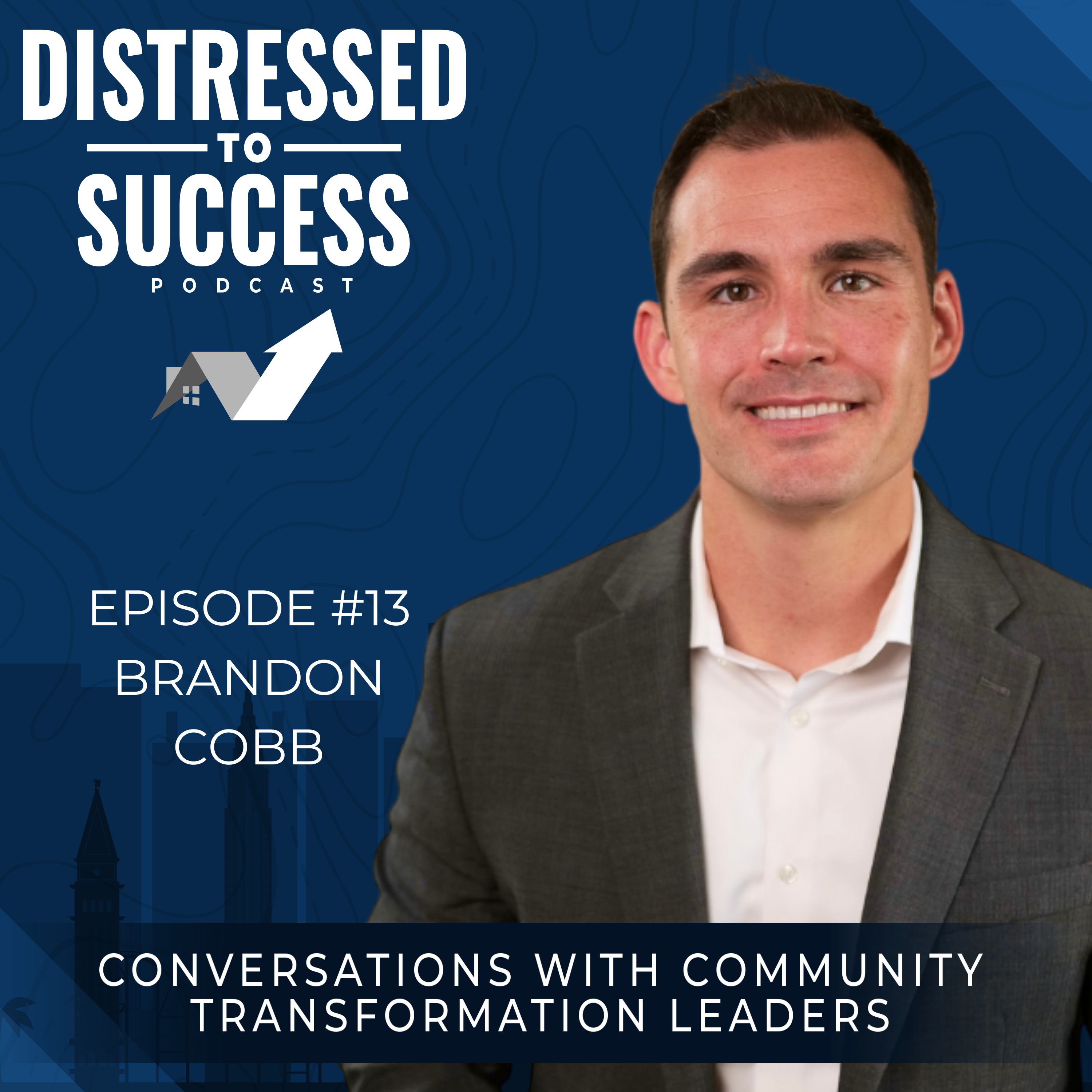
Today I was lucky enough to snag us some time from Brandon Cobb. He's the founder of what's called the Land Development Accelerator and HBG Capital.
And Brandon has an immense amount of knowledge in, in how to really take land right from raw to entitled, right. And ready to. To build communities, which I think is just an awesome and, and fascinating topic. But before we, before I steal all of the thunder, Brandon, welcome. Thanks for hopping on with us.
[00:01:22] Speaker A: Hey, man, the. The honor's all mine. Thanks for having me on.
[00:01:26] Speaker B: Well, maybe before we talk about Land Development Accelerator and HBG Capital, I always am always fascinated by the journey that folks have from when they decided, hey, maybe I want to be an entrepreneur to the success that they've had and are having today.
So maybe tell us a little story of your background and how you got to where you're at.
[00:01:51] Speaker A: Yeah, so I like to tell people I'm what you call an accidental entrepreneur. I didn't have this dream of doing something one day and I got fed and sick of, tired of my job, and I said, ah, screw it, I'm. I'm gonna take the leap.
I was actually living my dream, which was doing medical device sales. That's what I thought was going to be my career that I was going to do for the rest of my life. I spent years trying to break into medical device sales when I was a young buck out of college, searching for his career. And I was attracted by, you know, getting to wear scrubs every single day. I thought that was really cool, being in the or rubbing shoulders with successful orthopedic surgeons.
I liked the idea of training the hospital staff on how to use my product, and I loved it. It was everything that I thought it was going to be. What I really loved about it was the fact that my product was making a difference in the patient's life. So it's fun to sell something that you believe in that's making a difference.
And the guy I was working with, my boss, was a father figure to me. He's a mentor. He was a great dude. He finally gave me my shot to break into medical cells.
Man, things were just chugging along, going great, until one Friday afternoon I got called up. My boss said, hey, meet me over at Starbucks in West End.
And I was having a great day as a sales rep. One of those days where you're pumped up and excited to tell your boss, like, how much money you'd made him and the company and, you know, wanting to add, atta boy.
And before I could get the whole story out of my mouth about the great day I had, he fires me.
And I remember when that moment happened, all I could think about was, what did I do wrong? What did I do wrong? What did I do wrong? Just for hours on end. And after the shock wore off, I learned an important lesson, which was nobody was going to look out for my financial well being but me. You can be as loyal as you want to a company, put the blood, sweat and tears in, climb the corporate ladder for a decade.
You're just one restructuring, one merger and acquisition, one big economic event away from losing your job.
And so, for whatever reason, it was in the best interest of the company to let me go that day. But that lesson stuck with me.
Nobody was going to look out for my financial wellbeing but me. So that's what started my entrepreneur journey. I started a course on how to break into medical device sales thinking. Okay, well, I did that and I had people reach out to me and ask me how I did it. And so maybe, maybe there's something there that failed. I started an online motivational blog because I was really into the motivational stuff that failed. I really liked the whole life coaching, Tony Robbins stuff. I was really into that. I was like, you know what? I'm going to be a life coach. And Brian, you're not going to believe this, but it turns out not many people want to take life advice from a 27 year old.
So that business flopped. But then I discovered this magic vehicle, as you know, called real estate. And, and at first I made all the mistakes. I was flipping houses, wholesaling houses. I think my third deal I did was like a new construction project. I lost $40,000 on it. So there was Quite the learning curve. But you know, fast forward five, six, seven years, you know, I did over 187 transactions. Went from flipping houses to building houses. We needed to scale the number of homes we were building. So we started going after land where we could put the roads in and you know, build 40, 50 homes instead of the little vacant single lot builds. And everything was going great. Then we got a knock on the door one day from a national home builder, you know, publicly traded firm on the, on the stock market. And they said, we really like your development, we want to buy it. And we were like, get lost, it's not for sale, can't have it. And then they sent us a contract with purchase price and my partner looked and I looked at the contract, looked at each other, looked at the contract, look at each other, and we said, it's for sale, you can have it. And do you want the one across the street too? Because we'll, we'll develop and sell you that one too. So that's how we kind of sort of accidentally got into the whole land development space is. It started with the need to scale our new construction company. And you know, now we're mostly focused on land entitlement and, and land development. You know, we've got our own mastermind community of other people that are doing it and you know, we teach how to do that without making mistakes.
[00:06:14] Speaker B: That's awesome. That's awesome. So what I guess when you were 27. So I guess how, how many years since then till I'll say today with, you know, how long, how quick was that journey?
[00:06:25] Speaker A: I'll say, how quick was that journey? So let's see, I started when I was 26, 27. I'm, I'll be 30. How old am I? 36 this year.
So yeah, you know, give or take about a decade.
[00:06:38] Speaker B: So it's the common theme, right? I guess I asked that question because the common. I think a lot of folks that are either just getting started in their entrepreneurial journey or in real estate is like this overnight success, right? Like I'm going to have an overnight success. But the common theme is it's, you know, 20 year overnight success or 10 year overnight success is it's takes a lot, a lot to build it to all of a sudden being at the level right. That you're at today.
So anyway, you did it a lot faster than, than I have. And so kudos to you, but that's fantastic.
So you have really the, the land development accelerator, which I, I guess you and I kind of talked in the background, but help help the audience understand what that is in more detail.
[00:07:27] Speaker A: You know, when we were getting into land development and land entitlement, we knew we wanted to be part of a mastermind community. There's so much value in leaning on a community that's already doing it or having a coach that's already done a bunch of them to make sure that you're not spending money on things you need to, or buying a bad deal or just going about it the right way. We knew that's what we wanted to do because we had been part of so many masterminds and coaching programs previously. You know, when we first started, one of the best things we did was join a house flipping mastermind to get all the information that we needed. Hey, use this type of marketing. Here's the onboarding guy to train your sales rep. It's kind of like a done for you thing. You just need to implement it and you've got that knowledge and expertise from other people who are on the same journey and the people who've already done the thing that you're trying to do. So we, we knew the value of coaching and masterminds when we were getting into this space, but we could not find a community.
It's just not something that is widely taught out there. And so my partner said, well, if there's no other communities of these developers out there, let's create it. And so that's what we did. We created the program partly because a lot of people had reached out to us, saw what we were doing, and said, guys, I'm looking for someone who can kind of teach me this stuff. Will you coach me? And we're like, no, we're not interested in that because our core business is doing the land entitlement and the land development stuff. And after a while we were like, you know what, let's do it. Because we can learn too, from other people who were teaching it. We had a guy in the community just the other day show us a trick that I didn't even know about on how you can extend the timeframe to do a 1031. Like, I thought that you need to, you know, as soon as you sell a piece of real estate and you're gonna 1031, you got six months. And he's like, no, you can indefinitely keep the money there. I was like, how did you do that? And he showed me this special vehicle and I was like, this is, that's, that's huge. So we wanted a community of other people that were doing this type of stuff so that, you know, we could be a part of that. And so it's a huge value add. Especially if people are getting into development, wanting to do their first land entitlement deal. Or you. Of development.
Because, you know, we, we, we've, we've done it. Right. I've got the arrows in my back.
I've lost lots of money on deals. I've made all the mistakes and we just don't want to see that happen to other people.
[00:09:48] Speaker B: Well, it sounds like. And we'll dive into HBG capital here a bit, but it sounds like you've learned a lot of what I like to call nuggets of knowledge. Right. Or, or tuition along the way. Is there anything in your land development accelerator or really just the land development journey. Right. That you could go back to yourself, back in time and say, hey, Brandon, young Brandon, younger Brandon, like what here? If do these three things in your. Save yourself a whole lot of either, you know, pain. Right. Mental pain, maybe money. Right.
Or time. Do you have any gems of knowledge that you would share with your younger self along that.
[00:10:32] Speaker A: Yeah, I'll share some specifics. What's. What is very disheartening was I was already doing the thing that would have prevented a lot of the heartache, which was I was looking for a community to lean on. It just wasn't out there. Right. Getting advice and guidance from someone who's already done these land entitlement development deals already, you know, built dozens and dozens of houses, if that's what you want to do.
I mean, it's invaluable, the feedback and guidance that you can get. And again, it just wasn't out there. So if I could go back and do it all over again and force feed myself, I would have probably found someone who was doing it and been like, dude, can I pay you whatever amount of money you're willing to take to just have access to you for a full year and run all my deals and things through and just, you know, be able to make sure I'm doing this the right way. I wish I'd done that instead of, well, I can't find a community out there. There's no coaching program that I can find. Let me just figure it out myself.
I wish I'd done that. But some of the biggest mistakes that we've made and we see other people make are kind of as follows. The. The biggest mistake that we see is people designing a community without the end product in mind. So once a month I get a deal from a brand new Developer who spent all the money and the year to something approved and they're trying to sell it. Right? These are sophisticated real estate investors, right? They've, they've made their money in real estate and they're wanting to get into the big boy game, right? You know, development stuff.
And he sent, I get these plans and I looked at one and it was designed with an 11 foot wide town on product.
What he did was he just shoved as much density, you know, oh, the skinnier the home, the more I can get, the more I can get, the more money. Great.
Nobody has an 11 foot wide town on product. Nobody's gonna buy it. And I'd made this mistake. One of my first developments that I bought was approved for 42 homes.
So all we had to do was go develop it and sell the lots. Well, we're shopping it around to our builders going, hey, you know, we got these lots, you know, do you want to buy them? We'll develop it for you.
Thank God we didn't just go develop it. We, you know, lined up the end buyer first and they go, guys, your, Your lots are 30ft wide.
Our smallest product is 30ft wide. You gotta have a little bit of space between the edge of the home and the property line. You know, the homes just can't all connect. You get, you gotta have 10ft between the homes. So you need 5 foot between the house and the property line. Well, that meant if your lot is 30ft wide, you needed to build a 20 foot wide home. So you have 5ft on each side.
Well, we had to go back and get it, you know, reapproved for not 42, but for like 35 lots. And we were selling those lots for $85,000 a piece. So 85 grand times the loss of seven lots, that's a $600,000. Oh, okay.
Luckily, it was a really good deal and we still made money on it. It was still a great deal. But. But that's a big mistake that people make. They don't design it with the end buyer in mind. You want to get your builder buyer lined up during your due diligence period to make sure it's designed properly. And then I kind of touched on the second.
The second, which is putting too much density on it. Designing something without the community in mind, just throwing as much housing on it. You don't want to do that. And the third mistake that I see a lot of people make is they buy the property before they get the approvals. Never do that unless you really know what you're doing. You've been in this business a long time because anything can happen with the city and the zoning. You just, there's. Even if you bring it to the city and say, yeah, like we'll rezone this, yeah, we'll approve this development.
Don't take anything they say at heart.
Make sure that you put an option in, you will buy it once you have all the approvals in place. And so those are some of the big mistakes that we see people make.
[00:14:51] Speaker B: Those are, I'd say for anybody listening that wants to get into the development, you know, land entitlement, like you said, those would save them a whole lot of, you know, money. Right. And mental anguish. Right. If they can avoid those two, two big ones, those are two giant ones. Well, I want to dive a little bit into like land entitlement just for folks that are listening that maybe have heard the term but don't know what it all entails. So can you, can you give us just like a one on one, a quick summary of all the things that go into the land entitlement process? Brandon?
[00:15:29] Speaker A: Yeah, so land entitlement is just flipping paper. You know, there's no bulldozers, there's no construction.
It's what a lot of people start out with when they get into development and then they'll kind of work their way up and actually doing the, you know, the horizontal. So like there's three phases of development. Phase one is the entitlement. You take a piece of farmland and you get it approved for a new housing community.
When you do that, when it goes from farmland to 50 homes, 100 homes, 150 homes being approved, you create a ton of equity in the property.
This is what allows us to pay the owners of the property more than what the property's worth. So we're not having to go low ball people. Like we're actually paying them more than the property's worth. And there's a huge value add component to that. So we're not having to spray and pray with our marketing. We're very sniper approach about who we're going after.
So that's, that's phase one, just getting it approved. Phase two is the development portion where we're actually developing the land, the roads, the infrastructure, and then selling the ready to build lots to builders. So you're creating a neighborhood just with no houses. And then the third phase is like the construction of the homes. You don't need a ton of money to do land entitlement, right. During the due diligence period, we go get the land under contract, we get a concept plan done. This is a 2D aerial image of what the community is going to look like. So it's just rooftops and driveways and roads. We bring that concept plan to the city.
And if we say, hey, do you want to buy? Do you guys want to approve this? Like, would you approve it? You know, we don't take them for the word, but we want to see how excited they are about it. We want to get some feedback. And if they say yes, like, we're interested in this, this is something that you should move forward with and submit. We take that concept plan to our list of builder buyers. Now, for us, it's national home builders. So we work with like, you know, Leonard Dior, Horton, those kind of guys. And if they say they want to buy it and they give us a deposit and a contract, they now we start taking it through. And so the entitlement process starts. Once we have that, that is how you de risk doing a lot of the land entitlement and what it essentially is, Brian, is making sure that you have in a community that is approved and safe.
So, and I didn't understand this for the longest time, but it helps to understand the behind the scenes of why we do this entitlement process.
So the city has different departments that are in charge of the upkeep of the community.
So you have a stormwater department, you have a fire department, you have a zoning department, you have a public works department.
Each of those departments is in charge of looking at all of the developments that get sent and making sure it's safe.
And once each of those departments stamps it and go, yes, we've passed it.
That's called entitlement. They're approving the development because they think it's safe. So, like, the fire department might look at, okay, are there enough fire hydrants for us to access? Fire in case there's a fire. Are the houses too close to the power lines?
The stormwater department is going to look and see how the stormwater flows around the community, make sure that it is not going to flood something. The public works is like, what's the slope of the road? You know, is it less than 8%? Stuff like that. And so that's what entitlement is. It's the city departments looking at the civil drawings of the community and making sure it's safe.
So once you have your civil drawings approved and we can get more into the land entitlement process, specific steps if you want to. But once you've got those civil drawings Stamped and approved.
You know, you're, you're the, the most of the work is pretty much done at that point.
[00:19:15] Speaker B: Got it. And so I think a key, right, of, of the process. It wasn't one of your nuggets and nods, but I think a key or I guess it was, right?
You get under contract, right? And because you're able to offer a price that's more, I don't know if you're, you know, suggesting go after those that are already for sale or you target certain hope, you know, landowners in an area and maybe they don't have it for sale. You're able to offer them more than what the county says their property is, is worth in its current estate, right. And then they're like, okay, sure, I'd take that price. But now you've got time, right? That's the biggest thing is time to. Because you haven't bought it yet, right? You have time to go. It sounds like approval from both directions. And you start with the end buyer, right? If it's a Dr. Horton or like whoever's going to do the building itself, make sure they are on board and they say yes, I will buy that. Well, now you've got a buyer of that product you're going to build, right? I'm, you know, kind of come back to any product, right. If you have that end buyer in mind and if you already have a signed contract, it makes it a whole lot easier to, to bring all the other steps right along the way. And you kind of have a budget you have to work within. So you, you buy the time by paying slightly more than it's worth. You have the end buyer in mind. And now it's. The game's probably not the right word, but it's the process of going through and making sure it meets all of the county or city requirements. And then you can hand that paper over, you know, to the end buyer, right. And there's no actual digging of a shovel in that process. Did I summarize?
[00:20:49] Speaker A: That's right.
You can just flip the approved paper and make really good money. We don't have to do a ton of deal. I only need to do two or three deals a year, right. I mean it's, it's, it's a great add on strategy for a real estate business that has cash flow, right? That's the key. You need cash flow already because you're not getting any cash flow from these things. You know, they're going to take you 15 months to get approved. But these are the huge wealth generational wealth builders. You know, if you do one of these deals every two years and you're making half a million million bucks and you're just stacking that away for 10 years, like this is where generate. People call about creating generational wealth. This creates generational wealth as an add on to a, a cash flowing real estate business.
[00:21:33] Speaker B: Got it.
Got interesting. So now you mentioned there's not, I mean, you're not digging, right? You're not, you know, using a shovel or any machinery to actually do it. But there is a cost, right? Civil drawings and developing all of that, right? Is it, is it one of those where it's the same rough cost, whether it's 10 homes or 300 homes, or is there a pretty significant increase depending on the size of the project that you're typically taking on?
[00:22:01] Speaker A: There's economy of scale.
So the more units, the less it will cost in engineering per unit. So, you know, right now we see your average cost being about $2,500 per unit. So if you want to go get a 50 home development done, you know, it's going to be about $125,000, you know, somewhere around there, maybe a little bit less.
But here's what I tell people. You, you don't need that capital to do the deal.
You need to get it to the preliminary plot approval stage. So that, that's the first big step in getting these things to the finish line.
A preliminary plot approval is, you know, once you've got your concept plan and the city says, yep, like you should submit this and you got your end buyer lined up. Well, now you'll submit for your concept plan to get approved.
Right. And what they were going to ask is, okay, well, we like the concept you got on there, but Brandon, we need to see a little bit of engineering. How's the stormwater going to flow? What's the grade of the property look like? There's, there's a little bit of engineering that has to be done. Cost you maybe 15,000 bucks in engineering to get that stuff done. It's not going to be a whole lot of money. Now if you're doing a 5, 600 home development, maybe it'll be, you know, $30,000, but it doesn't cost a whole ton to get it to that preliminary plot approval. Or once you're at the preliminary plot approval and they have given it to you and approved it, you have an approved community.
You just can't start construction yet they've approved it. Contingent on seeing the civil drawings. The civil drawings are the equivalent of the architectural plans of a home.
So you might own a lot that's approved to build one house on, and you hire a builder and to go pull that building permit. The city wants to make sure that that home being built is safe. So you're going to submit the architectural plans, and they're going to look at the plans and they're going to be like, okay, are the windows big enough for a firefighter to get in and rescue somebody if need be? They're going to make sure those plans are safe. And if they are, they will then approve it and the builder gets their building permit and you can actually build the home. It's the same thing for civil drawings. You have a piece of land that's approved for a community. After the preliminary plot approval, Next step are to get the civil drawings designed. And that's what's the slope of the grade, how, where's the sewer going to go? How deep is the sewer going to go? How deep is the water going to go? Where's the mailbox kiosk, where all that kind of stuff, the road slope. It takes a while to design something like that. And it's expensive, you know, 2,500 bucks a unit.
Um, but once you have it at that preliminary plot approval, now you can go raise capital for it. So when you have an in contract from a national builder, you know, rdr or even a local builder in a deposit and you've got an approval, and you're going to investors saying, I got an approved project and I got a buyer, I just need the money to get it there. It's very easy to raise money for that. There's institutions and capital firms that just focus on those types of deals. You can reach out to them and they will, they will fund your entitlements for you, but they want to see that in contract, and they want to see that you've de risked it by having that preliminary plot approval. So you don't need a whole ton of money. You know, you're going to have to learn how to raise private capital anyway when you get into real estate and start doing some bigger deals. So that's what we kind of coach people do. That's sort of like the second part of the community.
The first part is teaching how to do the entitlements and, and navigating the whole process and how to find the right land and all that kind of stuff. But the second part that we teach is how to ra private capital. So I share the same systems and processes and techniques that we've used to raise over $15 million of equity in our, our, our boutique investment firm, HBG Capital.
[00:25:49] Speaker B: I think it's a, that's a perfect transition to, I guess. Can you help us understand a little bit more about, about hbg?
[00:25:58] Speaker A: Yeah. What do you want to know?
[00:26:01] Speaker B: Well, it's, you know, is it a fun structure people can invest in? Is this, is this the, the just the, you know, assume I know nothing about HBG and, and all the things that it does and, and how people can participate?
[00:26:17] Speaker A: Yeah. So there's two types of, of avatars that we serve. I've kind of gone over the first, people that want to learn how to do what, what we're doing and like the idea of being a part of a community. So you know, we've got the land development accelerator. For that people can go to learnlanddevelopment.com we've got a free course, land development 101 below the video. Just click that button, put your email in and you can get access to that course.
The other is like the idea of adding land development, land entitlement to their alternative asset portfolio.
So these are usually business owners that like the idea of real estate or already invest in real estate and they just want to be hands off. So they just want to make money, put it into investments and have those investments create returns for them.
That's the other person. So that's what HBG Capital is a good fit for. And I tell people if they want to learn more, go to HBGCapital.net waitlist you can watch a video on the whole investment strategy. But essentially our firm finds land, we get it approved for new housing communities and we sell it to like Lennar, Dr. Horton, those big publicly traded national builders. So that's what we focus on and we do various stages. So land entitlements, one land development is another. That's where we're actually going in and, and executing what the civil drawings say. So bulldozer coming out. We're moving earth, putting the utilities in, we're putting the roads in and we're selling the individual lots to a, a national builder. So that's who that firm is a really good fit for. So it's great if you want some kind of passive income secured by that specific type of real estate strategy.
[00:27:58] Speaker B: Got it. So it's the, the capital access right to take it from that entire just paper entitlement. Right to. Right. Build a build vertical build ready. Right. So it's taking care of the horizontal development piece.
[00:28:13] Speaker A: Yeah.
[00:28:13] Speaker B: Is that the right understanding. Okay.
[00:28:15] Speaker A: Yep.
[00:28:15] Speaker B: Okay. Very interesting.
Well, I guess before we dive into, like, how folks can to. Can connect with you, Brandon, I guess I liked. I like to ask this question of our. Of our guests, right. I call it Carve Outs. It's a name that I totally plagiarized from another podcast that I listen to. But any sort of random nuggets of knowledge, whether it's a gadget, a word of advice, a book you read recently that you think the audience would highly benefit from, that can have absolutely nothing to do with what we talked about today.
[00:28:58] Speaker A: You know, different time periods at different points of the journey. I'd tell you something different right now.
Read two really good books, same author, and they both have to do the same thing. One is called the Surrender Experiment. The other is called the Untethered Soul. It's just really, really good. It's probably the first kind of introduction that I've had to, you know, spirituality that's like, not specific, religious, and, you know, not to get woo woo on anything, but if you're an entrepreneur, you're probably dealing with a lot of stress. In fact, let's face it, most of us are dealing with a lot of stress and in our life. And those books do a really good job of slowing life down, being present and really working on the thing that's between your ears that's causing most of your problems, which is. Which is your mind and your thoughts.
You know, I've never been a big guy on meditation. I just couldn't sit still and not think for years. I mean, for decades I've tried to meditate. You know, there's nothing to it. But then you keep hearing people like Tim Ferriss in Tools of the Titans and the similarities of successful people that he's interviewed over the years.
And like, meditation just keeps popping up. And I'm like, why does this keep popping up? But I can't do it. Like, I hate it. Both those books reframe what meditation is, which is learning to slow the mind down in a way that allows you to really get a grip of your thoughts. The most interesting thing was, you know, to me, our consciousness gets to experience life and three different ways.
One is through what we see.
And based on what we see in here, we have thoughts about it. And then based on our thoughts, those thoughts go down to the heart and cause emotions. And so the root cause of most of our stress or unhappiness is our thoughts communicating to the heart and bringing out the negative emotions that we associate with the act of Meditation and slowing life down, being more cognizant of what you're thinking by slowing things down.
What it does is it short circuits that system where you can prevent those thoughts from causing the negative emotions and communicating to your heart. And for me, I had a closed off heart for a long time and it wasn't until I'd taken some very specific intention through meditation and, and going down this rabbit hole where I was like, oh my gosh. So I started learning to open up my heart more, being a lot more aware of my thoughts, preventing it from getting to my heart, causing the emotion. And quite frankly it's absolutely life changing. And for the first time in my life I started to be able to meditate because I was using it as a tool to be able to slow things down, recognize what I was thinking and preventing those from kind of taking over my life. So that's my two bits on it. That's one of the recent things that I've kind of gone through that I've been exploring. I know this isn't like a spiritual show and believe me, I'm not, you know, I'm not going to push one religion on you toward the, towards the other. I'm not that kind of guy. But this is a book. No matter what your religious affiliation, it's spirituality packaged up completely different.
[00:32:11] Speaker B: That's awesome. What was the name of the book again?
[00:32:14] Speaker A: The Surrender Experiment is Michael Singers, the author. His story about his life and all the crazy things that happened and I mean he's done some incredible things and he attributes all the success that he had to surrendering. Just letting life happen, not fighting life. Let you're paying attention to what's going on. Certain patterns that reveal themselves in life. Instead of fighting it, just letting things happen, surrendering. And some pretty amazing things unfold in his life that just.
You can't say that it was an accident up to chance it was because he was surrendering. And so that's like the cool story about it. And it usually gets people hyped up like okay, well how do I do this? And then his book the Untethered Soul is like the how to practice, you know, surrendering and of course, you know, meditation and some other stuff is, is, you know, in, in the book and what he talks about. So the Untethered Soul. I would start with the Surrender Experiment and then follow it up with the Untethered Soul.
[00:33:15] Speaker B: That's awesome. That's awesome.
I guess to kind of share your. I grew up and I certainly wasn't a woo wooer. In that kind of self help mindset as I've gotten deeper, deeper in the entrepreneur space. And I think everyone probably hits that either ceiling or breaking point or whatever you want to call it, tipping point where you have to find some other way of dealing with that stress. Right. And the load of. Of amount of things that are thrown at you. Right. And so I've, I've 100 bought into say the self help, you know, mindset of, you know, listening to books and, and tried and done, you know, things that I never would have thought of as a kid that would remotely even try. Right. But those two books sound amazing. They're definitely just made it on my read lists. I have not heard of either one of those, but I'm excited to listen to those coming up. Brandon, I'm gonna shift in a very different direction from those two because in mine is def is not really a word of advice as much as have you heard about this claudebot thing, Brandon, in the AI world.
[00:34:28] Speaker A: We were just talking about it today on our Mastermind call. Actually I have not used it yet, but we, you know, every week we have like speakers come in on a specific subject and he, and we had an AI guy come in today, AI Marketing Automations. And he brought it up and I was like, and we were talking about it and I've heard that it's, it's a game changer. What do you know about it?
[00:34:49] Speaker B: Right. And I, and I'm not an expert on it and I do geek out on AI to a certain degree, but I'm not a leading edge type of guy. Like I'm going to go install this and do this tomorrow. But it was introduced to me a couple days ago and really by the time this episode airs it's probably going to be a month or two old. Right. Which is sad to say that it's old at that point, but in AI world it is. But it's, it's definitely a evolutionary shift or jump right in AI versus I think most people that are familiar with AI right now. It's like I'm going to go to ChatGPT and ask you the question or Gemini ask you the question, etc. And this totally flips it on his head. And I and the and more and more videos you watch on it, I highly suggest not doing it. But you can install this on your computer or your device. Device. Right.
And then it becomes your personal assistant that it can access everything that's on your computer or your device and all the information about you and really start acting on Your behalf to do these things. Now, one hand, that's absolutely terrifying, right? To me and I think to most people and almost every video I've watched so far is like, do not do this on your personal computer. But if you want to buy a computer to specifically, you know, spin it up to do this or from a professional standpoint, right, train an AI to do a certain thing, that is a very repetitive online based task. This is, you know, basically taking AI out of the cloud, right. And basically placing it at your fingertips. And where my mind goes is why it's so evolutionary shift is they say it can run on a Raspberry PI, which I don't know if you know what it is, but it's a, it's basically a minimized computer, right? And so if it can run on that, that means, you know, can it be uploaded to any device, right? In theory it can, right? And as long as that thing has access to the Internet, it can now become an independent thinking thing. And again, right. It's a, on one hand, a very cool like, holy wow, this will, this will change the world. And on the other hand that's highly terrifying, right, to think about it from that perspective. But anybody listening that is, you know, interested in AI geeking out on, maybe hasn't heard about the Claude Bottom, definitely check it out again. By the time you guys are hearing this episode, there's probably many additional versions of what the cloudbot was and this is version one. But I definitely would recommend, you know, seeking it out and learning more about it because it is going to be a, a major shift in that space. So that's mine for the day. Cloudbot. Check it out.
There's a million videos on YouTube already. I don't need to point you to a certain one and I don't have one by any means, but it is very fascinating.
[00:37:23] Speaker A: I'm gonna go check it out now because that, I mean, two times in the same day for the first time I'm hearing about it, the universe is telling me.
[00:37:29] Speaker B: So yes, it might be telling you something. Exactly, exactly. Well, Brandon, before we wrap up, I guess if folks want to reach out or connect with you or someone on your team, with the land development accelerating and want to get into the space, how do they do that?
[00:37:44] Speaker A: Yeah. So if you're interested in learning how to do land entitlement development, scale your new construction, build more houses, you got to learn land development dot com, Grab the free course. If you want to learn more about the Mastermind community, there's a video on the page Just watch the video. You can book a call with me. We'll explore whether or not this program's a fit for you based on your experience level. And if you're an investor that wants to add this kind of stuff to your portfolio, you want to book a call and get to know us a little bit better, go to HBG capital.netforward/waitlist can watch the video on our entire investment strategy. And then if you'd like one of our free educational sources, go to HBGCapital.net it's pronounced Harry BobGaryCapital.net, and it's.netnot.com and that's somebody stole that from us.
But there's a free ebook on the website hbgcapital.net called 100 Questions Business Owners Ask Before Investing. So you can grab that. We put that out there because we realized when people are wanting to invest in the alternative real estate asset space, they need to educate themselves. And I think that answers or I'm sorry, questions unlock the answers. We need to make more informed investment decisions. So go grab that guide.
[00:38:55] Speaker B: Everybody listening, that is thinking I gotta rewind and figure out what that link was. It'll be in the show notes below so you can just click on it as opposed to trying to write it down as you as you listen. Well, Brandon, I immensely appreciate your time today and educating me more on the entitlement process, development process that I never knew. Definitely highly appreciate your carve outs as well and I hope to connect with you again in the future.
[00:39:24] Speaker A: Thanks man.
[00:39:25] Speaker B: You too to all of you listeners. Hopefully you got a gem of knowledge or two from today and I look forward to the next episode. And take care everybody.