Episode Transcript
[00:00:00] Speaker A: Honestly, we're to the point where we couldn't get our boats in and out of our own marina because it was that bad.
[00:00:04] Speaker B: They would usually say that project is just not feasible.
[00:00:08] Speaker A: There's not somebody coming to your community to save it. Right. You need your local community members to step up, take the risk, do the things to reinvest in the community and get it back on its feet. You can have nice things. There's not going to be this big shiny star of an outside developer that comes in and saves the day.
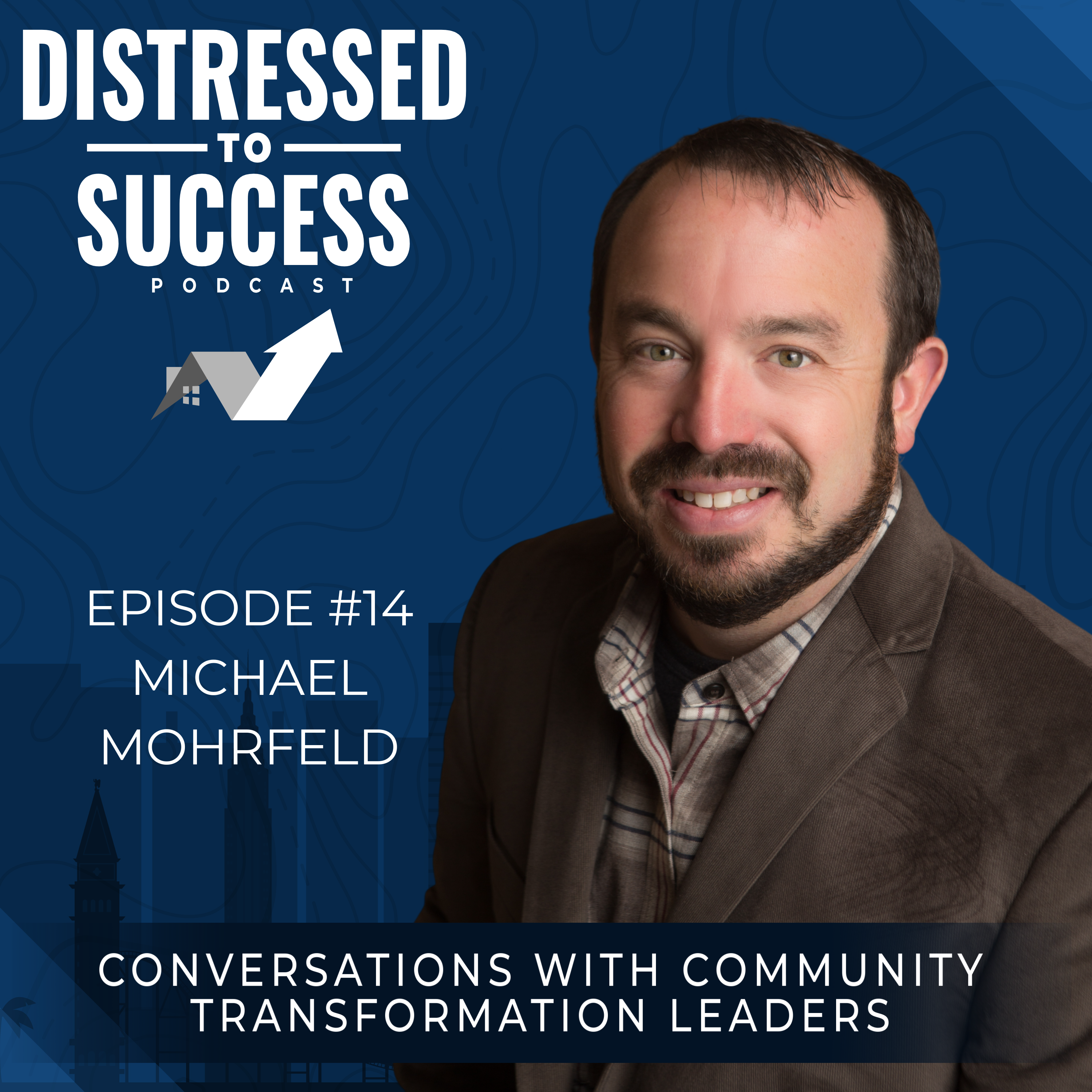
[00:00:28] Speaker B: This podcast is for informational purposes only and does not constitute financial, legal or investment advice. Please consult a professional advisor before making any decision based on what you hear on the show. Hello, everybody. Welcome to another episode of Distress to Success where we talk with professionals who are helping reinvent blighted communities in a profitable way. And as with me today, I was lucky to just nag some time from Michael Morfeld. He's a contractor for Green Oak Development Company and I'd say just a general community leader coming from Fort Madison, Iowa. And luckily, Michael reached out to us and so I'm excited to hear more about his story and some of the projects that he's been working on. But Michael, thanks for. Thanks for joining us. Welcome.
[00:01:12] Speaker A: Yeah, you bet. Appreciate you having me.
[00:01:14] Speaker B: Yeah, I'm excited to hear about how you ended up taking on some of these projects that you mentioned in our previous call. But I guess before we dive into those specifics, I guess could you tell us a little bit about your background and kind of how you ended up, I guess, in the development space and got to the success that you're seeing today?
[00:01:39] Speaker A: Yeah, you bet.
So honestly, came through as an electrical contractor, started my career as a electrician, apprenticeship, worked my way up and started my own firm 2006. So right at 20 years in the electrical contracting space, still my priority business is our primary focus.
Total, we've got about 70 employees.
Back in 2014, we started a development side and this was kind of the give back to the community trying to town that's seen a decline in population and no new housing stock. So I wanted to see if I could come in and fix those things.
So started a new development on a 13 acre parcel, 45 lot subdivision.
We're actually in the final phases of that project, but along the way we've started multiple other projects on the housing fronts, so.
[00:02:38] Speaker B: So you've really started the con. Yeah, really. I guess there's, there's two ways to come at a development project. Right. As you know, a lot of Developers come at it from a, I guess pure financial, you know, upper end right or top down, right of, you know, here's what it's going to cost, right? And they build in all these things. And I guess quite frankly, a lot of projects are a lot more expensive because of that approach.
They don't necessarily understand, right, all of the, the really nitty gritty details, right? And how, how and where you might be able to, to save a dollar to make a, a project unrealistic all of a sudden, you know, very, very realistic, right. And so you, you, you have a very different perspective than a lot of developers, which is really, I guess what got me excited, Michael, to kind of hear some of your stories and how you made some of those projects work. But thanks. Just can you kind of dive into, I'll say, two or three of the projects that you've worked on over the last 10 years and we'll go from there?
[00:03:41] Speaker A: You bet. You bet. So like I said, the first project was a single family home development.
In that project we've built 35 new construction single family homes.
I think the first open house we had this influx of retirees show up and they said, we love everything that you're doing here, but we really want a condo development. We want maintenance, free living. It's like, oh, shoot, kind of missed the mark, you know. And so we bought a 100 acre parcel up on a bluff and with a gorgeous river view, cleared that parcel off and we built some higher end condos.
Currently we're halfway through that project. We've got 23 condos, walkout, basement, slab, a combination of both, really neat property.
And then Covid hit, right? So things got expensive, we start doing a little looking, you know, what's this mean from an affordability segment? So we start searching into some multifamily projects. So the last couple years we've had a real strong emphasis on redevelopment projects. On the multifamily segment. It's opened my eyes to the workforce, housing tax credits, grayfield and things like that. So very, very new on that front.
But that's kind of where I don't say our focus is, but that's where we're spending a fair amount of our time is on multifamily segment. Again, trying to respond to the area's affordability and market demand.
In that mix, kind of the unique project we touched on was a big marina revitalization.
So we're right on the Mississippi river, known for flooding issues and those things, but we had a marina that was just completely end of life.
The Mississippi rivers, it's a dirty body water, so creates a lot of silting issues. So these marinas take constant, constant maintenance.
Ours had completely deteriorated to the point where boats couldn't come in and out of it.
So a group of us got together, led a charge to completely revitalize the marina which dredging effort raising the park so it didn't get flooded out anymore. Brand new docks and there's a private investment segment of it which is building a brand new restaurant and event center. So we, my company kind of led the charge on all fronts, including the best investment component to the restaurant.
[00:06:11] Speaker B: So we'll unpack some of this stuff here shortly. But I guess just to reiterate, so from electrician to single family developer to, you know, condo developer to marina and restaurant developer. Right. Does that. Do I have that right?
[00:06:29] Speaker A: Yeah. And those are all the side gigs. So electrical contracting is the focus and solar is actually focused.
[00:06:36] Speaker B: Throw some solar in there too. Yeah.
[00:06:38] Speaker A: So solar is solar and electrical contracting is where I spend, should be spending most of my time.
[00:06:43] Speaker B: So that's awesome. That's. Maybe we'll start with the, the 35 home single family home development. Were they. Was that all purely spec home like you build and sell, build and sell, build and sell. Is that simply how that worked?
[00:06:57] Speaker A: Started that way.
So first, first spec was a slab and you know, this is, this is 2014. So I stood up in front of city council, said I'm going to build spec homes. They're going to cost less than $150,000.
First thing I learned is I can't build a house for less than. And this is 2014, you know, so this.
And.
But the feedback was really pretty good. People came to the first open house and said, well I like this but I want a basement home. I want a little bit more. And so I missed the mark. I mean the demand for higher quality was there.
So really 50, 50. We were building spec and then we were doing custom homes side by side.
It was always our goal to build three or four at the same time to get some synergies going. So. So yeah.
[00:07:44] Speaker B: So over how many years did you, did you build that development or multiple developments? How did.
[00:07:50] Speaker A: So that one property has actually been ongoing with kind of some breaks in between where we, we split up and focused on the condo development a little bit. Again, we're, we're not a growing community, so the, the demand isn't huge.
But we, when we were hitting it hard, we were building, you know, 12, 14 homes a year.
Then we Then we pulled out when we did the condos, we, we built 23 condos I think in a 18 month to 2 year period.
Pretty good push up there.
And, and actually we're back on the original development putting the last Lego road in right now building, building four homes right now. So.
[00:08:30] Speaker B: Got it. Okay. So and you started that one and you said 2014 or 2016.
[00:08:35] Speaker A: 2014. 14. Yep. Yeah. So it's been, it's time to be done.
[00:08:40] Speaker B: Yes.
Well, you know, you're kind of in a unique position in seeing like I'll say roughly the same type of property built right. Over a 10 year period and maybe you know this answer off top of your head or not, but like how much has the changed from a price per square fit for that that property in 2014 versus what it is, you know, today in 2026.
[00:09:04] Speaker A: Pretty pretty drastic. I think when we, when we first started we're, we're actually below 100 a finished square foot. That, that included the property acquisition. So pretty, pretty attractive. And granted we were part of that too is we were learning a lot about the process as we went, but now I think we're seeing numbers closer to 170 a square foot. Finished square foot. So you know, not, not quite double.
[00:09:31] Speaker B: Yeah. In you know, less. Well, I guess it's just over a decade. Right. So a pretty significant increase in cost. And I guess one of the nice things is right is the, has the price of properties doubled or more to where you know it's yes, it's more expensive but at least the, the demand and the when you do sell a property, it's well worth the time.
[00:09:53] Speaker A: You know, this community, the demand hasn't has been consistent. Right. We actually Covid when we got the most nervous like lumber shot, everything shot up. Right.
And we, we puckered up when we shouldn't have because interest rates dropped and, and we weren't, we weren't in the best position. We were, we should, we should have put more holes in the ground quicker but we were really skeptical of what, what was going to happen so we responded a little bit too late to get them up. So.
[00:10:25] Speaker B: Yeah, well, you know, rightfully so. Right. Hindsight is always 2020. I guess that's my, my theory is always easy to look back and say ah, you know, you know, should have done this, should have done that. Right. But in reality I think any, any smart developer would have done exactly what you did. Puckered and go oh, we don't know what you're getting yourselves into. And I like to kind of Joke with the, you know, the, the folks that are in real estate that acted, I'll say fast enough, you know, when, when Covid hit and real estate went oh crap, you know, the ones that could actually sell everything quick, you know, quickly, you know, and they're like, oh, they're, they're brilliant. Well, six months later they're going, man, that was the worst decision of my life. Right. As values just, you know, skyrocketed. So you don't, you don't ultimately know, but obviously we're able to. To pivot through that and learn and still maybe want to be done just to have the project done, but still worthwhile at the end of the day.
[00:11:22] Speaker A: Yeah, it's been quite a process to learn that. And then just to, you know, through this, through a pretty trying period. Right. When you look at the last 10 years, I mean, quite a, quite a change of environment.
[00:11:34] Speaker B: So yes, to say the least. The past 10 years have been a period of definitely a lot of change. Some of it good, right. Some of it not so good.
But definitely no shortage of having to pivot and learn along the way.
And that kind of leads to. So it sounds like the Kano development really was a result of those initial conversations with potential buyers learning from, from their conversations of what they didn't like about the single family home development and how you could roll that into your next development. It was a truly that much of a feedback loop if you didn't even have the, you know, the, not the multifamily, the, the condo development in, in mind at all until, until you used to have those conversations. Do I understand that?
[00:12:23] Speaker A: Right? It, it truly was. Yeah. We were just a few houses into the process and there was an overwhelming female in. I'll be honest with you a little bit that's self serving too. My, My mother was looking to take the next step and so we're multiple things. So the property came available, exceptional property. And we saw. Had a vision there that we thought we had a pretty good market response to kind of know where the affordability is, you know, in that empty nester market.
So responded accordingly. And there was a lot of earth moving. I mean this was, this was really just a bluff, a wooded bluff. So six months of clearing trees, leveling things off and you know, it was pretty, you know, million dollars of road to just to get to the first building. So it was pretty big leap, you know, that early in the development career.
[00:13:20] Speaker B: Pretty big leap of faith. Exactly.
[00:13:22] Speaker A: Yeah.
[00:13:22] Speaker B: Well, so that one is, is. Was started when again the condos.
[00:13:28] Speaker A: I Think we started in 2016, 2017, the first development we started in 2014.
[00:13:33] Speaker B: Okay, so. And you're still while finishing up the condo development as well.
[00:13:37] Speaker A: The condo. The condos have been idle for we, we made a big push there in 2017, I think we 2019, we sold the last one, but we only developed half the property. We were. The intent was to do single family, higher end homes on the other half of the property.
The feedback from the condos was, was great, honestly. The demand's been there for a couple of years. But things like this marina project, honestly consumed. Consumed us on the development for a good two year period.
And then Bounce also got another condo or I'm sorry, another housing development out of town. Small community called West Point.
And then multiple other projects we've taken along. Kind of interjected. We self performance is a big deal to us. So the carpenters are my folks, the electricians obviously are my folks, the plumbers are my folks.
So we kind of go in a herd and take on what we can. So even that marina project, we self performed as much of that project as we possibly could.
So. So it ties up, does tie up our resources and part of that's.
Could we contract some of that? Sure.
But we do enjoy the, you know, the process as well.
[00:14:54] Speaker B: So what's a. It's an awesome story and I think a good transition into, I'll say the, the really juicy, you know, story of, you know, how you, how you fell into an arena and how you ended up. Because my understanding ended up being kind of a partnership. Right. A private, you know, public partnership. And so you're learning about, you know, nonprofits as a component of it. You have a profit piece of it with a restaurant on site. And so I guess maybe start from the beginning. How, how in the heck did you end up with that?
Even as a, as a thought of that you want to tackle that project. Was it, was it purely a.
You saw this, you know, dilapidated property and thought something more could come of it. Did somebody come to you with an idea and you partnered with them? How did it, how did it come to be
[00:15:43] Speaker A: multiple things? You know, number one, I'm a boater. We. We would boat. We would, we drive three and a half hours to the Lake of the Ozarks, you know, seven, eight times a year. And we would get our boating in down there when we sit here and we live right on the river.
But it's honestly, we're to the point where we couldn't get our boats in and out of our own marina. Because it was, it was that bad. So pretty, a pretty disgruntled community saying, we've got this great resource, it's underutilized, we need to take care of it.
I remember we're at a city council meeting for a development project. I think we were on the agenda. And I remember public works director was making a recommendation to not act on a DNR match. That was for the 2019 flood. So we had a big flood in 2019.
And I think the.
I'm sorry, it was FEMA. FEMA would have paid for 80%, I want to say, of the mitigation cost to dredge the marina and the financial constraints they're making. Their recommendation is don't do it because we're going to have to fund the other 20% of the project.
There's really not enough asset there to make this worthwhile.
And there was some stir at that council meeting, like, gosh, I wish people would get together and figure this out and solve this problem.
The city owns, still owns the property.
City wasn't doing the best job of maintaining the property. There wasn't much revenue there. And you know, and I can understand as a city's perspective, reinvesting into, you know, a segment that only holds 60 boats is probably not a great look when you've got other financial constraints.
So what we did, we got together a group, created a nonprofit group and first and foremost we raised money. Right? It was an expensive project, probably it was close to $15 million project. When it's all said and done, that includes the building piece that was a separate arm. But the local community got together in this thing in a huge way.
We've got casino just north and there's a revenue base that kicked in one and a half million dollars to the project. We've got a local hospital foundation that kicked in a million and a half to the project just, just for the wellness component. You know, we had a walk, beautiful walking trail down there and you know, some live quality of life improvements. They saw value in the city of Fort Madison, kicked in a million and a half to the project.
We, that FEMA money, we didn't lose track of that. They came in and actually came in much, much higher level.
But then outside of that, we, we raised over $3 million just from business and industry. That's banks, that's private citizens, just for this effort to raise this park, dredge this marina, build a brand new jetty path and all brand new docks. I mean it's really a state of the art facility.
And then the final Component was, you know, the city drew a hard line stating that we're not going to be in the space of restaurants. You know, we're not going to compete with other restaurants in our area. So that needs to be its own standalone entity. So I was tasked with, you know, running that arm of it as well. So really it's not business we wanted to be in at the time, but we're here. We are.
But it's a cool space. It's got a big, big outdoor patio. We've got live music every weekend, you know, event center. So we're doing anything from weddings to celebrations alive to safety meetings for local industries. I mean it's very, very well utilized facility.
You know, we kind of the hub for our area is Burlington, Iowa where everybody goes to Burlington on the weekends to, to get to, you know, get exposures to more restaurants.
We've, we've, we've changed that a little bit. Now we've got some folks from Burlington coming down and different, different communities coming to us. So it's, it's really a very successful restaurant area and atmosphere is just really, really great.
[00:20:01] Speaker B: That's, that's amazing. That's me. So did, did you take on like you and your organization take on role of. Sounds like fundraiser as, as well as restauranteur. Right?
[00:20:12] Speaker A: Sounds like we. So we raised the money for the, for the building. For the, for. Yeah, for that component of it and the building. About a three and a half million dollar project with the event center and everything. So we did that. My business partner and I led that charge.
We, we hired a group called Convergent on the non profit side that spearheaded the charge for raising money for the nonprofit. And that was the big, that was the big arm that was nine to $10 million fundraising effort.
Best move we ever did was hiring that firm to do that.
You got to make some uncomfortable asks to the community to raise that kind of money and they, they do a really good job of laying out the groundwork, what the need is and, and, and selling the story and bringing it all in. It really it was neat to see that community buy in after they put the work forward.
[00:21:17] Speaker B: It was, that was called Convergent Convergence.
[00:21:21] Speaker A: I'm gonna, I think I misspoke that.
[00:21:24] Speaker B: I guess those listening, we'll get there the information and put it in the, in the, the notes, you know, for anybody else that wants to, to investigate, you know, working with, with that group. So yeah, so I mean it started ultimately it started with I guess a community that cares. Right. And, and I guess, I mean are you on the city council or in the meeting and kind of highlighted, hey, we can do this better. And, and so, you know, luckily you had the, the whole community behind you, but you were the, you know, the, the spearhead, you know, going into that. Is that correct?
[00:21:57] Speaker A: So, so all reality is a lot worse than that.
My uncle was the sitting mayor of the city at the time. And there was, you know, we were in a time period where social media is at its prime. Right. And there's.
I've always been a community vested guy.
You know, the housing development stuff started way before he was ever even on city council.
But when we started this project, he, he was a key component to the entire project. I mean, it was a huge success story for, for his, his tenure as mayor.
He led a lot of the, the financial charge as far as raising money for the projects and then what the value that we brought to the table. As an electrical contractor, I've got a lot of partnerships with all the other contractors, right. So while we're out there asking people to write five and $10,000 checks, I was out there asking concrete contractors to donate their time, their resources, their equipment.
So we were merely paying for the cost of concrete, you know what I mean? So we were leveraging that money so much through donation, through trades as well.
Anything from the handrailing on the property to the dirt moving on the property, all the concrete on the property, we were leveraging a lot of local contractors to step in and make those lifts for us.
So reality is, I think we've got a 20, $25 million project, and we do a lot of the design in house too. So we had, surprisingly, we had some freedoms to do that because we were working. There were segments that were public money. So those portions of the project, the dredging was a publicly bid effort.
So, you know, when you're dealing with public money, everything's gotta be engineered and publicly bid and awarded out. But when you've got private donated money going to that effort, we were able to leverage that money much, much further, you know, through, through volunteer channels and improving the property. So.
[00:24:17] Speaker B: Yeah, absolutely. Do you have, do you have any. Did you guys ever do a study of. Of you said it was roughly $15 million and, and that, you know, that was highly leveraged, right, from, from donated time and, and labor. So what would that, you know, project have cost if it was, you know, done retail, for example? Do you have any idea?
[00:24:36] Speaker A: I, I would, I was short side. I would say $22 million.
I get folks out of bigger markets down Here, you know, St. Louis coming up or Des Moines coming down, they see the facility, they said there's no way you did it for that, that amount of money. This is, there's. We couldn't do this in our community for, you know, for less than $30 million. You know, and there's.
Yes, public projects can get out of control really quick through the design phase and things. The, you know, just, just add a lot of cost.
[00:25:09] Speaker B: Well, I think the main thing is that you had a community that cared, right. Community that, that was behind, you know, the project and then community members that were willing to donate, you know, the time, labor, right. To make it not only financially feasible, but then actually bring it to fruition. Right. And I think all of those components, yeah. Played a gigantic role. And because I think you're exactly right. I think it's that to me, right. As, you know, not doing that exact project, but, you know, many projects, I mean, that sounds like a 30 to 40 million dollar project, right. Done From, I'll say the other end of the spectrum. Right. The developer that's looking down saying, well, this typically cost this and then would, would usually say that that project is just not feasible. Right. But if you come at it from your angle, right. A different angle, then it can turn that project into a, you know, I'd say a community life.
Life.
I don't know if it's technically a lifesaver. Right. But it, you know, certainly, you know, change things around. And so I guess did it, did it change that theme of say, population decline to is it somewhat stabilized? You know, where, where is the community of Fort Madison today?
[00:26:26] Speaker A: Is huge impact. I mean, the quality of life. It is.
The common theme is when people do visit down there at the restaurant, they'll. So I never expected to see something like this in Fort Madison. Right. This is something I would expect in a large city.
So it, you know, kind of lifts some spirits that, hey, we can have, have nice things.
And you know, the restaurant's been open two and a half years now that we've. The marina, the, the, the boating is. We're filling the docks in actually.
We. So two of our docks are full covered docks and two of them are open.
We don't see covered docks really in this area.
A lot of the concern is the affordability of it to lease them and things.
What we're real close to making a decision on is actually purchasing another covered dock and selling one of our uncovered docks because our covered docks are completely full and we're, we're pretty underwhelmed. With the success of our open docks. So, you know, all the things that we, the things that were betting against us were proven to be. Yeah, this is. Right, you know, this is, this is the stuff that works at the lake of the Ozarks or at the big lakes. We're able to bring that here and make it work. But you know, when you, when you're able to go down there on a, on a Friday night or Saturday night, sit on the patio, listen to a one man band, you know, awesome atmosphere, it's just cool.
[00:27:56] Speaker B: Yeah, so it, I can imagine. Yeah, it's like a, probably a crowd. Right. And a lot of community members that participate in it can sit there and feel proud of what was put together.
[00:28:08] Speaker A: Yeah, absolutely. And that's, you know, it's good to see people having, you can, you can see that there's meetings going on there and that maybe, maybe that's a facility that, you know, catered a meeting that led to the next project. Right.
[00:28:22] Speaker B: Yeah.
[00:28:22] Speaker A: And that's, you know, when some of these site selectors come into town, where are you going to take them? And that's. Yeah, you know, there are some bigger things going on. So.
[00:28:32] Speaker B: Yeah, you mentioned as part of that specific project, but part of your projects. You know, a couple terms that you use that we haven't talked about on the show but piqued my interest. Right. Because you mentioned Greyfields. I'm familiar with Brownfields. I've never heard the term Greyfield so I want to dive into that and you know, workforce housing tax credit I am aware of but haven't dove into that on the show either. So can you maybe give a quick overview of, of Greyfield and how that works and how it played into your project or projects.
[00:29:02] Speaker A: Full transparency first.
We are on the front side of our first Greyfield project so I can't speak too intelligently about it. So we are working on a proposal on a project in a neighboring town that would include redeveloping an existing facility that was, you know, gosh, 110,000 square feet.
Looking to turn it into 40 apartments north of 32 apartments. So 32 to 45 apartments is where it's going to fall.
We have had success with the workforce housing tax credit in Iowa on three projects now. We actually have 40 new construction apartments going on right now with that tax credit.
Great program, highly competitive tax credit.
We, we did a revitalization project in Keokuk just last year restoring 3, 3 existing historic commercial buildings into. We combined them, put a corridor through them and, and turned it into a 16 unit apartment building.
Absolutely beautiful project. We're working, finishing up one next door to it right now. It's right next to the courthouse.
Really cool historic project. I'd love to show you photos of that one. It's, it's a neat, neat piece.
And there's some IEDA money attached to that particular project.
[00:30:36] Speaker B: You said iaea. Ieda, but that's another new term I never heard before.
[00:30:42] Speaker A: Yeah, yeah. Iowa, Iowa Economic Development Authority. And, and again, I'm going to, I wanted to show you how green I am a little bit. You know, some of these, a lot of these grants are new to me and one off type, type scenarios.
At the end of the day, as a developer, you're looking, you know, you just look at the bottom line. But we're, if we can find, you know, north of 30% of incentive on a project cost, we feel like we can make it work.
Is kind of where my target's been. Workforce has been blending in, you know, 15 to 20% the Iowa workforce Grant. So we've got to stack that with something else, whether that TIF incentive, a grayfield incentive or ieda.
So we're again, very early phases, but we're, we're working very closely with regional planning in Burlington to help see what those are. And you know, I know there's a lot of opinions of grants and incentives that are out there, but the reality is especially smaller communities with rents the way they are, you know, and to keep the rents low, you got to do it to make it work with. When you got construction costs the way they are.
I mean, you're, you're knocking on the door of $160,000 more per unit to develop and then you start looking at insurance costs the way they are. You know, carrying costs the way they are takes incentive, right?
[00:32:25] Speaker B: Yeah, well, it's a difference of a project happening or not.
I mean, I've yet to come across anybody that, you know, uses those programs and you know, it's all just additional pure profit. Right. It's a squeaking by.
Usually those programs have a lot of checks and balances. Right. Of like they're not just handing them out. Right. Which I think is, is a misconception by a lot of folks that maybe have heard of it. Right. Is like, oh, just government handouts and it's not right. It's only used typically in scenarios where the project either happens or it doesn't. Right. And it has to have these incentives in order for it to become a real thing on the workforce. Housing tax credit I want to I guess dive into these a little bit just so the listeners can understand maybe how to implement it and their project and whether or not the state has it or not. But I'm assuming the workforce Housing Tax credit is a state of Iowa program because I'm not familiar with a federal program. So is it and so you're not able to use it in every state. Right. But Iowa has this, this program and you mentioned is it basically based similar to a historical tax credit or a low income housing tax credit where based on total cost. You said 15 to 20% of that is is basically given back as a tax credit. And then you as a developer can you monetize that right to or is that just used by you as a developer as a tax credit or can you do both? I guess. How did you guys utilize it?
[00:33:56] Speaker A: And we are doing both.
So it's great. You can sell it yields decent.
The one we're just finishing up is. Was a smaller one project that we're gonna partner and I are gonna complete or gonna self consume the project that I have underway right now. It's a. It's a larger project and we, we plan to plan to sell it.
So it's very attractive in that sense.
We.
What's more attractive is it's truly what it says. It's a workforce housing tax credit. So there's no restrictions on the other side. Our tenants are. It's their market rate apartments in this application and it's a tax credit. This is also used for new construction homes that you can sell as well. So it's got a lot of liberties in it.
And really when you're applying for this and they're qualifying it and judging it, they're looking at the segments of Iowa that are maybe the most in need and also the ones that have received the tax credit. You know what I mean? They're trying to keep it spread across the state as well.
They do show some preference through to smaller communities with the credit but very gives you the liberties to.
To perform as you normally would. You know it's not layering you up with Davis Bacon wages and you know some of the things that historical tax credits would.
[00:35:26] Speaker B: Right.
[00:35:27] Speaker A: May incur with. With engineering and things like that.
[00:35:30] Speaker B: Okay. It's a little more leeway on that.
[00:35:34] Speaker A: A lot more freedom. A lot more freedom to perform most historical.
[00:35:40] Speaker B: Historical at least federal programs. I don't know. I'm not familiar with every state's program but has this. You can't. Can't sell the property for a period of Time. Right. You know, with historical. Usually it's five years. Does the workforce, housing program have that workforce?
[00:35:54] Speaker A: You can, you can sell the property.
[00:35:56] Speaker B: Okay, so a lot more flexibility. Now when you go to, I'm gonna say monetize, I don't know exactly how that structure works. You know, some of them are monetized through creative ways, but when you monetize them, you're not going to get like 100% of the value of that tax credit. But are you going to get 90, 80, 70, 60? Like what is, what does that look like when you go to monetize it?
[00:36:17] Speaker A: We're expecting 85 to 90.
[00:36:19] Speaker B: Okay, 85 to 90, which is good.
[00:36:21] Speaker A: Now in state of Iowa, income taxes is dropped down to a flat, flat 4%. So.
But I don't know that I've heard, you know, I think there's a lot of banks that are still out there buying these and doing things. So. Okay, so self consumption is probably less as a result, you know, so I think you're looking at big corporations that are, they're still in the hunt for them.
[00:36:49] Speaker B: Okay, okay, well, sounds like we might need to circle back after you get your, your hands dirty a little bit more on the gray field and the ieda, you know, structures. But are you, so are you learning all of that in house? As in you, you and your team are, are taking on that, I'll say workload, right. Of. There's usually lots of paperwork associated with those programs and, and maybe not as many regulatory aspects that you have to manage for. So is that something that you guys have taken on directly or do you work with like third party consultants to help bring all that together?
[00:37:30] Speaker A: We, we have a group called Regional Planning Commission that they cover five, six county area, southeast Iowa. Regional Planning Commission.
Leadership in that group has been extremely close to those folks.
I think they like what we're doing. You know, the product that we're turning out and the efficiency that we're turning the product out.
They have been extremely instrumental in putting these together, finding, finding the grants, helping teach me through the process.
It's, I'm in a very fortunate role there that they've been so resourceful for our organization because that, you know, my background's contracting. You know, it's not, it's not that side of the side of it. So it's good because we're chasing the other end of the stick that we know how, we know how to chase concrete costs, we know how to save or try to bring the total project cost down.
And they've been Extremely resourceful there to help find the incentives to make the project viable. So just absolutely great partnership with that group.
[00:38:51] Speaker B: So is this, is this group akin to what I'd call like an economic development authority for the area because there's smaller communities. Right. And so they've kind of teamed up to create a, like a regional economic development.
[00:39:05] Speaker A: Yeah, so regional, regional group that works, works directly with economic developments. They sit on a lot of similar boards, but they, they've got, they've got their hands in a lot of different focuses. They do a lot of municipal work with the local towns as far as helping facilitate grants and things at the city level also.
But just a great organization. Honestly. What I need to do is put you in direct contact with Mike Norris, the regional director.
Become a good friend of mine over the last few years and just a, just a tremendous asset. Probably be worth, worth a podcast future
[00:39:50] Speaker B: episode for everybody listening.
[00:39:52] Speaker A: Perfect.
[00:39:53] Speaker B: Yeah, I guess, Michael, we'll have to circle back and talk about the, the, the gray field and the, I, you know, was it Iowa economic development? Ieda, Right.
On another episode. And, and maybe this other gentleman as well, just to learn more about how to make all of these, I'll say smaller community projects, you know, viable, which I think is excellent. If, if you were to I guess go back to Michael Moorefield, right, in his early 20s, right. You've got Michael J. Fox in his back of the future time machine.
If you could give yourself like a nugget of information or two that would say accelerate your path to success or maybe, you know, eliminate or avoid some of those painful, I call tuition points. Right? You learn, learn each time you, you make a mistake.
What. Do you have any nuggets of information that you would give yourself to, to, to speed things along?
[00:40:51] Speaker A: Boy, that's a, that was a good one. You know, honestly, I think we just, we, we outlined them pretty well.
I see my shortfalls on the, if, if I truly wanted to be the developer and if I, if I, if I could advance my space in the development side another 10 years, you know, would have been, would have been great.
So getting in, getting in tune on the financial side of it, the, the incentive side of it, knowing, knowing what risks. We've taken a lot of risks. So I, but knowing when to borrow and to, to take the risk. You know, I'm an old fashioned guy. I want to, I want to own it. Right. You know, I don't want, I don't want to be leveraged and, and that's not a bad trait to have either, but but you know when to better put that on paper. When does it make sense to borrow? When did, at what percentage does it make, make sense? Because when you, when you start talking about these large scale projects, obviously you're, you're borrowing, you know, and, and, and I'm later in my life making these decisions. Like if I would have done this earlier, you know, I would have positioned myself a little bit better.
[00:42:09] Speaker B: So educate yourself on those.
The right use of leverage at the right time in the right amount.
[00:42:19] Speaker A: Right.
[00:42:19] Speaker B: Would Be your, your gem of knowledge.
[00:42:22] Speaker A: Correct? Correct.
[00:42:23] Speaker B: And I, Yeah, yeah, I think that'd be a, a powerful one. Right. Because it's, think it's, there is a, there is a, a good use for leverage done the right way. Right. But to your point, in the right amount, right.
And used for the right things and obviously with the right terms, I think a lot of multifamily developers are learning that kind of the hard way. There's a lot of things that you don't know. And if your project is wholly dependent on the factors as they are today, right. Knowing that your project's not going to be complete for three or four years, I don't know, that's, that's a different form of gambling. Right.
You know, when you're using, you know, 90 plus percent of, of that, you know, leveraged funds and it's very end
[00:43:10] Speaker A: day, I think we're, if we were, you know, 20 years from now, I'll probably look back and say, man, I'm, I'm, I was very lucky that I was diversified. Right. Because I, you know, we're seeing the peaks of solar right now. You know, I don't, I don't know what that's going to look like in five years from now.
So to be able to pivot and see different segments of the business go, go through waves.
So I think being diversified, granted people have been critical of me for being so diversified, but I do think, you know, 20 years down the road I'm going to look back and say, yeah, that was, that's probably a pretty good move.
[00:43:46] Speaker B: Yes, I think you're, you're spot on. Well, thank you for that. And I guess the, the kind of last bit of knowledge I'm going to extract from you today, Michael, is, has absolutely nothing to do with anything we talked about. I, I call it carve outs. And I, I stole that term from another podcast I love to listen to. But it's anything you have bought recently, a gadget, a book you've read, maybe a piece of advice that you've heard that you think listeners in general would would benefit from from that you can share and I'll give you some time to to think on it while I while I lay mine Recent one out I was recommended to read a book called Theo of Golden and I think it's a, it's probably one of the best sellers. I don't know how high on the list is best sellers, but started listening to it a few weeks ago and, and well into it at this point. But I mean there's a lot to it I'm seeing you can read it for different reasons. For me it was a.
There's a quote in there I'm trying to remember of, you know, you, you get more out of being the donator versus the one you out of gifting as opposed to receiving the gift.
And the the bulk of the story is about a gentleman who is on this mission to, you know, give something away, right.
And the amount of joy that he gets out of it. And it's just a constant reminder of the success that we, we all have at some points in our life or builds upon itself. You got to remember to always, you know, give back to the community like exactly like you've done, Michael, or you know, just giving back in some way, shape or form because not only will it give back to community and the community benefit from it, but I think we as individuals will also grow immensely and get a lot more satisfaction out of doing that than than even, you know, completing a project, you know, for example, which has a lot of gratification but still doesn't quite, you know, play the same note as if you, you know, donated, you know, your time into a community project and seeing that through. So anyway, for everybody reading that needs something, you know, heartwarming to kind of listen to.
I honestly don't know the end of the story, but they haven't got there yet. But it's I highly recommend it is is the book called Theo of Golden shouldn't be hard to find on Google because I know it's definitely on the top sellers list. So hopefully I give you some time to noodle there, Michael, but what would be your carve out for today for the listeners?
[00:46:18] Speaker A: My carve out it's gonna be a little more broad than maybe you're expecting or like. But what you just spoke on, especially people coming from these small communities that are seeing a decline in population or struggling and I this, this one's been hitting me hard here the last few years seeing what's what the 10 year outlook is there's not somebody coming to your community to save it. Right.
We need, you need your local community members to step up, take the risk, do the things to reinvest in the community and get it back on its feet. You know, there's not going to be this big shiny star of an outside developer that comes in and saves the day. And that's what I think. A lot of these small communities have the resources to correct the path. They're just not taking the risk. And I just want to encourage so many small communities to do a better job of recognizing people that have the capacity to do the thing to, to find a way to make those moves and make it happen.
So that's, you know, hopefully there's somebody listening that can motivate to step up and do something. The other one is I'm going to go and shift another course.
My children, I've got three children.
One just turned 17 today and happy birthday.
[00:47:54] Speaker B: Four girl. All right. Happy birthday to her.
[00:47:57] Speaker A: Yep. So I've got a 12 year old and a 10 year old and, and so many people when you see out in public this is, spend time with the kids. They'll be gone before you know it, you know and we are, we are absolutely doing that right now. My wife and I are, are full, full in. Our, our youngest son, he, he's big into racing so we, every weekend right now we get in the motorhome and we drive four hours to a racetrack and we race on Friday night and we drive back the next day. And my daughter's real big into horse riding things so finding balance with all the careers.
But when the I told my partner, I said I'm here, I'm committed, I'm working on the hours but my weekends are going to be with the kids for the next four or five years. You know we're this, they're in the crime age.
I'm going to take advantage of this, this time with them and, and we're, we're truly just having a ball right now doing, doing those things. So it's, it's something that's kind of shifted in our lifestyle the last year too and we're just loving it.
[00:49:06] Speaker B: Spend the time with family. I think I'm trying to remember the exact stats. I'm going to butcher this but I, I believe it was in the mid upper 90s like percent like so you the 90 some percent of all the time you'll ever spend with your kids happens before they graduate high school. You know and I, I think once I heard that the first time which is in the last couple years. It was. It was an epiphany moment, like, oh, holy crap. Like, my kids are a little younger than yours, Michael. But it is, you know, you kind of take it for granted until it's gone. So for anybody listening that maybe is hearing this for the first time of the. Don't take it for granted. Because the. The time that you have with your kids, you know, it does. It flies by and then it's gone. And I'm told it just keeps getting faster and faster, which is a little terrifying to think about, but you won't get that time back. So definitely utilize it while you have it. So I appreciate that, Michael, for. For highlighting that. Again, everybody listening. Hopefully you got as much out of this episode as I did. I love the conversation. Michael, thank you again for all your knowledge and wisdom and insight into these programs. I look forward to hopefully having you on the show again sometime in the near future to talk about these other programs that you're educating yourself on.
Then we can educate the audience on as well. So thank you.
[00:50:28] Speaker A: Sounds great. Truly appreciate it. Yep.
[00:50:30] Speaker B: Good visit and good luck, everybody. Hope you guys have success and keep doing what you're doing.