Episode Transcript
[00:00:00] Speaker A: Most of the people in this area owned their homes free and clear, but those homes had no value.
So just imagine that. Imagine you have a mortgage, you pay it off, and then the area has just went all the way downhill to the fact that you were still underwater. You didn't even have a mortgage. The beauty about these containers are they're like Legos. So you do a one, a one looks like this, a two looks like this. That's the first floor. You just bring them together, push them together, weld them, and then we're good to go.
Don't sell your property. We'll help you get it fixed up. Everybody's going to gain equity in this, and this is going to be a big movement.
[00:00:39] Speaker B: This podcast is for informational purposes only and does not constitute financial, legal or investment advice. Please consult a professional advisor before making any decision based on what you hear on the show.
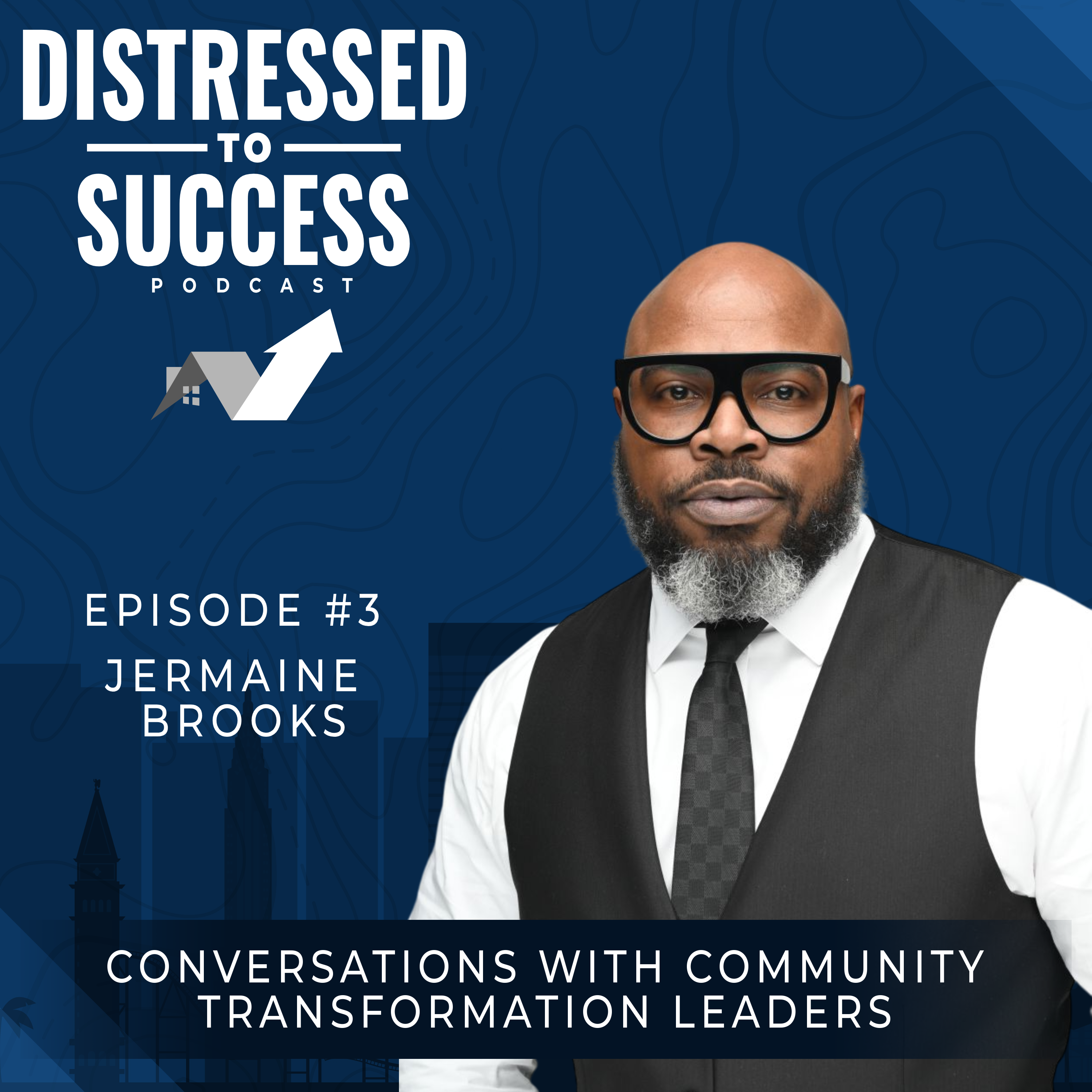
Welcome everybody, to Distress to Success, where we talk about professionals who are helping reinvent blighted communities in a profitable way. I've got with me today Jermaine Brooks. He's a entrepreneur, developer, realtor here in Cleveland, Akan area. And, and Jermaine, we've talked a little bit about some of the cool projects you have on, but I guess first, welcome. Thanks for being on with us.
[00:01:16] Speaker A: No, no problem, Brian. Thanks for reaching out as well.
[00:01:18] Speaker B: I know, you know, we talked briefly about one of the major projects you have going on in the up north, up near the lake. But yeah, I mean, let's just start with, you know, tell us a bit about your background and kind of how you ended up where you're at.
[00:01:34] Speaker A: All right, that sounds good.
So like Brian said, Jermaine Brooks, native Clevelander, graduated from Warrensville Heights High School, started getting into real estate in late 99, 2000.
Probably the wrong time, but it was a learning lesson. Bought my first five houses with, with a stated income, all in the same day and all had adjustable rates and you know how that ended up turning out. But from there was a learning lesson and I fell in love with real estate, so started buying more houses.
My brother, he, he moved after he got finished playing ball at West Virginia. He came back up to Cleveland and we started buying properties. We met some investors from Israel and had put together a nice portfolio.
Meanwhile, my other two partners, Richard Singleton and Willie Levy, they were doing the same thing. So we were all working in different silos, but it was all about real estate. Buy and hold, couple flips here and there. And in 2019, my partner, Willie Levy, he reached out and this was when opportunity zones first hit. And he said we might have some good. You know, Cleveland has a lot of vacant properties, a lot of empty land and lots. And maybe we could leverage opportunity zones to start doing something a little bit more bigger, have a major more impact instead of all of us working in silos.
So we came together and we started WRJ developers Willie, Richard and Jermaine. Real simple concept. We started that. And the whole purpose of it was to figure out a strategy to take over all the lots that were in our, in our areas on the east side of Cleveland. When we got our neighborhood stabilization money, when the crash happened and everything like that, they just came and demoed houses.
So you can go down the street and it's like 10 houses vacant, five there. But we looked at that as an opportunity. So we figured out all the. If we can start this process in the opportunity zone, we could raise capital for that. And then all we got to do is come up with an easy way to put a house on the lot and we'll be good. And that's what the strategy was. But it didn't work out like that.
This was our first deep dive into development.
And we tackled a project in Cleveland's east side area called Huff. And that was our first project that we had.
We, we approached the city of Cleveland with. It was about 15 or 20 vacant lots and we were putting multifamily on those four unit apartment buildings on those and got fully approved. But then the councilman at the last minute said he wanted to transition us somewhere else.
During that period, we had already started talking to GCs and things like that. And we found out that their numbers just weren't numbering coming from where we came from as far as renovations, rehabs, flips and things like that. We. We knew once we got a structure there that we could finish it on our own so that we started looking for products. And that's what took us down the shipping container alley. And we looked at it as modular manufacturer traveled across the United States, seen a lot of them that was going up and we were like, this is a product that would give us a niche in the market.
Something that we, we had a learning curve on, but not in Cleveland. So we were the first ones that were coming with the residential cargo construction project in Cleveland. And that's what took off our container on 72nd, on 72nd and St. Clair immediately right by the lake off East 72nd and St. Clair, Route 2. You get off on 72nd, prime area. And it was just, it was, it was sad. It was just distress.
We. We grew up playing baseball right by Gordon Park.
So. And the funny story, Brian, we got off the highway, we. We left City hall from City hall, telling us, no, the Huff Project wouldn't move forward after we spent much money on beautiful drawings and everything like that. And it took us three months to go through City Planet, and we were a little deterred. So we got off on 72nd, and when we got off on 72nd, a shipping container was sitting right there on a vacant lot. And it was just like the stars open, right? It was a sound. I was like, we got to do this. And just so happened like, I'm in real estate as well. So I had a client that was trying to sell for the parcels right there. So I called him immediately. My partner, Richard had another friend who was trying to sell the apartment building, and it was right there.
And it just started coming to fruition from there. And we reached out to Three Square. We had seen them on HGTV for cargo construction and container construction, and they were right down the street in Detroit, Michigan. Reached out to them, we teamed up, and then that's what we put together a 64 unit apartment building made out of shipping containers being built on.
On 72nd.
And that's what really got us.
Yeah, that's what really got us moving. And from there, that's when we actually really became developers. To be honest with you.
[00:07:04] Speaker B: I love it, right. There's so many aspects. I love the fact that, yeah, you saw a problem, right? And I. That's exactly why we started this podcast. A problem of there's there. All you hear about is a shortage of. Of housing, you know, in the country. And at the same time, you know, we're seeing all of these houses, you know, basically going dilapidated, being, you know, demoed. And I just, those. Those things just don't seem to sit right. Right. So it's like, what are, what are some of the solutions?
Right. And so I also love the fact that, you know, the shipping container, you know, you know, which I've. I've read about as far as, you know, a plethora of shipping containers. How can they. How can they be used outside of, you know, just, you know, shipping industry?
And I've heard of, of houses, I've not heard of, of multifamily, which. And I want to circle back on this project more germane. But if I can take a little step back because I think, you know, I'll say lessons learned or had a really smart mentor once, you know, calls it tuition. As far as Lessons learned. And, and, you know, I guess spending money on something that doesn't ultimately work out, the only time it's ever a failure. Right. Is if you give up. Right. And I think certainly it's not in, in your vocabulary, it sounds like. But what, I guess as far as the, the, the tackling, you know, individual vacant lots, you know, in fill projects, and you mentioned that not working out, is there any particular reason or reasons of why that wasn't working out?
[00:08:30] Speaker A: All right, so I think what we've learned is that to come into a neighborhood and build one house on one lot is not the solution.
You have to have an overarching plan in order to bring that entire neighborhood up with that one property that you're looking at. So what we came up with was our concepts. We wanted to do multifamily. The reason why is because from the, from coming from where we came from, we all own duplexes, four units, things like that.
And being able to have a product like that as an infield brings more people into the community. That's number one. Number two, it also allows for individuals who have never purchased real estate before to finally become a landlord and start building some type of wealth by house hacking. They can stay in the first floor, rent out the second floor. Now you create individuals that are getting into legacy building through real estate and understanding that they're living rent free and how that works. So that was our whole concept for wanting to bring multifamily in.
Plus as far as understanding comps, appraisal values, things like that.
And the cost of construction is still high. And we, we were tackling this during COVID so the numbers were crazy. So we had, we had to sit back and understand that these won't be a for sale product.
And we still had a need. Well, Cleveland and Akron, you already know, is huge rental market, so we were able to take advantage of that as well, send back, recoup some money with an exit strategy in year three to five.
So that was our whole basis behind, you know, the multifamily. And as far as the infield, like I said, we didn't really become developers and understand what a developer is as far as having a holistic approach and upliftment of the entire community. And until we got on 72nd and did the apartment building, we were like, all right, we're building an apartment building and everything else is still abandoned and distressed and vacant lot. I didn't want to stay there, you know, so we, we figured we might as well attack the entire block. So from There we started working with the city of Cleveland, the council person, community development centers, knocking on doors just to get a feel of the neighborhood. And from there that's when everything just started to come to fruition and take off. And that pushed us to our infill. The same concept we had over in the Huff area, that got denied. Now we started building those as an infill in the back of our apartment building. So now you're bringing up the community, you're bringing people into that area.
You, you're. At the same time we're still helping our neighbors out by assisting them with, with funds to get the house painted, roofs on, portraits fixed and things like that. So it became a big movement in the area.
And that's when I said we really became developers at that point in time.
[00:11:41] Speaker B: That's awesome. Well, it sounds like it's more, more of an equation of, of timing.
[00:11:46] Speaker A: Right.
[00:11:46] Speaker B: Let's say bad timing. Right. And most of it, you know, I'd say all of it's not really under any control. Right. Is like Covid, which is not a great time to really do anything.
I think we all still remember that. Even though I feel like sometimes it was a blocked out year and a half of my life that I, you know, it was a blur.
And then obviously, you know, construction costs during that time, you know, didn't help.
And but by the time all that was cleared up, this new, new larger opportunity presented itself. And at the end of the day there's just only so many hours in the day and so the larger opportunities really where you guys have decided to focus. It wasn't that the other model wouldn't work, right? You probably just haven't circled or have you circled back on, I'll say the, the economics of, of that infill is that still something that like is on there just weighing a far back burner or you know, kind of ruled it out entirely.
[00:12:38] Speaker A: Yeah, it's in the pipeline. It's definitely in the pipeline. And like I stated, just being strategic on where you build and being able to raise those values up gradually so that you will have comps in the area. So when it's time to put a for sale product out there that you already know the numbers, you know your build cost and you know your sale price and you have already built up community in which people are starting to be there and you know, so now it's more of a community instead of just one house being placed and trying to find one buyer to come by that one house.
So that that strategy has been and seems to be that it will work out for us.
[00:13:19] Speaker B: Yeah, that's awesome. Well, I guess circumback on, on the larger project.
What. Do you have a formal name for that larger project yet?
[00:13:28] Speaker A: Yeah, so for some reason we came up with a name Architectainer on 72nd. It's a mix between architecture and container.
So the apartment building project is called architectural 72nd and then our infield project is called Architect Infield. So that's, that's what we're closing on right now. Where we've been in underwriting it seems like forever, but we were able to get city city funds, City of Cleveland, through their ARPA dollars.
So we, it was RFP that went out, we applied for the rfp, went through the whole process.
So we were able to get $1.2 million from the city of Cleveland. We got an additional 300k from our city, Councilman Councilman Harrison for infrastructure. Because you already know Brian, when you, when you're talking about vacant lots, the infrastructure is the, the worst part. Sewer. I mean sewer lines, water taps, curbs, sideways aprons and all of that. So he, he's given funds for that. And we were just putting the capital stack together. First Federal Lakewood is our, our, our lending partner.
We were able to get pre development money from community Development Advisors. So we've been through everybody just knocking on doors. We need help, we need assistance. This is the plan. And we were able to get a lot of that buy in.
And it's just been a, it's been a process. Yeah, it's been, it's been a process coming from, you know, buy a property, renovate it and get it on the market or flip it. You know, development is really tedious.
It's a longer process. You have to be prepared for it. Yeah, we didn't. If I knew what I knew now, I don't know, I would have went down this path. But once you get in it, you're in it.
Once you get in it, you're in.
[00:15:23] Speaker B: You'Re getting a PhD in development whether you realize it or not, Right?
[00:15:26] Speaker A: Exactly. And the more times you bump your head, you say, I'm not gonna bump my head that hard again. And then you bump it again and you're like, oh, I did it again.
But the thing that really kept us moving was the fact that we were in an area who had not seen development in years, decades.
And the people that were there, we were like a lifeline to the point where they owned their homes. Most of the people in this area owned their homes. Free and clear.
But those homes had no value.
So just imagine that. Imagine you. You have a mortgage, you pay it off, and then the area has just went all the way downhill to the fact that you were still underwater. You didn't even have a mortgage.
So by us coming over there, just the way people's eyes lit up and the first thing we said was, don't sell your property. We'll help you get it fixed up. Everybody's going to gain equity in this, and this is going to be a big movement. So that was really the big push that really motivated us to keep going and keep growing.
[00:16:33] Speaker B: It's not only, I guess, financially, you know, beneficial. Right. For. For you, but it's also financially beneficial for. For the whole community. So it sounds like it's turned to. Into a little bit of a, you know, passion project on. On top of just a project. Is that about right?
[00:16:49] Speaker A: Yeah, definitely, definitely. And just to be frank, like, coming for the minority community, a lot of us didn't understand how you could actually build generational wealth through real estate.
And so we're able to show them how we can do that within this area with just using that one property that they have and that they paid off and how they're going to grow equity in this and how they'll be able to use that equity to go buy something else or use this as a rental and then go, you know. So just being able to have those conversations were very intricate and near and dear to myself.
[00:17:23] Speaker B: Got it. Got as far as far as the, the phase or stage of, of where you're at in the, in the project, is it. I mean, it sounds like you've come a long ways. You got the plan, you got the.
All the designs, you got some, you know, funding, you got lender.
[00:17:39] Speaker A: Right.
[00:17:40] Speaker B: You're essentially, you're down to, is there a capital raise or do you have what you need? You're in. In the initial stages of.
Of actually digging dirt. Where. Where's the project at this. At this stage?
[00:17:51] Speaker A: Yep. So we, we have the first duplex is up, is at 860 E. 73rd Street. So that was our proof of concept. It's the first duplex.
Well, what we, we've been hearing, we can't deny or validate it, but we've been told that this is the first multifamily shipping container project in Ohio. So that was intriguing. But we have that one built and rented out. It's been rented out for about a year and a half. Tenants love it there. We actually got approved through the City of Cleveland to build 10 more on that street. And we're building them in groups of five just for exit strategy purposes as well as capital needed for closing and things like that.
So we're that proof of concept was stage one. So we're in stage two right now and closing the loan with the City of Cleveland First Federal for the first for the next five which is another 10 units. And yes we did have to do a capital raise once again learn learning lesson as a developer. As I mentioned before, we took pre development loan through Community Development Advisors. So we were able to get plans drawing surveys, all soft costs taken care of for those 10 lots of.
However we had to pay it back at closing at construction signing. So that created another gap after we were raising the money for our capital stack from the beginning. So we actually decided to do a fundraise, a community fundraise with friends and family.
We put a goal for the new company that we started that will hold those five duplexes, 10 units that we will give 25% fundraising to our friends, family and potential investors.
So at first we just put it out there. We wanted 350,000 and a lot of the investors that were coming to us wanted more out of the project, wanted more equity, wanted more of this, that and other. So we said let's just make it a little bit smaller. So we broke it all the way down to a half a share to one share in which it made it more economical for individuals to come in. So you could actually buy half a share for 6,000, buy a whole share for 12,000.
We're in the Opportunity zone so you can possibly get the 10% Ohio tax credit for investing in Opportunity Zone.
We reached out and got grant funding for Cohen and Partners. Huge CPA just does real estate and OZ projects. So they, they came on board so that you know, managing the fundraise. But we, we have enough right now in order for us to close our loan with First Federal. But we still do have openings for that 25% what we had.
So that, that was key too because the, the calls we were getting were ridiculous. We didn't know it was a need for people to that wanted to invest.
And next thing you know, myself and my partner will, we're having one on one conversations, town halls and everything like that. So it's been an extreme joy.
Now we're just in our last phases of underwriting with First Federal and finishing up our GC contract on the AIA documents so that the city can approve those and then we're done we're trying to hit the ground.
You know, everything's done. About 75% of this is done in, in the warehouse.
So our GC right now is located in Appleton, Wisconsin. He's actually looking for a place up here to relocate. But as soon as we get the aok, we're, we're ordering the containers. They're going to start manufacturing and in cutting and getting those already so that they can start being shipped. The only thing we may run into an issue with, with the weather would be getting the foundations in.
But our GC told us he doesn't see us having an issue with that.
So we're, we're pushing. Right. When I get finished with this, I got another call. We're, we're pushing to get it all done and try to get these up and done by spring of the year.
[00:22:11] Speaker B: I love it. So it's, it sounds similar to, you know, prefab construction, right. Where they can build the units, you know, in the comfort of a warehous.
[00:22:20] Speaker A: Right.
[00:22:20] Speaker B: And then ship. And I guess as far as, you know, building it, you know, it goes a lot faster right on site. And so you have it, you have it set up. Where the shipping containers is, is similar. So they, are they doing all the work in Wisconsin then? Or are they doing it, you know, here, here in Ohio or like are they able to ship the containers here? Is that, how's that?
[00:22:39] Speaker A: Yeah, so the way, the way it goes is we order the containers, the containers are being shipped to Appleton.
Once they're in Wisconsin. He's doing one duplex at a time with a four week manufacturing fabrication time frame.
They'll be all roughed in electric and plumbing and H vac mini split system, everything like that'll be all roughed in. When they get here, it'll just be finishing. So flooring, cabinets, toilets, you know, sinks, things like that just be the finishing.
Everything is pretty much inside the warehouse. The beauty about these containers are they're, they're like Legos. So you know, you do a one, a one looks like this, a two looks like this. That's the first floor. They just bring them together, push them together, weld them and then we're, we're good to go.
So like I said, it's about 70% in a warehouse. The other 30% will be done on site. And that'd be mostly a lot of the finishing work.
We were able to get our contractor certified so that we could get our mechanicals inspected, the framing inspected, everything like that within the warehouse. So that was another thing that we learned throughout this process that's going to help us become more, you know, expedient and more meticulous to get all of that type stuff done in the warehouse and out of the elements. So once we get there, we'll just be doing all the finishes and then it's final approval, which is major.
[00:24:14] Speaker B: Yeah, that's. That's awesome. So they. They do the kind of the 70. 70% of the work totally off site. Throw the container while it's a shipping container. Right. And go on a. Probably a semi train, whatever. Right. Goes up and. And then you put the Legos together. Yeah, that's such a cool concept.
[00:24:32] Speaker A: Yeah. Yeah.
And the more you do it, it's like just running off a conveyor belt. And that's. That's where we want to be. The big picture is that this could be a solution. Right now we're working on single family concepts, working on some different structural designs and things like that, because once you have it figured out, then it's just, like I said, it just becomes a manufacturing tool and then it's just running so that we can move a little bit more faster and tackle a lot of these lots that are here.
[00:25:04] Speaker B: Was this. Is this concept something where if. If a developer in another area wants to, you know, use this concept? Right. Can they reach out to you, Jermaine, to. To say, hey, you know, work and work with you in trying to put that project together?
[00:25:21] Speaker A: Yes, definitely. Definitely.
And, you know, a lot of times you start getting a lot more benefits out of volume. So the more we can do in value, the. The more the manufacturer, the more the GC is doing, then we can really start breaking these off. Definitely.
[00:25:35] Speaker B: Okay, what's. I guess if somebody wants to reach out to you, what's the best way to reach you? And we'll include your. Your general contact information in the notes below.
[00:25:43] Speaker A: Yeah, you call me direct. I'm. I'm still a little guy, Brian. You can call me direct. 216, 224, 4326. Yeah, definitely.
[00:25:53] Speaker B: Before we officially. Oh, sorry, go ahead.
[00:25:56] Speaker A: No, I was saying then I can share my email with you too, so you can send out.
[00:26:00] Speaker B: Yeah, go for it.
[00:26:01] Speaker A: It's wrj.developersmail.com and anybody that's maybe listening.
[00:26:09] Speaker B: And able to see the notes below, we'll include that as well.
Before we officially wrap up, Jermaine, I have a segment of the show we call Carve Outs. And carve outs are.
I didn't come up with this idea. I totally stole it from another podcast that I love listening to, but basically go away off script into, you know, it could be one or two things that either you bought lately, listened to lately read, you know, an experience, whatever it may be that, that they just want to share with the audience, you know, to, you know, as a recommendation. Right.
And I'll just, I'll do mine first to give you at least a few minutes to think about it, but.
[00:26:49] Speaker A: Okay.
[00:26:50] Speaker B: A book that I read recently is, is called Chop Wood Carry Water and it's, it's a fantastic book about, you know, focus on the process as opposed to the goal.
And actually I'm, I'm, I'm listening to it in the car with my 8 year old daughter. She, she caught a 30 second snippet of it and asked to listen to it. And, and so it's been an awesome thing to do together in the car on to and from school every day. So there's my, my carve out for anybody that wants to listen to another group. You know, I'll say motivational type book, but it's called Chop Wood Carry Water. So anyway, I don't know if I gave you enough time, Jermaine, but do you have any carve out or carve outs you'd want to share with the audience?
[00:27:34] Speaker A: Yeah, you know what, it's funny, Brian, my favorite saying is when people ask, how's it going? I said chopping wood, carrying water. I've been saying that's.
[00:27:43] Speaker B: You obviously read the book.
[00:27:44] Speaker A: I read the book too. I've been saying that since college, high school. I played at sports and everything, so it's always just that.
But yeah, so I've been listening to a podcast through our Keller Williams. I'm an agent with Keller Williams and it's a podcast called the Color of Money and it is really good. It's on Keller Williams YouTube page and it's called the Color of Money. They have some great episodes on there. Everything is real estate based investor base building wealth through real estate and things like that. So I suggest everyone take a, take a listen at that as well.
[00:28:25] Speaker B: They were good. Podcast Colored money and book. Carry wood or yeah, chop wood carry water. Yes, you can carry wood chop water. Although that'd be kind of strange.
[00:28:35] Speaker A: Right?
[00:28:36] Speaker B: Well, Jermaine, I immensely appreciate your time. You have such a cool project going on here. I'm, I'm down in Akron. I'll have to come up and, and check it out sometime. Is there anything else you'd like to share with the audience?
[00:28:48] Speaker A: Nope, Just feel free to reach out if you're interested in. In any kind of shipping container project or even just becoming part of our team and part of our family and, you know, chopping wood, carrying water as we get this done.
[00:29:02] Speaker B: Well, I love it. Well, thanks, everybody, for listening. There's another episode of distress to success.