Episode Transcript
[00:00:00] Speaker A: Many good people fall on hard times. So a lot of these distressed sellers are good people and they just, they're looking for a reset button in life. I was one of those people that was on the brink of foreclosure and bankruptcy in 2009, 2010, about to lose it all.
Sometimes the house is the only asset we have, or it could be something that's really holding us back from getting to that next step like it was. Distress comes in various ways. Emotional distress, financial distress, physical distress, stress. And as I stand here today, we're getting very close to closing on a 500th off market acquisition.
[00:00:39] Speaker B: This podcast is for informational purposes only and does not constitute financial, legal or investment advice. Please consult a professional advisor before making any decision based on what you hear on the show. Welcome everybody, to another episode of Distress to Success where we talk with professionals who are helping reinvent blighted communities in a profitable way. And.
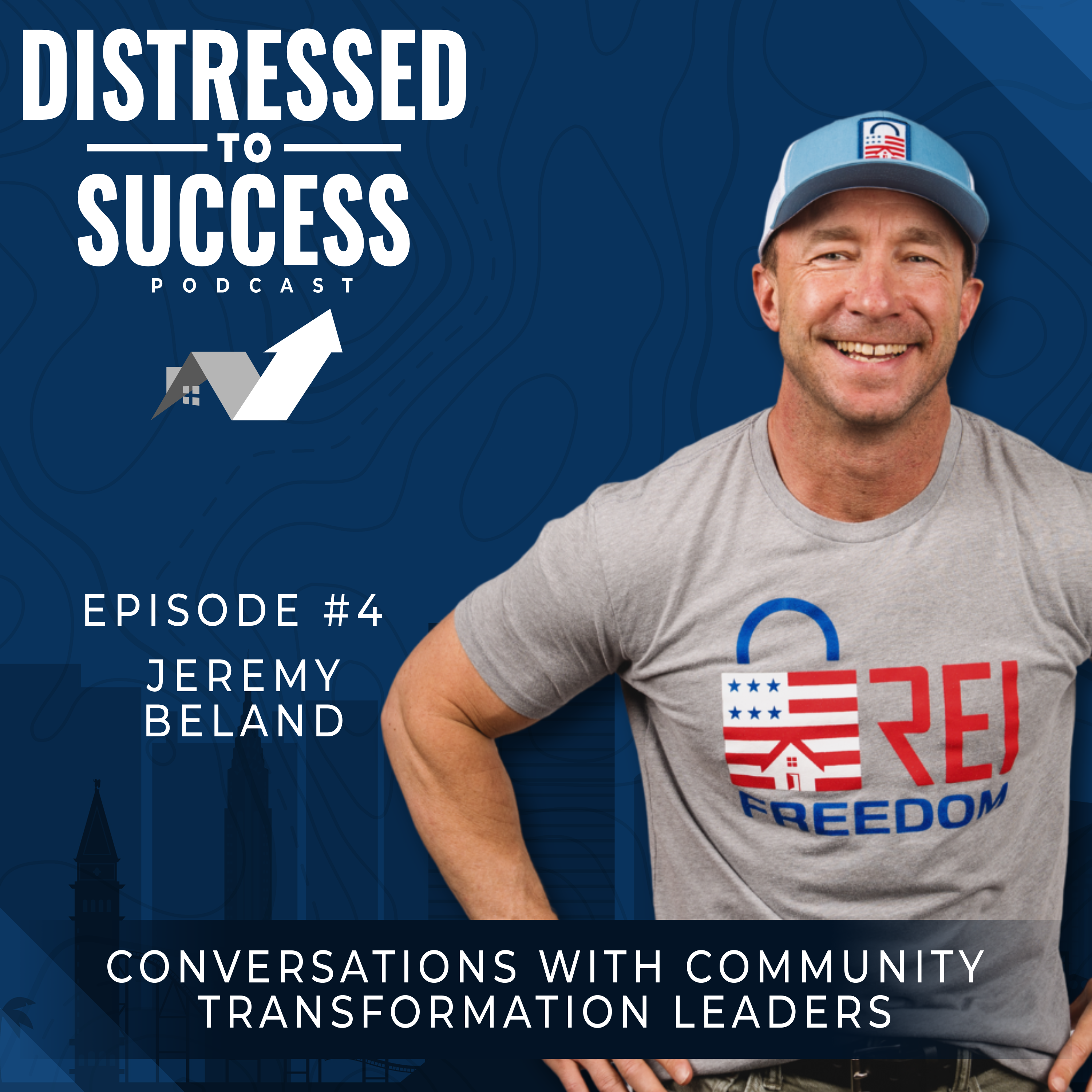
And today I have with me Jeremy Beelin. Jeremy's a real estate investor and home buyer coach. You. Kind of a unique resource in this space, Jeremy. But I guess first off, well, welcome for. Welcome and thanks for coming on, Brian.
[00:01:13] Speaker A: My pleasure, man. Happy to be here. It's a great honor to be on your show today. So thank you.
When.
[00:01:19] Speaker B: Because, Jeremy, you had me on your podcast a few weeks ago and twice. That's right, it was twice.
[00:01:25] Speaker A: We had you back.
[00:01:26] Speaker B: Twice.
You were, you were one of maybe two podcasts I've ever been on where I talked about tax sales and you actually knew enough to be dangerous and we could actually have a legitimate conversation. Most people interviewing me are kind of deer in the headlights. And so.
[00:01:40] Speaker A: And I bought my first property from a wholesaler via tax sale and I have my attorney right now working on getting us clear title behind the scenes as we get ready to refi it. You know, we got a few months before we do all that, so it's going to be a turnkey rental property. But yeah, it was funny because when, when we had you on my podcast, I just learned through this and it's all brand new to me. And I was like, what do you mean I can't get clear title? Then he told me the things that we could do to get it. I was like, okay, all right. So yeah, it's pretty neat. Always, always learning in this business. I love it.
[00:02:14] Speaker B: Yeah, isn't that a fact? Real estate in general and why I got into is you, definitely. You never end learning if you find somebody that says they know everything, like run away.
[00:02:25] Speaker A: Yes, right. Exactly.
[00:02:28] Speaker B: Well, I guess Jeremy, on, on, you know, we kind of focus on, let's say, models that people have turning these, you know, typically giant eyesores of buildings, whether they're, you know, single family residential, all the way up to, you know, industrial projects. I was actually in a, this is a side sidebar, but I was in a hotel in Savannah right on, right on the river there.
It was a, it was JW Marriott that they had recently done. I don't know if for anybody that has a plan to go to, to Savannah, I highly recommend this hotel. It is a, it's a, I say going on a trip not only because they built it and they've got like actual fossils, like a historic history, history lesson. Walking through this whole Savannah and never been and seen anything like it. But, you know, they, they definitely had to have used historical tax credits to make something like that legitimate because this, you know, building was an old power plant. And I can't imagine the, the true expense of trying to convert something that into a hotel, but man, did they do a, a fantastic job. But anyway, you know, trying to highlight similar things. I know you've certainly done it all. Well, maybe not all, but doing a lot as far as dealing with this type of asset. So I guess give us a little flavor on the, on the type of, of properties that you've gone into and some of the kind of unique strategies you've been on. Been implementing and making unprofitable.
[00:03:50] Speaker A: Yeah, sure. Well, I definitely don't take old manufactured buildings and turn them into hotels. That's definitely not my, my niche. But yeah, I know you're talking about actually up on Tampa in the Riverwalk, there's an old power plant that they turned into like, restaurants and stuff inside, like an indoor, like, you know, I don't know, marketplace, which is pretty cool. Amateur works, I believe it's called. And it's really wild because you can still see like a lot of the old things from like the 1800s on the walls and stuff. And just a really cool way to just recycle some old space. And, you know, I love what you're doing here with this podcast, Distress to Success. You know, myself, Jeremy Bean, you know, I'm an investor out of New Hampshire. Been working out in New Hampshire, Massachusetts since I started my journey at 40 years old back in late 2016 into 2017.
As we record this today, you know, I'm just wrapping up my ninth year, getting ready to go into my 10th year.
You know, I've had a lot of success, fortunately, by, you know, investing into some Good coaches and building some good team members along the way. We've done a lot of business in upstate New York, Buffalo and Rochester. We're up there for a few years at a whole bunch of wholesale deals. And then, you know, I do some flipping and wholesaling down in the Treasure coast of Florida as well. We, we dabbled in Wichita, Kansas for a little while, had some moderate success, and then things didn't work out. Even tried luck in Las Vegas. Unlike so many, I did not fare so well there. So. But you know, basically what my business model is, is, you know, I typically started out as a wholesaler. If you guys listening don't know what a wholesaler is, it's basically we get a property under contract for 1, 2, 3 Main street typically a distressed property, not always, but typically distressed property. And we can assign the rights of that purchase sales agreement to somebody else who will execute it. Typically what we call in our industry a cash buyer. So I get a property under contract for 100,000, the cash buyer buys it for 120, I get that $20,000 in between. And that's kind of how I got started out in this business. As of today though, you know, I am a house buyer. I wholesale still, but I buy houses and you know, and we're, you know, real estate investors as far as landlords and things of that nature. So our business model is to find distressed properties or distress sellers. Distress comes in various ways. It's not always the house. Sometimes it's the situation.
Emotional distress, financial distress, you know, physical distress, you know, there's all kinds of distress outside of just the houses. But we take these distressed properties, we get them under contract as well as possible and then we decide what makes the most sense as far as, you know, providing revenue for my business. Does it make sense to wholesale this?
Do we wholetail it? And what a wholetail is, we will actually use money, a private lender, to buy the property. We do little to nothing to it. We just buy it, basically clean it and immediately relist it on the MLS and make money that way.
Sometimes we will buy it and turn it into a flip and renovate the property. We sell it that way. Sometimes we burr it, which is buy, rehab or buy, renovate, rent, rent, refinance, repeat. I always get the acronym all screw up too many hours in it. But that's basically how we, you know, take a underperforming rental property and turn it into a performing rental property.
You know, we do some creative ways as well. But the goal here is to provide value with distressed homeowners, whether the house is distressed or they're distressed or a combination of both and help them out of those tough situations, give them a reset button in life and then turn around and sell those properties through the multiple exit strategies for maximum revenue. And that's how we do it. And we rinse and repeat. And as I stand here today, we're getting very close to closing on our 500th off market acquisition. So that, that number.
[00:07:38] Speaker B: Congrats.
[00:07:38] Speaker A: Thank you. Should we're going to be close to hitting it this year. If we don't hit it this year, we should kick off the next year with it.
[00:07:43] Speaker B: So that's awesome. That's a big, big milestone.
[00:07:46] Speaker A: Fun milestone for sure.
[00:07:49] Speaker B: Well, what I guess a couple questions for you, Jeremy, on the, you mentioned, you know, helping the current, you know, occupants of the property, which is something that, that we, we have, we certainly, I'll say deal with or, or work with, you know, in the tax sales space. What are, what are some of the, you know, strategies of helping those folks get, get, get their feedback under them in a new scenario? What are some of the strategies that you have?
[00:08:18] Speaker A: Yeah, you know, Brian, it's a great question and I'd like to preface it by saying that, you know, many good people fall on hard times. So a lot of these distress sellers are good people and they just, they're looking for a reset button in life.
You know, I was one of those people that was on the brink of foreclosure and bankruptcy in 2009, 2010, about to lose it all thanks to the Great Recession because we're all one or two life choices or one or two life events like the Great Recession putting us in a position where we're basically on the brink of just losing everything. And sometimes the house is the only asset we have or it could be something that's really holding us back from getting to that next step. Like it was for me in the recession, right. My house was anchoring me into, you know, my own personal recession, you know, in financial distress and everything else. But not to mention like emotional depression and I couldn't unload the house because I was upside down with it.
But a lot of times, you know, these people just, they're just in tough situations and it come in different ways, right. Sometimes people are in pre foreclosure like I was back in the day. Sometimes they own the house free and clear, but, you know, then haven't been making tax payments on it and now they're behind one or two, three years in taxes in the city or towns being willing to take the property away, maybe they're just, you know, a seller or a homeowner that has had a lot of deferred maintenance and it's just accumulated so much over the years now it costs more than they can afford to fix it or even live in it, or it doesn't even make sense for them to fix it up and sell it because they don't have the resources to do that. Whether it's financial or just, you know, physical or anything else, people inherit houses that they don't want from different family members and get them through probate and inheritance situations. Especially if you're somebody in a different part of the country and somebody gives you this shed out in the middle of nowhere, you may not want to shed out in the middle of nowhere, and now you're stuck with paying the taxes on it. Right.
Sometimes in certain cities, people get stuck with code violations and those code violations start to pile up really fast, and next thing you know, they're. They're sinking in code violations and can't get out from underneath it. So these are all various forms of distress that we come across.
You know, sometimes it's a Thai landlord, right? People get into real estate thinking it's all, you know, rainbows and sparkles and unicorns, and they realize that, you know what, I am a terrible landlord. These tenants are taking advantage of me. I do not want to be a landlord anymore, you know, and I've gone through evictions and everything else, and I don't want this property anymore, but I can't sell it. My tenant won't go. The house needs too much work, you know, is all these different scenarios. So we go and find those people and we find creative solutions to help them out of these situations by providing value behind the scenes in exchange for monetary value. So basically what we do is we provide value with these houses on these situations. Everything's unique. So it's a specialized, customized solution specifically for them. And they pay us back by giving us equity in their home. And then we take that equity and we turn it into revenue.
[00:11:30] Speaker B: Gotcha. Gotcha. And that's maybe this is one of the strategies that you use, but I guess we come across that in the tax sale world, rarely are these properties that anybody would find on mls, Right? Well, you might. Right. But not. Not traditional, you know, to sell to a homeowner that's going to move in.
And so I think some of the scenarios that you mentioned, every ring home of, you know, there's the maintenance is beyond something that the current homeowner is, is able to do. Right. And, and so, you know, you get a realtor in there and the realtor says, yeah, you know, I could sell this, but you got to do X, Y and Z. And that adds up to 20 grand that, that, you know, particular person just doesn't have. And, and not everybody thinks beyond that, Right. Just look at it. I'm trapped, right.
[00:12:17] Speaker A: 100%.
[00:12:19] Speaker B: And so it's, it's a, hey, you know, we're willing to buy the property, right. I don't know if you do this, but we do a lot of cash for keys where, you know, if there is an occupant, whether it was a previous owner, which is rare, right. Actually, it's much more likely that it's actually a previous tenant. It's, hey, you know, here's, here's some cash, right, to go find another place. And we're going to. Because if, you know, usually the property's in distress, right, Needing some maintenance. You can't do that maintenance with somebody living there. And so, hey, here's some cash to go find somewhere else new. Quite frankly, most people love the fact that we're just, we're willing to give them something, right. And let alone, you know, three, four or $5,000 gets them in a new place, they have some extra cash, right. And everyone's happy. At the end of the day, that's kind of one scenario.
One of the, I guess, real stories on our end that sticks out is we end up buying a property that we thought was abandoned because it was in such disrepair. And lo and behold, there was a, an older gentleman who was about 90% blind trying to live in this house that was about ready to fall over, had no power, no running water. Like he was not living in a space that anybody in his shape should be living in.
It was, it was really sad because the, the family was nowhere to be seen until we, you know, worked out we were actually, we were paying to have him re.
Position in, into a, a nursing home.
[00:13:46] Speaker A: Yeah.
[00:13:46] Speaker B: And we were willing to pay the next six months, right. To get him in better living condition. He did get us in contact with the, with his family members, right. To say, hey, you know, we're helping to this point, but we can't be that long term permanent solution. And then wasn't really until then that they started talking about, well, how did you guys end up owning the property, right? And say, well, where have you been for the last. This didn't happen overnight. This is.
[00:14:09] Speaker A: Why am I Getting paid for this house.
[00:14:11] Speaker B: Where. Where have you been for that? Yeah, that's exactly like they wanted their, you know, piece of that. It's just sad, the type of scenarios that. That people end up in. And that's. That doesn't help the community at all. Right. And that's kind of what we're talking about here is one of the things that help community. So anyway, I don't necessarily want to hit on that too much, but there's definitely a lot of strategies that that can be employed that actually, I think most people, maybe not anybody listening, but a lot of people think of foreclosure properties as. As doing harm. Right. The buyers of those. And that's, I think in your experience, in mine as well, is, yeah, there's some bad actors out there, but very, very few. Like, quite honestly, the. The vast majority of those scenarios, the buyer is actually doing good with the community as a whole. And that's where. That's where we want to focus.
[00:14:59] Speaker A: Yeah. You know, can I interject real quick there, Brian? I think there's a misconception out there that a lot of people just think, you know, a real estate agent is the best option and the only option. And I will say, you know, probably 95% of the time working with a licensed professional real estate agent is in everybody's best interest, whether you're trying to buy a home or sell a home. But there come these houses that don't fit into that traditional box and you know, that 5%, as if you will. But there's so many of those situations, obviously you're talking about, about that older gentleman living in a house in disrepair. An agent's not going to take on that property and help that guy out and clean and list it. You know, there's also hoarding houses. Right. And hoarder houses are way more prevalent than people think. There's so many of them. And when you need to get a house clean and clear out for a showing and a hoarder physically and emotionally, mentally can't do that, that isn't going to happen. And what about if a landlord wants to sell his house and he's got bad tenants in there and the tenants aren't cooperating with showings and everything else, but he needs to sell the house. He's financially strapped. Right. This is another situation where, you know, I'm just giving you a few examples where agents aren't the right, you know, solution for them, but cash buyers or investors like ourselves are.
And a lot of people, as you touched on earlier, just don't really know what they don't know. They don't. They just think, oh, if an agent can't do it, I'm stuck here. And that's why, as you know, real estate investors and cash buyers and everything else, it's really in our best interest to be out there marketing our services and company like any other company. We need to be marketing and educating those people. Hey, you don't have to be stuck. I can help you out. I may not be the best fit for you, the right fit, but I am an option. And if this option feels right to you, we can move forward. If not, no worries. You know, there's other options out there for you. So, you know, a lot of people just don't realize we do provide a lot of value. And so do real estate agents.
You know, there's a lot of nice houses where it doesn't make sense for them to sell to me. They still sometimes do because they saying, hey, I'm relocating for a new job in a month and I don't really want to put it on the market. And, and I'd rather just sell it for speed and convenience. Right. There's no distress. The house is turnkey, and people do that too. But, you know, majority of those times are real estate agents the way to go. But there's a lot of houses out there where the investor is the solution for these people, and it's really just getting us connected with those people and educating people along the way.
[00:17:27] Speaker B: That's a really good point. And, Jeremy, have you ever come across the scenario where, you know, just talking to the, the seller, all of a sudden they're like, oh, there is an option. And so they feel empowered to go, maybe, maybe your solution or our solution isn't the best fit. And before they were feeling trapped. Now they feel like, oh, well, you're gonna. You gave me an option. I feel empowered to go find another solution. You know, where previously I felt trapped. Have you ever come across that?
[00:17:55] Speaker A: Yeah, you know, the way we do it in our business model and the way I teach others in through our coaching program is really to just be a friend and a consult.
So when we go in to meet with the distressed seller, we're setting the precedent that, hey, we're probably not going to do business together today because we're probably not the right fit. Hope that we are, but chances are likely that we're probably not. And then in that process, as we're trying to get a better understanding of what this situation is, what is the cause of distress? You know, along with, like, what's your next steps if you sell the house and don't sell the house? Right. I really want to have a clear understanding of that situation, but also, you know, just saying, why don't you list it with a real estate agent?
[00:18:33] Speaker B: Right?
[00:18:33] Speaker A: I'm asking them straight up, why don't you listen with a real estate agent, they'll tell me why they don't want to or why they can't or why they. Whatever, you know, why don't you fix up the house? Why don't you keep it as a rental? I discuss all these options with them, and I discuss all the options because I'm one of a handful. But all the other options, they're basically telling me, I don't want to do that or I can't do that for various reasons.
And now it's just a matter. Is our option the best option for all them? Sometimes, you know, we'll sit there and we'll be like, listen, I appreciate you wanting to try to make this work, but we are not the right fit for you. What you're trying to achieve, you are best suited to work with a real estate agent. I know you don't want to, but you should, because what you're trying to achieve, a real estate agent can provide for you. I just can't provide you with that far, which is typically, you know, maybe more. More money than I'm willing to give. Right.
And then it's up to them to decide if. Whether or not they want to move forward with that. But, you know, if they don't want to and they're willing to, you know, sell the house as is and look for speed and convenience. And, you know, another thing is, like, a lot of times they just don't know what they don't know. They don't know if it's a hoarding house that they can leave all the stuff behind. Right? So for them, it's overwhelming to think that I got to pack up all this stuff. I don't even know where to begin. It just, you know, it just shuts them down. Or, you know, the fact that, you know, there's mold and water damage and you don't have to worry about any of that. Or, hey, we could take it with the tenants in place and do the cash for keys like you said, you don't have to worry about that. Or, hey, what if we close on your house, let you stay in for 30, 60 days after we close, rent free, we'll give you a majority of that money so you can then go buy your next place. We'll keep some money in escrow. We call this a lease carryback. And then once you vacate the property in 30, 60 days, we'll release the rest of those funds out of escrow. And this will help you transition from where you are now to your next situation. Right. So there's all these scenarios that we can provide help from, but at the end of the day, we're asking them, why don't you go with these other options? And if they're telling us they don't want to for various reasons, then sometimes that only option left is the person they're staring at. And that's us.
[00:20:35] Speaker B: Yeah. Yeah. Well, like asking that question might spark their, their thought process. Right. And so you're, you're inadvertently providing, you know, positive service in those scenarios where maybe, you know, maybe that's not the goal going into the conversation, but ultimately, you know, helps the person, helps the community, and that's the, the, that's the goal. Right, right.
[00:20:54] Speaker A: As much as we want to buy every house, Brian, it's just not, you know, it's not realistic and we're not the right thing for everybody. And at the end of the day, if the seller is misled to do business with us and they don't really feel in their gut that we are the right solution for them, then they're probably going to back out of the deal anyway because they're going to get sellers remorse or sellers regret and cancel the contract. So it's really important that they feel 100% certain and confident moving with us is in their best. And if they don't, then I really don't want to do business with them anyway because it's, it's, it's not going to be in everybody's best interest. We're going to just waste a lot of time.
[00:21:32] Speaker B: It doesn't, doesn't benefit anybody. Yeah.
[00:21:34] Speaker A: Yeah.
[00:21:34] Speaker B: Well, if, with the time that we have left, Jeremy, I'd love, if you, if you're willing to, to share a little more insight, a little bit of the secret sauce, if you will, on a recent deal or maybe two of, of, you know, kind of walk, walk us through, like how you purchase the property. You don't have to give away exactly where it was or the address or anything what you, what you would, you know, how you negotiated, what you bought it at, what you ended up doing with it, and, and then what were the end result was.
[00:22:01] Speaker A: Yeah. You know, so let me think. There's a whole bunch of different scenarios, you know, there's always like the same 12 or 15 scenarios that just kind of repeat themselves.
You know, I think of this one, it happened about a year ago and it was brought to us by an agent that we met with because we do let agents know that sometimes when they come across those properties that don't fit that box, we can be an option for them. And they brought us in. And basically the scenario was that the mom had passed away and left two properties in a trust. One was a single family home, which they didn't have any interest in talking to us about, but they also had a two family home in this, in the city that they had family members living in. There was four children and one of the four children that the other three children didn't get along with was living in this house and living there for 15 years rent free. And this house had a lot of deferred maintenance.
So, you know, they tried to get some showings going with the agent, like some pocket listings, some small groups. And the person living there was very hurt that there was a lot of family discord. And a lot of families have a lot of discord. So when you're dealing with probate, inheritance and stuff like that, this is very common, right? And there was just a lot of internal fighting. And she was really hurt that her family was selling the house and basically telling her, her, she had to go. But the trust said that they had to sell the house, they had no choice.
So in the meantime, since she lived there 15 years rent free, you know, from her mom's house, she was basically, every time somebody came in, she was trying to like hurt the showing, right? She was saying, well, there's mold, this is broken, I'm not letting people in. She was, whatever she could do to sabotage it. Eventually the agents got really frustrated and said, well, we know somebody who may buy this.
So we went out, met with the family at the single family house and there was the two siblings and one that was in New York. We sat down with them and talked to him and basically just said, you know, we could buy this house as is. We'll buy it with the people in place. I haven't seen the house, I'm going to buy it sight unseen with the people in place.
I'm willing to do all this so you don't have to worry about it. You can just get your sold, get your cash. I'll worry about relocating her and dealing with all the headaches that come along with that, you know. And we, we talked to the two siblings and I thought they were the only two decision makers. And as we're getting ready to come to an agreement, they said, well, I got to run this by my brother to see what he thinks. I'm like, wait, there's another decision maker? My agents who brought me in didn't tell me this because I didn't. I didn't have any, you know, too much information going into this. So I'm like, well, listen, you need to get him on the phone right now. I'm here. Why don't you get him on the phone?
And they did. We called them on the phone, and I just spent an hour talking with them. Now I got to go through this whole process again with the other sibling. We get the other sibling up on the phone. Now we have all three decision makers talking about it. We talk about pros and cons, everything we can do.
And, you know, it was a. Basically, the. The ARV was $500,000.
You know, I anchored down. They wanted 300. I said, no way. I anchored it, too. We basically settled at 250, which was my goal going into it. Why I anchored low, you know, and then I. We stepped out. I said, why don't you guys talk about it? My wife, you know, we'll step outside with the agents. If you guys want to move forward with it, Great. If you don't understand, but why don't you guys sit down and talk about it? We went out in the driveway. They talk about it. We do this a lot in our process because we do not want to leave the house without a contract. Right. We're trying to get the deal done while we're there, because if you do leave chances slimming down, you're going to get the contract.
So they decided, the three of them talked it over, came back. We agreed at the 250 we're going to buy a site unseen. And I was going to deal with all the headaches of the family members in place. So we did. I used private money, so I borrowed the money from somebody else to buy this property.
They funded 100% of the acquisition, closing costs, and everything else. I didn't have to pay for anything out of pocket. Then I worked very hard to be very kind with the people living there. The.
The sister and her daughter who was on Section 8 upstairs, tried the cash for keys, tried to re. You know, find places for her. And, you know, it's very.
You know, it was very. What's the word I'm looking for?
She was just basically very stern on. I'm not cooperating with you. I'M not going down without a fight. There's nothing you can provide me to make this easy and work. So unfortunately we had to go through an eviction.
Went through a nine month long eviction of getting this property vacant. Finally agreed that we got a vacant after nine months. I cleaned out the property after she left, had it on the market a few weeks later.
Took me nine months to get there. But once we got there, we had the whole house sold and under contract in less than 30 days and we made $100,000 profit on that house.
[00:26:49] Speaker B: That's the patience, right, to deal with those scenarios. And have you seen that house since? Is it in. Did it end up getting fixed up or what's the.
[00:27:00] Speaker A: I have and I sold it to some cash buyers that were going to renovate it. And I don't know what they did with it. But you. We originally were going to renovate it, but after it took so long to get it, we figured we just take our money and run. Sometimes you'd be surprised buying a house like that and throwing on the market as is sometimes. And I want to say sometimes a lot of times can make you even more money than it can than rehabbing it. Because when you start renovating properties, you end up opening up a can of worms and your budget is, you know, quickly get out of control. So, you know, it was, we were in it for nine months. I owed nine months of investor fees and everything else and I was emotionally just exhausted with it. I'm like, I'm just going to sell it. And yeah, we made pretty well on it. And you know, earlier that year we had another scenario for another property, very similar situation and we did the same thing. It took us 11 months to go through the eviction in Massachusetts. Once we got it cleared, we vacant. We cleared it out, put it on the market. We made $200,000 on that one.
[00:27:57] Speaker B: Wow, those are amazing margins. If you could only do that in every scenario, right?
[00:28:02] Speaker A: Yeah, I wish.
My team today we're fighting over this awful seller and this terrible buyer for a $10,000 assignment. I can tell you a lot of times the biggest headaches come from the smallest deal. So. Yeah, and not all home runs like that. There's a lot of strikeouts and base hits. But hey, listen, they all average out to be pretty good in the long run.
[00:28:23] Speaker B: Man, that's awesome. That's awesome. Well, I guess wrap up. I have two more kind of sections and, and I guess for. For folks that would love to learn more about REI freedom and get in contact with you Jeremy, how can they do that?
[00:28:37] Speaker A: Yeah, thanks for asking. Listen, I'm all over social media. Jeremy Bland, B E L A N D Jeremy B Land. Just how it sounds. And REI freedom, real estate investing freedom. You catch me on all the socials. If you reach out to me, ask me questions, I will get back to you. I talk to people all the time. I'm very passionate about what I do, helping people in my community through buying houses. But I also love helping people get out of, you know, the 9 to 5 rat race in corporate America by building a life of freedom through real estate investing as well. So I basically accomplish both of those things in my daily activities. So feel free to reach out to me anytime. Happy to take time out of my day for you.
[00:29:16] Speaker B: Awesome. Anybody listening? If you're able to or watching this on your computer instead of listening on your phone, you check out the notes below. We'll have a link to Jeremy's REI Freedom website.
All right. Now before we officially wrap up, Jeremy, I have a section I call Carve Outs.
I did not make this up. I totally stole this from one of, one of my favorite podcasts I listened to. But basically it's what is one or two things that you've come across recently, whether it's a book you read, a gadget that you bought, some advice you heard that you think listeners would benefit from.
And I'll, I'll go first to give you a few minutes because I didn't give you much of a heads up on, on anything along those lines, but one of the I guess podcasts that I'm listening to that I actually, you know, stole this idea from and I'll throw it out there is, it's, it's called Acquired and there's two guys on there that go through the history of businesses and the recent episode I listened to is on, on Trader Joe's and it was fascinating and learning all about the origination of Trader Joe's and two Buck Chuck, the the wine the most people have heard about and the story that's out there which actually is not true. I won't give away the story so you can listen to the episode to figure that out. But this is not a 20 minute episode type podcast. This is like multi hour in depth and by far the best breakdown of businesses. You know from Google to Trader Joe's to Hermes bags. I never considered myself much of a stylish guy but after listening to Rolex episode and Hermes like the, the handbags that are $20,000 and up definitely made me appreciate those Items that much more. So anybody that digs that kind of stuff, highly recommend. The show's called Acquired. You can find it on audible, I'm sure anywhere out there. But anyway, that was my carve out. Hopefully that gave you enough time, Jeremy, to kind of think about one from your end. Do you have anything?
[00:31:15] Speaker A: Yeah, you know, I, I read a lot of books and books are really great. You know, I, I would say there's been a few books that really have hit home for me in what we do.
One of them is, yeah, see if I'm actually using them to hold on my computer because of that grave right here. One of them is Equity Happens by Robert Helms and Russell Gray. They run the radio show, the real estate radio show. These guys have been around a long time. It's just the power of equity in America. When you buy a property and hold onto it, that's really where the real wealth is held onto. You know, we buy a lot of houses for cash flow, but cash flow is much harder to achieve than you think. But depreciation and long term wealth of paying down that mortgage over time and appreciating assets is life changing. And then this is another great book, Flip the Script with Oren Clough. And it's just, it's more about a sales book, you know, because in our industry, you know, and I'm going to put this back under here to get my computer high again. But in our industry when we're talking to sellers, you know, it really comes down to your ability on the acquisition sales side of things. So you, the better you get at talking to sellers on the phone and in person. Not necessarily sales skills. Yes, some sales related to it, but acquisition skills training is really the catalyst to success in our industry. So if you want to be a house buyer there, you want to, you know, be very successful acquiring off market properties direct to seller, then that is a skill set that you have to master to learn.
And the better you get at it, the more money you will make.
[00:32:49] Speaker B: That's awesome. That's awesome. Two great books. I've not read out one of those. I gotta add those to my list.
[00:32:53] Speaker A: I recommend it. Equity happens is like $90. It's ridiculous. It's such a hard one to find.
[00:32:57] Speaker B: But exclusivity.
[00:33:00] Speaker A: Yeah, exactly.
[00:33:01] Speaker B: Late.
Well, Jeremy, I immensely appreciate your time joining us today and, and all the advice and stories that you had. Anything else that you want to add?
[00:33:12] Speaker A: I'll, I'll just leave everybody with these three things. And Brian, I really appreciate you being on your show today. It's really been an honor, so I do appreciate it. Thank you. It's just these three things. Always be marketing, always be learning, and more importantly, always be taking massive and perfect action. Apply those three things, you'll do great things.
[00:33:28] Speaker B: I love it. Well, thanks, everybody. Good luck out there and hope to catch you next time on distress to success.