Episode Transcript
[00:00:00] Speaker A: Every problem falls on your shoulders. If something isn't working, your job is to make sure it works. You don't become some untouchable that's like, oh, I'm CEO, so I'm not going to do this or that. No. If things aren't working, you have to figure it out. Which means basically your brain, this masterful quantum computer that can create whole realities while you sleep, that you can dream about, that can come up with all sorts of ideas, your unconscious mind that can work out all sorts of crazy things and whatever, you're not using it. I love the idea of getting your team to focus on an impossible goal.
How could we hit this? And it doesn't matter if you hit it. This is the difference. Because if you have an impossible goal.
[00:00:41] Speaker B: This podcast is for informational purposes only and does not constitute financial, legal, or investment advice. Please consult a professional advisor before making any decision based on what you hear on the show.
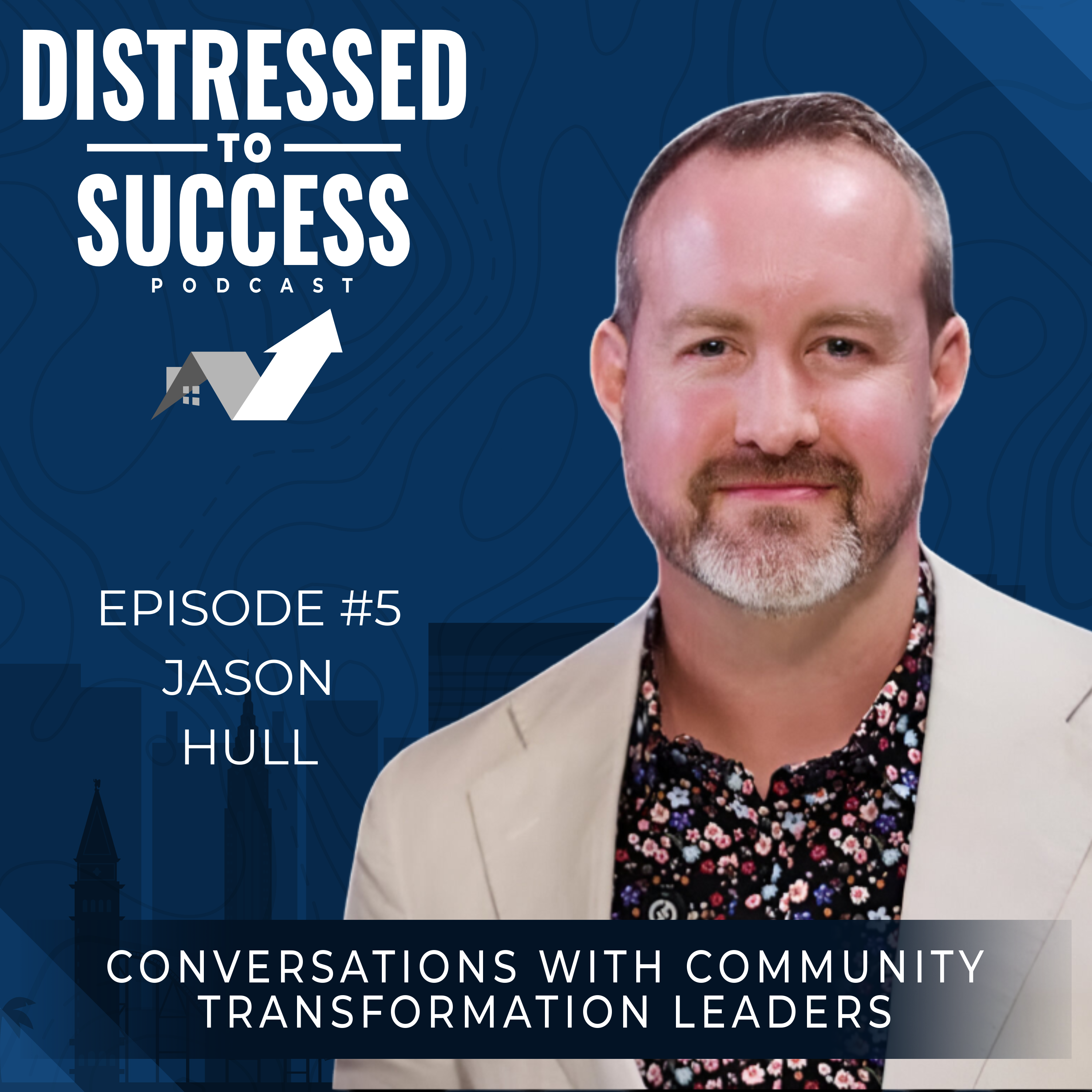
Welcome, everybody, to another episode of Distress to Success, where we talk about professionals who are helping reinvent blight communities in a profitable way. With me today, I have a really awesome guest. He. He was gracious enough to have me on his podcast, and learning enough about what he does is like, you know what, Jason, I really want you to. To hop on Distress to Success. And so anyway, I guess Jason Hull from Door Grow, welcome. Thanks for coming on.
[00:01:21] Speaker A: Yeah, Brian, awesome to be here. Hopefully I can share some value that would be useful to you and your audience. Excited?
[00:01:27] Speaker B: Yeah, I have no doubt of that for sure. Well, I like to start the journey with a little bit of background on. On you and, you know, just tell us about what your journey looked like and how you got to. To where you're at today.
[00:01:40] Speaker A: Well, back in the day, I decided to start a web design business because I was working for a company, found out my job was going to be headed to India, and I was actually already training my replacement. They accidentally cc'd on me on an email that showed the timeline.
And, yeah, I was working for HP at the time, and I decided I don't want to be part of something where my boss is lying to me. They're trying to trick me. They're not. They don't have my best interests in heart. So I quit that day. So I found another job working for, you know, a family member at that time. But I. It was basically, hey, could you hire me? Can I help benefit you guys? And they were like, yeah, sure.
And I then. And then that was back in like 2008.
Around then they the. The market Sort of shifted. They didn't have money to pay me. They're like, sorry, money's a problem. And I was like, okay, cool.
When you can pay me, pay me. You're now a client. I'm gonna go to the marketplace, right? And so I started doing website projects and stuff like this for business owners and started my company and.
And one of the people that wanted some help with their website was my brother. And he was like, hey, could you help me with this?
He had just bought into a property management franchise. And I said, well, sure.
But what really motivated me to get into entrepreneurism and take that leap was I had gone through a divorce. I wanted access and time to be able to spend with my daughters.
And that working at a corporate 9 to 5 just didn't really afford that opportunity.
It didn't really. It wasn't conducive to a week on, week off or like time or splitting time or anything like this. And I was like, this isn't.
This isn't the. This isn't what I want. I want to be able to spend time. And so, you know, I joke sometimes that my daughters kind of push me into entrepreneurism. So.
And I wanted more freedom. I wanted more autonomy. And that's why people become entrepreneurs is they either want more fulfillment in life, they want more freedom, or autonomy. They want. If they have those two things, they want to benefit others, they want contribution, and they want to make a difference in the world. And it sounds like, you know, what you talk about on the show is related to that quite a bit, this distress from to success idea and, you know, helping these blighted communities. Well, after contribution, you can't have those first three sort of reasons we start businesses or become an entrepreneur unless we also have support. We have to have good teams. We have to. We don't enjoy or have fulfillment and freedom in wearing every hat in our business. Nobody does. And so we have to eventually build a team if we really want to enjoy what we do.
And so I call those the four reasons of business is fulfillment, freedom, contribution, and support. And that's what I wanted more of.
And that's what I focus on helping, you know, my clients achieve more and more of.
There is a fifth reason. The fifth reason is safety and security. This is what everybody that doesn't want to start a business, it's usually because they prioritize safety and security first.
Now, as a business owner, I want that too. I want safety and security, but I don't prioritize that over fulfillment of freedom. To me, fulfillment and freedom are way more important. I would rather take a risk, feel less safe and have freedom. But most people on the planet are not entrepreneurial. They're not entrepreneurs. They would rather have safety and security first.
Then once they feel like they have that freedom would be nice, fulfillment would be nice. But they're not going to give up safety for that. That, that. And that's. That means they're not an entrepreneur.
And I realized I'm a minority, right? Entrepreneurs are minority right now. Maybe that'll shift in the future. But most people on the planet right now would rather have safety than have freedom.
And that's crazy to me as an entrepreneur. It's just crazy to me. But they think I'm crazy, right? Most people on the planet go, I can't believe you wouldn't just go get a stable 9 to 5 job and you're taking all these risks and working more hours than I'm working. And like you're trying to get this business going. Right.
And that's. The entrepreneur journey can be really sweet and fruitful eventually. But in the beginning, it's hard. It's harder than just having a job.
And a lot of people don't realize it. It gets glamorized a bit. But there's a reason why most people are not entrepreneurs.
[00:06:09] Speaker B: Yes. Well, you're spot on there. And it is a. Sounds like a journey similar. And most entrepreneurs talk to would echo this as well. Of that freedom is kind of a double edge, right? Of yes. You have the more flexibility as an entrepreneur in choosing the business that you go into. My wife and I talk about this on almost every vacation we go on because she's a entrepreneur and owns a business as well. But, you know, there's no such thing as a. As is a good old school vacation that we used to have when we were in corporate America where you actually could step away and ignore, you know, your job for any period of time. That just doesn't happen as an entrepreneur. But you have that flexibility of you can do whatever. You just have to be, you know, available to answer those questions and understand that by taking that risk, you, you are on the hook, right, for those things and you can't really just ignore it. But like you, I wouldn't, I wouldn't change it for the world, you know, finally making that leap. And it's been an amazing journey. And I can't imagine I'd be an absolutely horrendous employee for anybody anymore. I would probably be asking too many questions that would be poking at too many barriers Right. Of. And just wouldn't fit into any one box.
Which sounds like you're unemployable now.
[00:07:26] Speaker A: Yeah, way to go, Brian.
[00:07:27] Speaker B: Yeah.
Yeah, I guess that's the downside of, you know.
[00:07:32] Speaker A: Me, too.
I mean, yeah, it'd be really hard. Like, I. I remember working in organizations and thinking, this is stupid. Like, how people are doing things doesn't make sense. They don't seem to care. There's. There's better ways to do this. And a lot of times my supervisors or my superiors were like, why are you trying to rock the boat? Don't mess with stuff. I'm like, why are you mediocre? Like, I don't understand.
And so, yeah, there was. There was some conflict sometimes, and I had to learn how to convince my managers or supervisors that I had a good idea and that it was theirs.
And then they would maybe do it. Right. And then. Yeah, so I learned to be pretty good at that, you know, eventually. But then I was like, why am I doing this? So, yeah, I didn't. I didn't see the, you know, the clues that I was. I should have been an entrepreneur. Because in the beginning, I thought that's. You're supposed to go get a job, you go to college, get a degree, you go find a job. And the only thing I could, I thought maybe existed where there were inventors. Like, so I was like, maybe if I just came up with some magical new thing that never existed, an invention, then I could make a bunch of money. But I'm like, I. I don't have any crazy ideas like that. So I didn't realize. But then, you know, I was kind of thrown into it, you know, by wanting to take care of my daughters. And so. Yeah, but that's the thing. You're right. Like, if you are the CEO of your business, you're the owner of your company, then you, not just you have the worst job in the business, in at least in the beginning. Like, people don't realize this. Like, the buck stops with you. Every problem falls on your shoulders. If something isn't working, your job is to make sure it works.
You don't become some untouchable that's like, oh, I'm CEO, so I'm not going to do this or that. No, if things aren't working, you have to figure it out.
And there's a good book about that. It's called the Motive by Patrick Lencioni. And he talks about how there's these two motives that CEOs will have. One is they think the position of CEO is entitlement and allows them to not have to do things and to treat people worse and whatever. And then there's those that understand that if you're CEO, your job is this.
You are the servant of everyone. You, the business. If something isn't working, it's on your shoulders. You have the hardest position in the entire company.
Like if you own a burger flipping business, then you have to flip burgers. Like if somebody doesn't show up on time, like that's your job. And so that's the job of the CEO is any job that isn't working. Well, you have to take that on and figure it out.
And if there's any problem, you have to figure it out. And so there's kind of this servant sort of leadership aspect to healthy business owners that they understand. And so the good news is though, you can build a business that can largely run without you. But that's not even the goal I find for most entrepreneurs. And I've talked to thousands of coached hundreds.
Usually what we really want are those four reasons. We, we want fulfillment, we want freedom, and we want, we want to be doing something that gives us that. We don't want to be doing nothing.
And a lot of people think the goal is to do nothing. They're like, man, I just want to retire.
But a lot of people that achieve that are miserable. There's something beautiful and awesome in doing work that you actually enjoy. And I think the secret happiness.
There's a book called the Subtle art of not giving the F word. I don't know if I'm allowed to say that on the show, but we're.
[00:11:05] Speaker B: Not entirely G rated. But I get the point. Yeah.
[00:11:08] Speaker A: Subtle Art of Not Giving a beep. Right? And this book is by Mark Manson and in it he talks about basically the secret to happiness isn't having no problems. The secret is to have problems that you want to be working on that you choose to be working on.
And so, and that's what a business is or it should be. A business is this eternal problem worth solving. The pro where people get burnt out in their own business is when you are working on problems in the business that you don't enjoy working on or solving.
And not everybody, like, I don't enjoy doing the accounting stuff. That's not fun for me. So I hire people to do that.
There's several things I don't enjoy doing that I've hired and built the team around, but I get to do, I get to keep the things I like doing.
And that's the cool thing is the bigger your business gets, the healthier it gets, the less you do in it. But the more you get to do of that less that you actually enjoy.
[00:12:07] Speaker B: Yeah.
[00:12:07] Speaker A: And that's the goal.
[00:12:08] Speaker B: That's exactly right. I think that's a good, good kind of segue into why, right. In our here at Distress to Success we're a huge believer that the real solution to you know, these, these blighted communities, right. Is it has to be in a profitable manner. Right. And, and you know, typically that comes through an entrepreneur, right. And the entrepreneurs have, have that mindset of solving those I call big juicy problems. Right. And, and there's the more and more people I talk to, like there's a amazing amount of different solutions that are out there. Right. And it's, it's. And we try to be the source of all those coming together and everybody getting those ideas. And then ultimately, you know, every scenario has a solution if you're willing to investigate those different options. And, and, and just listen. Right. And that's. So I guess on that note, I guess I want to learn a little bit more about door grow, Jason, and how you kind of built that for your property managers and, and how I can tell you right off the bat, like how many of these communities have that scenario, right, where there's a opportunity, right from a lot of housing that are boarded, right. That need to be turned into something. And a lot of that, you know, it can be housing, right? Because you have another large problem in the country which is housing. And so, you know, why not marry the two, right? And I think that's a perfect segue. So just tell us more about, about door grow and how that kind of that can help some of our listeners.
[00:13:36] Speaker A: Yeah. So at door grow, our main purpose or why is to transform property management business owners and their businesses. And so we largely focus on long term third party residential property management companies. So basically people that managing rental properties for and on behalf of a third party, which is the, the owner, the investor that owns that property. And so we help them figure out how to get more clients, how to find more of those third party investors, how to systematize their business more, how to dial in operations, how to help them with hiring. We do a lot of cleanup on businesses. We're kind of like bar rescue for property managers. We do a lot of rebrands, we rebranded over 300 companies. We've done hundreds more than that of websites.
We coach them on pricing strategy, we help them dial in sales.
And so there's a lot that we do. We're very comprehensive and our goal is just to help them figure out how to grow and scale their business and build the business of their dreams. And most property management companies in most markets suck. Most are not good because it can be a hard business. And, you know, they can't take on every client. They can't, but they do. A lot of them do. And so they have to be picky about the owners they work with. They have to be picky about the properties they take take on. I'm sure even in, you know, the people that listen to your podcast, not every blighted community or distressed problem is something that you can handle or take on.
There's gotta be scenarios in which this might not be a good idea, right, for you. You might be biting off more than you can chew and that goes in, that's in any business, any business we need, the beginning of sales is we gotta qualify. We can't do everything. We can't take on everybody. And if you take on things that you shouldn't be taking on, you put yourself in a bad position and then you can't help anybody else either. And so it's kind of like putting your own oxygen mask on first. Well, I think, you know, those that are focused on working in blighted communities, one you want to find really good.
If you're going to be focused on housing, if you're going to be focused on rental properties, if you're going to be focused on kind of rehabilitating these, these communities, then you want to find really good partners. And property managers, they know the market, they know what areas and communities are the best opportunities. They know where, what needs to be done and what shouldn't be done to get a property up to speed so you're not wasting a bunch of money and time putting too much into a property that didn't need to be done.
In some properties, maybe the simplest, you know, tile or carpet or paint or whatever would work. And some people are going above and beyond, which doesn't make sense for that, you know, for the comps or for what, what's in that market. And so I think good property managers are an invaluable resource.
And the smartest investors usually start by finding a property manager, not a property.
If you find a property manager first, now you have a trusted partner that can help you deal with this, can make it turn key for you so you don't have to be the one managing it.
And there's a lot of dangerous legal liability in trying to manage properties yourself so they take that liability off your shoulders. They're more effective at being compliant and following landlord tenant law. They have systems and scale and leverage and tools that you just don't have access to with your small portfolio or with the limited number of units that you are able to deal with.
And so, and that's usually the least fun stuff. You want to have an impact, you want to turn properties over, you want to make it a change in a community and, and whatnot. My guess is you don't want to be doing tenant screening and placing tenants and doing maintenance requests and doing inspections on properties and doing rent collection. Like a lot of these things are uncomfortable and aren't fun.
And so a good property manager can help with that. And so one of the ways we can help is at Door Grow is if you're looking for a good property manager, then reach out to us at Door Grow and we might be able to help you find, locate one that's good, maybe one that we've worked with or one that we're actively working with now. And so we might be able to help you with that. You can probably also just Google your market for property management like Phoenix Property Management, and then add the word door grow and you might find some websites of some clients we've done some stuff for, might be a pretty decent chance. We've done some coaching with them as well then. So. But that's one way that, that we could help maybe some, some of the people listening.
[00:18:20] Speaker B: Yeah, I think that's, I mean, put the two, two things together. The second thing going to be, you know, you know, I guess a selfish plug for, for Mount North Capital. But we work with folks like property managers and helping provide the capital for them scaling their operation. And so you know, folks that have a project and maybe don't have the property manager identified nor the source of capital to make it happen.
Right. It's, it's a couple phone calls, it's calling us as well as, as you at Doorgrove, Jason, to say, hey, how can I put these two things together? And then you put those two things together and you have a pretty potent team, right. To not tackle any project literally. But yeah, you have two pretty good team members that can take on a lot of things that most people maybe aren't prepared to take on themselves.
Yeah, that's awesome. What I guess so as far as identifying property managers or if you're, you know, developer investor, right. And looking to move into an area and wanting to maybe either already have a property manager that has room for improvement. Is that something that they can reach out to you and say, hey, I've got, I've got these, these properties in this area. I have a property manager, that's okay, but they need or they have room for improvement. Is that something that they could engage you in as well?
[00:19:39] Speaker A: Yeah, I mean if they are working with a property manager now and they start to notice some cracks, you know, in this, they're noticing some cracks in the seams, they're noticing some challenges with their property manager. Maybe the ball's getting dropped, communications lagging a little bit. They're probably dealing with some challenges. Property management can be a tough business and we can help them get that thing optimized and cleaned up. So they, if you want them to take better care of your properties and be a better manager, then send them to door grow. Like we're, we're like the, it's like sending them to school to learn to be better. So we can help, we can help make that your property manager better and refer them to us. We would love that. And yeah, if you hit us up and let us know that you referred somebody over to us and we get them on as a client, we'll give you a check for a grand. Like I'm happy to do that. So yeah. So property management, property managers, like it's a no brainer for them to work in our program because we can usually Help them add 10, 20, 30 units more every month. And they're usually making at least $100 minimum per unit in their business. And so our program is, it ranges between like 1100 to 3 grand a month. And so if we help them add like 10 units, it's already paid for forever. So it's like our program's free. So it's really a no brainer for property managers to join our program because we're really good at helping them scale and grow. And one of the things we're really great at is helping them with the operational challenges. Because a lot of property managers can eventually figure out how to grow and how to get business.
But managing the business, especially when they get in that two to 400 door range, a lot of property managers get stuck at about 50 below 100 units. I call that the solopreneur sand trap. They get stuck there doing everything by themselves.
So if that's your property manager, then maybe send them our way and we'll help them clean up some stuff.
They're probably over communicating. They're taking on too many things they shouldn't. There's common mistakes at that stage, the next big stage where I see the most miserable property management business owners is around 2 to 400 units.
And I call that the second sand trap or the team sand trap. And usually at the stage they've built the wrong team around the business instead of the right team around themselves. And so their job gets harder and harder. Every team member they add and the business gets more and more difficult. Every door that they add and they usually hit some sort of limit somewhere around 2 to 400 units and the business is harder than it's ever been. They're more stressed than they've ever been and they can't figure out how to create leverage. And they're, they, I always hear them say why won't my team just think for themselves?
But it's because they need a better team and they usually think they need better processes and more KPIs and more metrics and more control to micromanage their team. But what they usually, almost every single time I've ever looked, what they really need is better people.
But they don't know how to create that or how to make that happen.
[00:22:39] Speaker B: So and that, that exact description I hear, you know, I guess come across with fellow entrepreneurs and listening to people.
[00:22:48] Speaker A: Grow their probably universal.
[00:22:49] Speaker B: It's universal, right? It's, it's just the, it's the scaling 101, you know, problems that you see in any business.
Obviously you can't equate it to doors in every business but every business owner listening, I'm sure can relate to those problems if not both of them on their journey to, to scaling. I certainly do 100 Jason.
[00:23:10] Speaker A: I've been there too. Yeah, I've, I often joke door grow was built on, on thousands of mistakes.
[00:23:18] Speaker B: Good way to, good way to look at it.
[00:23:19] Speaker A: It's the price of tuition in business and so we can either learn it the hard way ourself or which is the slowest path to growth by the way, is to do it alone. In early stage entrepreneurs, we wear it as a badge of honor where we think I'm going to bootstrap this. I'm going to do it all on my own. I'm going to read books, I'm going to watch YouTube videos. I was that guy. I thought I could do it all myself.
When I started getting mentors, coaches and help is where when I really stopped experimenting and I started collapsing time and I was able to make so much more money, so much more faster by getting some leverage through getting good coaching. And that's what we, our goal is adorable to provide to our clients is look, I tell them you can figure this out. It might take you a decade, but you'll figure it out. But if you'd like to do it in a year, work with us and then you can go on to a whole different level. Like we can, we can collapse time on this because all our stuff's proven. I've had hundreds of guinea pigs.
[00:24:21] Speaker B: I think it's a perfect segue to kind of the final portion of the show. Just because I don't want to forget my carve out but I want to talk about carve outs and this is a reminder. Jason, is some, any gadget book more of a device that you've heard recently that you would like to share with the audience you think would be highly beneficial to them? And I'm, I'm just going to go first just so I don't forget and, and hopefully make sure you don't steal my idea. But you were talking about the, the concept of, of this exact book that I read recently. It's called who not how. Right. It's the you, you spend more time finding the who's that already know the solution to whatever your problem is as a opposed to trying to figure it out yourself. Right. I think every entrepreneur goes through a phase. You have to figure it out yourself. Right. You don't necessarily have the, the economics to go hire somebody that has that solution. But as you grow you'll find that you, you are better served finding those who's and not necessarily solving that. How and when do you recognize the right time to do that? And this book does a great job of explaining when to recognize and how to implement that. So there's my, my carve out for for today but hopefully I give you enough maybe time to to think about on your end. Jason, what would be what are some one or multiple carve outs you have recently?
[00:25:36] Speaker A: Oh man, I, I love books I like. I'm a voracious reader. I'm always reading multiple books at a time. So who not how. Great book. I love Dan Sullivan and Ben Hardy. I got to hang out and with Ben Hardy down in Mexico at an event recently and we. One of his latest books I think is such a game changer. It's called the Science of Scaling and his previous book before that was called 10x is easier in 2x. Great book. Phenomenal book on how basically it's easier to focus on 10x growth than it is to focus on 2x growth. 2x growth has too many options. There's too many different paths you could go. It's a grind. It's a lot of hard work.
When you set 10x goals, he talks about there's very. There's a lot less options.
And so it narrows your focus to have 10x thinking.
So instead of thinking, how could I get to the next level? The worst goal, though, the worst absolute goal, survival.
That's the crappiest goal. If you're in the state of survival, and that's a lot of us start with that goal. Like, how do I just get. Make some money? How do I just survive?
That is the worst goal. So we have to figure out how to shift out of that. His Science of Scaling book, he talks about what he calls impossible goals. And so the idea is that if your goals are realistic, then the problem is your goals are based on your current limited level of thinking, which means basically your brain, this masterful quantum computer that can create whole realities while you sleep, that you can dream about, that can come up with all sorts of ideas, your unconscious mind that can work out all sorts of crazy things and whatever, you're not using it. You're basically saying, this is my current reality. So in order to hit these goals, my goals are realistic, I just have to work harder. So it gives you the crappiest or the worst path to get to that goal.
And it's a linear goal. So these realistic goals are usually linear. I gotta do step one and step two, and there's so many steps, and it's just work harder, basically.
And the problem with that is those realistic goals, instead of becoming something exciting, they become a yardstick by which we punish ourselves. We're basically hitting ourselves with this yardstick because we almost never hit the realistic goals.
They're too realistic and the path is terrible. So the idea of impossible goals is not.
It doesn't matter if you hit them or not. What matters is if you have an impossible goal, it forces your brain to think, think differently.
It allows your brain to come up with new pathways or new ideas. Because if you're focused on realistic goals, your brain has nothing to work on.
It's like, yeah, I know, I already know how to get there. Just do more, work harder. Which is a horrible path, right? So if you want to collapse all the steps and shorten the path and come up with new pathways and new ideas, you have to do a goal that's unrealistic, that's impossible with your current level limited thinking.
And so that means either making the goal 10x bigger, like he talked about his previous book, or shortening the timeline to dramatically shorter to where the goal is. So impossible, you cannot see a path to get to it.
And then you sit with it for a while, and then you will start to find new pathways to this.
And so I'll give you a quick example. I have clients. A very typical goal is like, I want to get 100 doors in a year. I want to add 100, 100 doors to my portfolio that I'm managing. Very realistic. All I have to do is work harder, pick up the phone more, talk to more real estate agents, do more work, whatever.
Anybody could do it, but most don't even want to because it's such a grind.
I had a client, he was at 100 doors. He had done work to get to that point, but he thought, I want to be at a thousand in a year.
Impossible goal, right? Very difficult is what his initial thinking was. And he was like, he could not even think of a way to do that. He was like, well, maybe I could find companies for sale. So he's looking. There's no companies that are like, hey, buy me. I'm. I've got 900 units for you right here. So he's, he's like, well, I guess I, I maybe the only thing way I could think of to get doors that fast is I need to buy a company. None are for sale. So I'm going to walk letters into all my competitors and offer to buy them.
So we walk letters in. So this is a completely different pathway than I'm going to make 100 dials a day, but I'm going to multiply it by 10 now and try to do a thousand.
Right.
So instead he's walking letters in and shaking hands and making offers. At the end of that year, he was at a thousand units because he had acquired his biggest competitor that had 900 units in his market.
[00:30:25] Speaker B: He's forced to think outside the box.
[00:30:28] Speaker A: Yeah, he found a deal.
There was an owner just waiting. He was like, he had had a vision of maybe exiting out of the business, but he wanted to give it to the right person.
He had built this up. He didn't want it to, like, be destroyed or hurt his clients or hurt his team that he cared about. And this client of mine was the right guy for the job.
And he was like, let's do the deal. He even went to the bank and couldn't get the funding to give this previous business owner the amount of money that he wanted. And he came back to him. He said, the bank will only loan me this much. And he's like, well I like you.
And it was about more than money. So he was like, let's do the deal. So he got it at a discount. So this client of mine had found a completely different pathway because he had set a goal that was so impossible he had to. It forced him to think outside the box and to find a completely different pathway which was way shorter and way easier than what he would have thought. Doing his current strategy initially to get to a thousand units, which probably would have taken him a lot more time and a lot of hard work.
[00:31:34] Speaker B: Well, 10, 10 years. Right. With the first guy.
[00:31:36] Speaker A: Yeah, yeah. And he then got a 900 unit team in property management. Teams that are over 5, 600 units are the best teams.
So that's a healthy business, a healthy team, great culture. So he got some of the best people on his team as well as part of that acquisition.
[00:31:55] Speaker B: That's an awesome story. Reminds me a little bit. I've never had it explained to the next level. I'm in a group called Entrepreneurs Organization and it's a big proponent or believer in entrepreneur operating system eos and there's several books out there to describe it. One of the things that's in there is this concept of a big hairy bleep gold B hag.
[00:32:16] Speaker A: They call it big hairy Audacious. Yeah, the B hags and yeah.
[00:32:21] Speaker B: Oh yeah, it probably is audacious. I've. I always kind of just thought of as a big hairy home, call it that.
[00:32:26] Speaker A: Some call it big hairy. A gold. Like a donkey.
[00:32:29] Speaker B: Yeah, like a donkey.
[00:32:30] Speaker A: Yes. Yeah. But yeah.
So the idea though, here's what's different with Bhags. The problem is when you throw those out at your team, it's demoralizing to your team because they want safety and security. That's why they work for you.
So in the problem I have with EOS in general is that Bhags, it's very, it's very top down Eos, it's very much visionary integrator. And the reason is the organization that pushes this is selling integrators, that's their coaches. Right. And it over inflates the ego, the visionary. What I believe is more effective is you got to get the team bought in and sold first. First and you got to get the team rowing in that direction. So it's not top down. The visionary doesn't have all the best ideas. They have some good ones. But you'd be surprised if you actually set up the system so that your team could come up with ideas. And so I love the idea of Getting your team to focus on an impossible goal.
How could we hit this? And it doesn't matter if you hit it. This is the difference. Because if you have an impossible goal, for example, Darius, like, that's the name of my client that I was talking about. If Darris had wanted to hit a thousand doors in a year, but he had hit 500, do you think he would have cried?
[00:33:43] Speaker B: Probably not, no.
[00:33:45] Speaker A: That's like five times bigger than he was. Right. It's a 500% growth. Like that be insane. He would have been ecstatic. So the cool thing, the difference between, you know, just this bhag that you're putting the team on the hook for to go bigger and, and an impossible goal. Is that the impossible goal? It doesn't matter if you hit it. The focus is not the goal. The. The goal is just a tool to change your thinking. That's the difference.
[00:34:13] Speaker B: Right.
[00:34:14] Speaker A: So we're not so hyper focused on the goal. Come on, team, we gotta work harder. We gotta hit this bag. We gotta go. And the team are like, how do I do this? Like, this is insane.
Instead we take the pressure off. It's not a yardstick by which we beat ourselves. It's here's this playground. We're going to play in with this idea as a thought experiment. Let's see what we could come up with. And if we don't hit it, it doesn't matter. But it's going to give us better ideas.
[00:34:37] Speaker B: Yeah, well, I love that.
That I guess follow up or play on the whole concept. And I think you're exactly right. And I've experienced that with my team of continuously need to explain, like the bhag is not intended to be a. I think we can actually hit this. Right. But listening to you explained, you know, hey, this is a mental exercise is just a much better way to present that. Because I always say if we shoot for the stars, we hit the moon, we're still happy, right?
[00:35:06] Speaker A: Yeah.
[00:35:06] Speaker B: And so I think that's the. The moral of the story. And again, what was the name of the book? Jason?
[00:35:11] Speaker A: The Science of scaling by Dr. Benjamin Hardy.
[00:35:15] Speaker B: That's awesome. Awesome.
[00:35:17] Speaker A: Great book.
[00:35:18] Speaker B: Well, Jason, I extremely appreciate time hopping on and I guess filling us with some of your wisdom. May I have to have you back sometime to talk more about that concept and some of those things that you might be able to help some of our listeners with.
If you're listening, hopefully you got as much out of it as I did. This was great and good luck, everybody.