Episode Transcript
[00:00:00] Speaker A: My father was permanently disabled when I was 12 and I think that probably changed my entire life because at the time, you know, he was a pretty successfully managed car dealership and we lived a very nice middle class life. He was not able to go back to work.
I just realized that our life turned dramatically different at that age and I became an entrepreneur very young. I literally melted crayons and made candles and sold them door to door.
I bought a book when I was 16 called nothing down and trying to figure out how I could buy real estate with no money. And when I was 19, I put $2,500 down on a duplex in Norway.
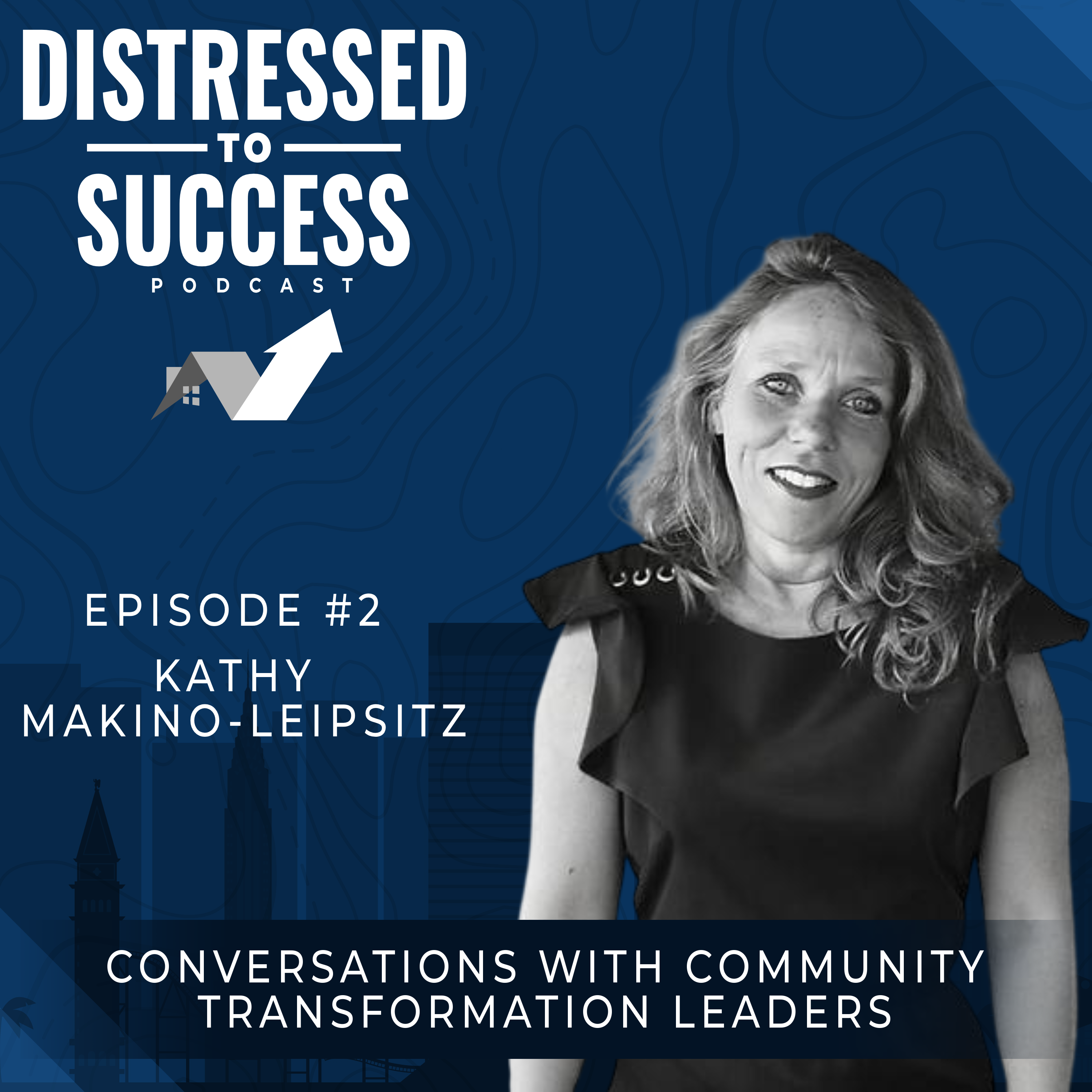
[00:00:44] Speaker B: This podcast is for informational purposes only and does not constitute financial, legal or investment advice. Please consult a professional advisor before making any decision based on what you hear on the show. Welcome everybody. It's another episode of Distress to Success where we talk with professionals who are helping reinvent blighted communities in profitable way. And with me today, I don't know how I was lucky enough to get Kathy Makino on, but Kathy is a affordable housing developer with.
We settled on boatload of experience. She's been doing this a very long time, has some amazing stories and I'm, I'm, I'm so excited to have you on Kathy. I know it's been a bit of a journey finally getting here, but maybe you'll just start there of just tell us a little bit about you and how you got started in real estate and how you ended up where you're at.
[00:01:40] Speaker A: Hey, well, thank you Brian, for having me.
It has been a little journey getting here. We've had a couple trying to get to today between appendectomy and a couple missed calls. And we're here though, so, you know, that's an interesting question and it seems like recently people have asked it of me more and more.
I think just probably because of my age and like, I think being a woman in a development capacity, you know, back in the 80s, it wasn't as common and you know, most people think that I had family in the business or that's usually I think how, you know, especially a lot of young developers start out because it is a tough journey really when you think about it, you know, not having a paycheck every week and trying to, you know, be able to, you know, feed your family and do all the things that need to happen in order to grow and to make the journey successful. But I was very lucky really in my early years. I mean my, I guess to start out, my father was Permanently disabled when I was 12. And I think that probably changed my entire life because at the time we, you know, he was a pretty successful. He managed a car dealership. And we lived a very nice middle class life.
And at 12 years old, he was not able to go back to work. He had a massive heart attack, was in the hospital for 31 days and they really didn't expect him to live. But you know, he came home into a hospital bed really for the rest of his life.
And I just realized that, you know, the auto industry in general, when you think about auto workers, you know, they have these wonderful pensions, they're unionized, you know, really great benefits I think all around.
And he literally had a massive heart attack and came home to no health insurance, no pension and no car even because he was driving a borrowed, you know, they used, the managers, used the car from the dealership every year or every day.
So I mean, our life turned dramatically different at that age. And I think I just became an entrepreneur very, very young. I did anything I could to help him pay the bills. My mother was a house, you know, homemaker. She had not worked my entire life. I mean, she was a wonderful mom and a wonderful homemaker, but didn't have an outside job.
And I mean, I literally melted crayons and made candles and sold them door to door and you know, wove potholders. And my dad and I collected newspapers. And you'd fill the car up with newspapers and take it and weigh them and then you get paid for that.
I dug night crawlers and sold worms at the local lake. And I mean, so it's been a, a real journey. But I think one of the things that happened to me is I became a full time babysitter for the gentleman that moved in across the street.
Him and his wife had two children and he was a real estate investor.
And I think just watching him and seeing, you know, the life he led, and I mean, he happened to invest in quarter car washes. I don't know if you guys, I remember those days, but they'd have bags of canvas bags like the cartoons of quarters all around his office.
And it just made me think, gosh, you know, he's doing something right. You know, we're struggling across the street and he's really, you know, become very successful at doing what he did.
And he happened to own a bunch of duplexes and fourplexes in an area near my hometown called Norwayne.
And it was built during World War II. And I mean they basically, they called it Shacktown or cardboard city.
You know, you knew that anybody that lived there, well, you felt at least the perception was that they were, you know, probably poor and that, you know, struggling. And he owned several of those buildings. And so I bought a book when I was 16 called nothing down and trying to figure out how I could buy real estate with no money and just started saving money. And when I was 19, I put $2,500 down on a duplex in Norway.
And that was kind of the beginning of my real estate career. And it evolved into, you know, I was very focused on kids, I think, I thought, I think being what happened to me and seeing how kids, the perception of being poor and how can it can really impact your life, that it made me want to do what I could to lift children at least and, and their families from, you know, what just to, I mean, to make a long story short, I, I fell across, across the tax credit program.
And the first tax credit development I did was in 1995 and it was in the same census tract that I had bought that first duplex in and ended UP building a 64 unit affordable housing development. And had, I had all these ideas what I wanted affordable housing to be. I wanted it to be beautiful and to, you know, not look like typical affordable housing did back when I was young. You always knew, you know, affordable housing and if it was public housing, you know, it was even more obvious. You know, you had the same design and.
Yeah, yeah.
So I mean, that's kind of how it started. I mean it's. And I've got some great stories that if you want to get into projects or. Oh, yeah. How that all happens to be.
[00:07:52] Speaker B: Yeah. I mean, as much as you're, as you're willing, I.
On the, I mean, on the tax credit side, I guess just to clarify and correct me if I'm wrong, but you're referring to low income housing tax credit lihtc. Is that the right, I'll say. Tool that you came across?
I guess out of curiosity, how did you come across it in.
Was it 95 roughly? Right.
[00:08:17] Speaker A: 95 was my first tax credit project. Yeah.
I'd have to go back 10 years prior to that when I think I've always been willing to kind of research things that interested me, you know, because like I said, I had a affinity with children and trying to. So, you know, out of nowhere I had had, I had struggled. I had had a miscarriage and a Stillborn son in 1983 and really thought I probably wasn't going to be able to have children.
So I just decided I wanted to open a daycare center. And I did that thinking. Now I look back on it and I think I was 25 years old, I had no knowledge of daycare centers. My degree was in economics. But I knew I loved kids and I wanted to help make an impact on kids lives.
So I remember going down to the state of Michigan's offices downtown to try to figure out how do I do this, how could I open a daycare center.
And I think I did the same thing when it came to tax credits because I, I somehow I went to a conference, I think it was a affordable housing conference. And that's where I heard about it.
And just hearing about it, I started to research it and to see and it, it truly is the most amazing program I think there is for building affordable housing.
[00:09:48] Speaker B: Yeah. And I guess I, I know enough to be dangerous. Right. But it's certainly I don't have the level of experience that you do. So I'm definitely, you know, want to dig into that a little more. But you mentioned, you know, that that first project, a 64 unit project, which is a heck of a. Was that, was that your first project of that size or is that, you know, you've done several that size and just happened to come across the LI Tech project or tool and implement it on, on that project?
[00:10:19] Speaker A: No, that was my, yeah, that was my first. It was new construction.
And it was kind of funny because a guy reached out to me and said, he came to me and said I have a site. It was an old school site that was in the middle of this distressed census tract and he wanted to build senior housing at the time.
And he said that he had approached Mishcha and they had said you need somebody with experience.
So he came to me, I'm thinking, well, I have no experience in this, but I'm willing to take it on because I think it's, you know, a super neat program and let me see if I can. And I just, I mean that's why I said I was just lucky I think, you know, because 9% tax credits are super competitive and you know, very difficult I think to, you know, probably one in six shots when you apply to get them.
And I put two applications and I had real estate experience and at that point I probably owned maybe 250, 300 units from that time when I was 19 and bought the duplex, I just kept buying.
Every time I had a dollar I would try to invest in real estate. I never, you know, when I got to 60 years old, and looked back, I thought, you know, I, I don't have a pension, I don't have any sort of, you know, estate planning type situation. I was like, everything, every time I had a chance, I just bought a piece of real estate. So that was my whole, you know, kind of game plan. I never really looked beyond that. Which, you know, was probably not smart. Although, you know, I can't complain about how it's treated me. But anyway, when I put the application in for this project and they own the land, which was, you know, worked out perfect, and I happened to have another building in Detroit that I thought, well, since I'm doing this, I'm going to put them both in at the same time. One was a rehab and then one would be new construction.
And I got them both the first time I traveled. Yeah. So I just, like I said, I was very fortunate.
And then from then on I've done 20 to 9% tax credit projects.
[00:12:32] Speaker B: That's, that's amazing. So doing them from, that's near the beginning of, of the LIHTC project. Were they as competitive back then as they are today from your perspective anyway?
[00:12:46] Speaker A: You know, I think they were probably as competitive. I mean, I remember the application numbers seem to have gone down actually. I mean, there used to be, you know, 80, 90, 100 applications for each funding round. You know, sometimes I've seen it now as low as 20.
So it's, you know, I think what's happened is people realize it's so competitive that they just get frustrated and maybe don't apply. But you know, that deal in particular, I look back on it and I think, why is that? Was that such a great project? My first project was probably number wise, the best project I ever did.
It was like I said, 64 units.
The land cost was minimal because of, you know, they owned the land, they had bought it from the school district.
So the land cost was low, but the pricing on the credits was 63 cents and there was no deferred fee.
We funded an operating reserve that we didn't need and ended up being able to take the operating reserve, release it like in year three.
I had 20% AMI units in that project, which, you know, is almost unheard of. You know, some of the units rents were, you know, a hundred dollars a month.
[00:14:08] Speaker B: Oh, wow.
[00:14:09] Speaker A: Yeah, I mean, it's just, it was, it was literally numbers wise and beauty. I mean, it's, you see it today, it's 30 years old, absolutely gorgeous. I mean, but it's because I, I wanted it to look like a market Rate I looked at every luxury project in the city and thought, what is it that makes them, you know, stand out? And you know, I had like a green dimensional roof rather than, you know, the old brown asphalt shingles and orange brick. You know, I had light brick. I had beige windows back when they were using the slider aluminum windows and you know, real big glass door store, you know, doors in the end, glass block around the entrances. And it was beautiful. I mean in it today, it's still beautiful. But I mean, that's the kind of thing to me when somebody goes home, it, it, you know, makes them feel good about where they live.
[00:15:09] Speaker B: Right.
[00:15:10] Speaker A: And that changes people's, I think, kind of feelings about everything. Gives them a little hope.
[00:15:16] Speaker B: Yeah. Perspective and optimism. Right. You're proud, whatever it may be, proud to go home, proud to go to work. Right? Just having pride in general what you're doing.
I'd love to. I mean, I understand, you know, most of what you're referring to, but I don't know that everybody listening would have that same understanding. So maybe unpack a little bit of. You mentioned LI tech being like one of the best or most magical tools, right, for affordable housing. Can you expand on a little more of why you think it thought and believe it is such a magical tool?
[00:15:55] Speaker A: Well, I mean, beyond the ability to build the projects and create these great places to live, it also the program itself, you know, I bought my first Section 8 project based Section 8 small portfolio like two buildings in Detroit in 1985.
I was 25 years old and I watched what Section 8 does to families. It, to me, it is something that we should not be.
Section 8 is an incredibly important tool, I guess for either handicapped, mentally handicapped, seniors. But family. Section 8 to me is not something that we should promote in our nation. I mean, we should be doing whatever we can to really help lift families out of poverty rather than keep them. And to me, Section 8 does nothing. But everything you do to try to make your life better, you get penalized for it.
So you, you know, you go from being the, you know, minimum wage worker at McDonald's to getting promoted to manager and you know, your rent's going to probably double or triple.
You know, there's no benefits. You don't see any incentive to make your life better.
And to me, that was something you.
[00:17:29] Speaker B: You can, you know, receive that, the section 8, you know, voucher to now you don't qualify and you're. There's no, like you said, there's no step up. It's a, it's a gigantic leap from an income standpoint that you have to go for them to compensate, which makes it a giant chasm to cross.
[00:17:49] Speaker A: Right, right, right.
And you know, I just seen, I watched, I mean, I was very hands on with my properties and you know, I would watch a grandmother, a daughter and a granddaughter all live in the same building.
And that was, you know, they thought that was like a win that you got a section eight, you know, to. And to me, I was, I. There was nothing more I wanted was than to, you know, try to help them get out of that property.
And so tax credit, I mean, to me, the neat part about it, besides, like I said, I can explain like the 9% tax credit if you look just on an easy number.
And first of all, distress census tract. So this project I'm talking about in Westland that I. The first one was in a. They call a distress census tract, which means that if you build in that census tract that you, your basis is multiplied by 130%, you have a 30% basis boost.
So on a project that's a $10 million project, and just say, let's say it's an $11 million project and 10 million of that is basis, all of a sudden you're generating credits off of 13 million instead of 10 million.
So if you're selling those credits at 90 cents on the dollar, you know, you're already creating, what is that, 11,000,700 or no, wait, 90 cents on 11 or on a $13,000,000. 27. Yeah, 11. 7. 11,700,000 in equity.
[00:19:34] Speaker B: So you're already net positive.
[00:19:36] Speaker A: Yeah, you're already in a. So I mean, it's, it's hard, you know, in the, the problem is, is that you usually the basis, you know, your land costs now are so high that you, you're, you know, instead of having $10 million of basis, you might have, you know, 7 million. Now you're selling that at 90 cents on the dollar or 80 cents, whatever. But it just, you know, what it's doing is it's driving your debt down.
So it's a wonderful tool instead of like, you know, doing a Section 8 project where your debt is 80% of your loan to value or whatever in a tax credit project, you know, my, my debt ranges from. Usually it's zero, but up to maybe 25%.
So naturally your rents, you know, can support, you know, the rents necessary to support a 25% loan amount are much less than what's needed to support, you know, an 80% loan amount.
[00:20:41] Speaker B: Right.
[00:20:42] Speaker A: So it's a, it drives the rents down, it allows affordable housing in, you know, a space where, you know, that would not be possible if you were just building that project market rate.
[00:20:56] Speaker B: So you can, you can create the scenario where you do have the beautiful building, right, which is one of your goals. Right. You can also achieve, say below standard market rates, right. For rent, still able to cover whatever debt facility you might have remaining and then create that living space, you know, for, you know, the, the person that is, is, is looking for something more than the Section 8 public housing scenario.
So you kind of check all those boxes, which is.
I'm with you. Right. For as much as I understand Lytec projects, it's, it's a beautiful mechanism that not very many people seem to know about and is, can create an amazing scenario as long as it's not used in a, the wrong way. Right. As long as the, the people doing the development are doing it with the right intent. Which is, I think is, you know, that's exactly what it sounds like you've done for many, many years. It is a, it is a magical tool.
On. So on the, I do want to get back a little bit on the mechanism of Lytec and I'll, I'll kind of explain, you know, my understanding and you can correct me where maybe I'm off a little bit on this, Kathy, but people might still be going, okay, how does that all happen? Right? And, and so I'm going to use, you know, round numbers and I'm going to get rid of the, the basis jump from distress census tracks and just kind of talk about, all right, if you, if you have a, a ground, a, a project, right? And that project is, is $10 million. The way LIQ works is there's, there's a, a 9%, 4% and a 9% credit they call it, and that 9% credit, but that's applied over 10 years and so it ends up being 90% of whatever that basis of the project is. So in your example, let's say it's $11 million project and $10 million of that is, you know, basis. Well, $9 million over 10 years is what can be applied as a tax credit. Now it is a tax credit. So it does need to be monetized in some way. And my understanding is some states allow you to monetize it normally and others, you know, have a unique, you know, roundabouts you have to go through to get to that point, but you're essentially selling that tax credit to a third party investor group and they might Buy it for, let's say 80 to 90 cents on the dollar. Right.
Even at that. Right. Discount. And their incentive is, hey, they're getting, you know, $9 million of discounted tax that they can buy. For 90% of that, they get a little benefit of buying those tax credits. So. But that generates the cash that you need to make the project happen.
And so at the end of the day, the cash that's actually required, you know, in financing or equity, however you end up structuring it ends up being a significantly less amount than if you had just went and said, hey, I'm going to go get a loan for $11 million to make that happen. And ends up being more of a loan for a couple of million dollars. Right. And that's what, that's what allows you to have a lot lower cash flow. Right. To, to support that lower loan amount. Right. Allows you to have the lower rents in order to support it. That's how the whole thing ends up magically coming together. Did I describe that in the right way, Kathy?
[00:24:26] Speaker A: Absolutely, yeah. Yeah. You apply, you get, you're applying for a credit, a one year credit that is multiplied times 10. Yes, absolutely. And the one thing I forgot to mention was that the reason I love the program when it comes to the residents is now what you move in. If you move into a unit. When I Talked about the 20, I had units at 20% AMI.
So you move into a unit, you're making $12,000 a year and you get promoted to manager and now you're making 30,000, you still qualify to stay in that unit. So now developers, some developers will move you up to a higher level AMI unit. So instead of paying the 20% AMI, you may pay a 50% AMI rent or whatever. I tend, I don't do that. What my hope is that that money, that, that difference, now you're able to start saving that and that's going to create the ability to, you know, lift you to either purchasing your own home or, you know, some sub benefit, whether just to move into a different area, whatever that is, but that you're, you use that as a, you know, as a way to help the family and just to give them more spendable income. I mean, sometimes, you know, people are paying such a large percentage of their income toward rent that they don't, you know, they can't take your children to the football game or, you know what I mean, that just to be able to have that opportunity for me is, is important.
[00:25:59] Speaker B: Right, right, exactly. Well, I guess to kind of dig a little Further into all this, you said you've done 22 of these developments over the years. Is that, Is that right?
[00:26:12] Speaker A: Nine, 9%? Yeah, I'm doing my first four.
Yeah, I'm doing my first 4% development right now.
I had people tell me when I was much younger, don't do a 4%, they're brain damaging. And now I'm starting to realize why I waited so long.
They're very difficult. Very difficult.
[00:26:34] Speaker B: Yeah. Now, since you mentioned it, right. What, what's the biggest difference or why is it bigger headache on the 4% versus 9%?
[00:26:46] Speaker A: I think it probably because you're trying to fill the gaps with other funding mechanisms. So, you know, you're either looking for home dollars or some, you know, the project I'm doing now is in Florida and they, I mean, they've been wonderful to work with, but, you know, there's bond programs through the county, affordable bond. I mean, I think, you know, people are starting to get it and starting to understand that they really, you know, I remember, you know, thinking about politicians and wondering, why do politicians not talk about affordable housing? I mean, the last five or six years you're hearing it, but for years, you know, you talked about Social Security, you talked about, you know, affordable health care things, but I thought they never talk about affordable housing. And it to me is the most important thing because if without affordable housing, every other socioeconomic issue we deal with somehow relies on it. You know, whether it's crime or drug use or, you know, food deserts or just child welfare, so many things are impacted by homelessness.
[00:27:56] Speaker B: Right. I mean, it's, it's, it, it's rough when entry level housing in the, the town I grew up in got, I grew up in Montana. And so the town I grew up in became popular from a recent, you know, Yellowstone show. And, and I used to think of Montana as a very affordable, a great place to raise a family. But entry home price in most of the parts of Montana went from 200,000 to over 700,000. I, I can't imagine graduating, you know, from a university.
You're already in debt, right? And then you stare at trying to buy a house at three quarters of a million dollars. I, you know, to me, that's unfathomable. That's, no, that's not affordable. That's just, you know, lifetime of indebtedness and nobody can get ahead in that. So I think you're spot on with. Why isn't it talked about? Right. That's part of what, what we're trying to do here.
[00:28:46] Speaker A: Right.
And I think, I do think they're starting to talk about it, you know, these last couple elections. You've heard about it more than you've ever heard about it.
[00:28:55] Speaker B: Yes. Well, yeah, with housing prices, you know, skyrocketing, it's, it's becoming a bigger issue.
Bigger than it already was. I think it's always been an issue. To your point, just as is. Is a, is. Is higher on people's priority list on, on those, let's say. Well, I guess to, to kind of highlight the, the 4%. So people that are listening going, what are they talking about? You know, essentially that example that I mentioned earlier, Instead of getting 9% times 10, you get 4% times 10. And so it, you get roughly 40% of your costs, you know, back through a tax credit, which means you got to fill that, you know, roughly other chunk with something else. And I know a portion of that is, is through bonds, etc. But you know, to your point, the headache is trying to bridge that gap. And so it's, it's helps. Right. But it's not as much help as a 9% because you don't have all of those options available to lower your rent. Right. Make it more affordable.
But it is, it is, it is some help now. So why do people that in mind, in your opinion, like, why do people go after 4%? Why don't they always go after 9%?
[00:30:06] Speaker A: Well, I think just the competitiveness, I mean, 4% is not competitive. You can apply and it's basically an automatic.
As long as you have a good team together. And you know, I think the competitiveness just pushes people away from the 9%.
[00:30:24] Speaker B: Got it.
[00:30:25] Speaker A: Knowing, I mean, you can try for years, I mean, and not get an application funded.
So, you know, it just depends on how long you can hang in.
[00:30:33] Speaker B: Yeah. How patient you have. Well, the fact that you've been successful in 22 of these over the years is, is amazing. And they have all 22 of those been in, in Detroit or they've been spread out in different areas.
[00:30:46] Speaker A: What's, what does that look like in southeastern Michigan? Yeah.
[00:30:51] Speaker B: Okay. And so on those that you did in the Detroit area, I guess are you still doing them in the Detroit or southeast Michigan area?
[00:31:05] Speaker A: I have not done a new project in Detroit. See, my focus really went to Detroit the last.
Well, I'd have to if I don't count the last 10 that I've done nothing there 10 years before that. I started really focusing on neighborhoods in Detroit in the early 2000s.
And you know, because the 9% program is a wonderful tool for taking especially the beautiful historic buildings in Detroit that are vacant, that have been vacant for decades, taking those. And because you really can't afford to do those developments with any other mechanism. I mean, they're, they're too expensive. They take a lot of, you know, between the historic, historic integrity of the building, trying to maintain that.
But that's where I really got, you know, had a bad, bad experience that took me back a few steps.
So I haven't been able to really bring those developments to fruition in the last eight or nine years.
[00:32:14] Speaker B: Was there those bad experiences anything that you're willing to, to dive into or better not today?
[00:32:22] Speaker A: Oh, no. I, I mean, I, I would say the. Well, there was a few of them, but I, the.
I think the most difficult thing I went through was back in the mid 2000s when everything real estate wise was a terrible time.
I had bought. I really started to focus on neighborhoods. So I would try and. To buy multiple buildings in neighborhoods that I thought were. I considered on the fringe that they were, you know, just a block outside of a really vibrant area or. But that just, you know, for whatever reason had been left behind.
So I had bought 14 buildings in this one neighborhood called Palmer park, and just a beautiful historic neighborhood. It's nationally designated. There was 52 multifamily buildings in this neighborhood and like six churches and one commercial building. It's just very, very dense and very residential.
And so I did one super successful one. And then 2012 came and Mishta had suggested that I package six of them together.
And which was great because I was getting, you know, six buildings done at one time. But, you know, I mean, it wasn't financially smart because, you know, one thing about it there, you're very tight. Like, I got one developer fee for all six buildings rather than six different developer fees. And as a developer, that's really all you have in these deals is you're not cash flowing, you know, for the period of time after you place it in service and intelligence over your, you know, basically just paying your bills. I mean, that's kind of what they're set up to do.
And so to make a long story short, I mean, a lot of things I look back and I think, you know, I should have fought harder for what I knew was right. But, you know, Mishta told me that they wanted. I came to the closing with six bonds, six contracts, one for each building.
And they, at the closing, they said, no, we want one bond and one contract construction wise, which, you know, looking back, that was Not a smart thing to do. I mean, having six individual contracts, you couldn't have any sort of liens be crossed. If you got one sub working on one project or one building and, you know, he gets upset or he doesn't do what's. There's some sort of dispute now if he leans it, he's leaning all six buildings rather than one.
And plus the bond, you know, we had six bonds that were between five and $7 million each, and all of a sudden, one $23 million bond for us, you know, we're just a small developer. That was a big deal. You know, it took us six months to try to get a $23 million bond. So now we're six months behind and construction start. You know, I still have to meet the deadlines that historic has placed on me that I have to have a building placed in service, you know, by the end of 2013, which, you know, means I have six months to build a building. And, you know, just lots of. Lots of things that I should. Like I said, I should have fought more, but I'm not. I have a tendency to think everything's going to work out and I can make this work and come, you know, at the end of the project, I submitted for my part three application for the historic, and one came back denied. For whatever reason, they only looked at two applications, and one was approved and one was denied. I never had a denied application, so I had no idea what to do. You know, I reach out to Washington, D.C. and they tell me, you know, you just appeal it. You know, so they. What they said was in their conditions, they put avoid wholesale demolition.
And, you know, I'm thinking they've already looked at all of our drawings. They've looked at the states, looked at them, national government, the city.
So avoid wholesale demolition to me meant don't do anything that you haven't shown on your plans, you know, your demo plans or whatever. Each plan.
So we did built it, right, according to the drawings. And they said that we moved a kitchen wall, which we do in every project on a historic rehab, every one we've ever done, we moved. And I was able to prove that every single historic rehab in the city of Detroit, multifamily, that was done five years prior to that, everyone had moved the kitchen wall.
But so I appealed it, we won.
Then the next four go in, they deny all four of them. I appeal it, and we lose.
And I know it was a $5 million hit to us, and it just, from there on, you know, just was a. It was A hard, the city kind of, I felt like they didn't stand up for us like they should have and the state didn't. And you know, it just turned into really kind of very difficult time being able to move forward.
[00:37:45] Speaker B: Right, right.
Yeah, I think there's, we kind of unpack that a little bit. I think you're, you're talking about what I'll call historical tax credits, right. Htc. And that was, that was something that you could use along with your LIHTC credit, right. For these older buildings and that, you know, the, for those that aren't familiar with the historical tax credit, they're essentially there, right. For the conversion of historical or renovation of historical buildings. Because typically those scenarios are more expensive. Right. And so, hey, here's a way of helping offset that cost. And so the cheapest route is otherwise is typically, you know, demo the whole thing and start over as opposed to trying to work within a historical building. And so the historical tax credit is a wonderful tool, right. To retain the historical nature of buildings. But right. When you say, you know, that can be what, 20ish percent, 20, 25. I don't know what 20%, but that, that is a significant portion of the overall capital needed in order to do those projects. And what you're saying is at the end of the day, you went through phase one, which is like it was a historical building, went through phase two, said, okay, you can proceed forward. And then in phase three, which is when you get it awarded, is where they finally said, nope, you didn't do something according to what they wanted you to do. Is that the right way?
[00:39:13] Speaker A: Right, right.
[00:39:15] Speaker B: And obviously that's a devastating impact to write on a project that large. Right. You said, you know, 5 million. And so it's what, a $25 million project, right? That's. There's $5 million. You now got a.
Either eat it. Right. Or figure out how else you fund it. And that's not an easy thing to do.
[00:39:34] Speaker A: Yeah, yeah.
[00:39:37] Speaker B: What, yeah, so what, I guess what did you, so what did you do in that scenario?
[00:39:45] Speaker A: Well, I mean, basically the limited partner took the project back and.
Which is a. Another was kind of a really difficult thing for me because I think I could have solved the problem, but I didn't feel like I was allowed to. So like I, you know, the city was willing to give some additional home dollars that they had in the project.
I was able. The project was a, it was actually a $36 million development with no debt, with no hard debt.
So I was willing to put debt on the property.
You know, had I not had historic credits, you could have put $5 million in debt on the property and nobody would have thought anything of it.
But since the historic credits were there and they anticipated, the investors anticipated having a deal with no debt, they wouldn't let me put any debt on the property. So I really feel like it was a lot of things working against me, but ultimately, I, you know, the limited partner took the project back, and now they have control of a project that I worked on, you know, almost eight years and put $36 million worth of.
Of funding together. You know, basically. I mean, it won this project, won the affordable housing magazine project, you know, historic project of the year. I mean, I think multifamily executive maybe was like. Or Nova Grady forwarded it, like, most complicated financing structure, something like that. I mean, we had eight layers of financing, and, you know, I, I worked so hard to pull it all together and then just to have kind of the rug pulled out from under you.
[00:41:31] Speaker B: Yeah.
Devastating. I can imagine.
[00:41:34] Speaker A: Yeah.
[00:41:35] Speaker B: We've obviously picked yourself up from that and, and kept going.
So what are some of the. What's a project or some of the projects you're working on today?
[00:41:47] Speaker A: Right now I'm working on this project in Florida that I was telling you about for veterans.
54 units of veterans housing.
Super excited. We're having our groundbreaking the first week of December. So.
But that's another project I've worked on 10 years. I mean, these are not. It should not be this hard to do something so good. I mean, I just say that all the time. These things are way too, you know, good to have to, you know, just make it so difficult to make them work.
[00:42:21] Speaker B: That is a. It's an ironic part of, of life. Right. The good, good things seem harder. So do your. Is that a ltech project then as well?
[00:42:30] Speaker A: It is. That's my first 4% one. Yeah.
[00:42:34] Speaker B: Got it. Well, that'll keep you, keep you going or keep you on your toes for a while longer then.
[00:42:40] Speaker A: Yeah, yeah, a little bit. A little bit longer.
[00:42:44] Speaker B: Well, Kathy, what, you know, for just for sake of time, I want to be respectful of your time. What. What are some of the top two or three kind of lessons learned over all the projects that you've done that you. That you think might help others that maybe are looking at this, Avoid those, you know, potholes and pitfalls Any, any large two or three that you're like, man, I just wish somebody would have told me that before anything like that you could share with the audience.
[00:43:22] Speaker A: Oh, gosh I have, I have made so many mistakes.
But, you know, everyone has been a learning experience. I mean, it's not, you know, they're not the end of the earth type mistakes.
But I don't know, I just think you gotta take risks. I think that, you know, we have a tendency to try to play it safe and not do things that you gotta go out on a limb and if you believe in something, you know, try to make it happen. There's just, you know, like I said, these projects, there's so many benefits to them. I think that, you know, we as a nation need to figure out some gap funding tools to help developers make them work. And, you know, I mean, I see so much.
I don't want to say greed, but, you know, greed is a terrible thing. And to start to see, you know, some.
What, some, you know, it's just, if I don't know, I guess it's, you know, money has never been the driver for me. And I'm not saying that it's not important because it certainly is.
But when you start doing too much of that and not thinking about, you know, really the right things and how, you know, how we can kind of bring the costs down of these affordable housing deals rather than, you know, costs have just gotten out of control.
And I will say that the government hasn't helped that. I mean, some of the costs that are incurred, you know, there's so many consultants and you have to, you know, it's just, it's gotten to a point where you're layering on a hundred thousand dollars a unit for things that you don't even know why, you know.
[00:45:00] Speaker B: Yeah. So much for being affordable when it's still, you know, two or three hundred thousand dollars a unit at the end of the day.
[00:45:05] Speaker A: Right, right. Yeah. It just seems like we could do it better somehow.
But lessons learned. I mean, you know, I have. I spent way too much. I was way too committed to the city of Detroit. I wish I would have kind of expanded my development a little bit further out. And I really, you know, just had all my focus there for so many years. And, you know, you're really only as good as the people that are there at the time. Elections change things and, you know, all of a sudden you're, you know, if you're not, I guess, on the right side of the. It changes everything, so.
[00:45:48] Speaker B: Right.
[00:45:48] Speaker A: I think I would have done that differently. I probably wouldn't have gotten politically involved. I would have just stayed more focused on just trying to do what I do.
But I don't know. I mean, I do. You know, the one thing I love is that. To the vacant buildings thing, to take a vacant building and to turn it around, I mean, the rewards are just so incredible.
[00:46:15] Speaker B: So focus on vacant buildings.
Focus on doing what you do best, the development side.
And, and I guess stay out of politics. Is that kind of a.
[00:46:31] Speaker A: I hate to, I hate to, I hate to say that, but I mean, I do think that I probably made some mistakes there.
[00:46:38] Speaker B: Yeah, well, that's the hard part with politics especially anymore, is there's. It's harder and harder to even have a conversation with somebody on the other side of the aisle. Even though in my opinion, most people are probably 95% aligned, man, that 5% can create a lot of emotional energy. We'll say, yeah.
[00:47:01] Speaker A: And I mean, I'm just a firm believer. I, I don't care if you're, you know, what, what affiliation you are. Like, you know, it's all about who you are. You know, it's not. I. So. But it's amazing that the kind of. The division it's been in this last several years, I've never seen that before. And it's. That's kind of a scary thing that I don't like to be involved in.
[00:47:27] Speaker B: It is, it is. It's a. Well, this is way in the weeds. It's, you know, seems to follow the trend of the rise of social media and I think there's a. Anyway, that's a whole separate topic for another day.
[00:47:39] Speaker A: Yeah.
[00:47:41] Speaker B: Look, look, Kathy, I, I would love to have you back on because I think there's some of the, some of the things that, that you mentioned I'd love to dive into further and hopefully you would entertain me in that again someday. But for today, I want to immensely appreciate or say thank you for hopping on and helping me understand better, helping the listeners understand better. If anybody would like to contact you, is there any way that, that they could do that?
And how could they do that?
[00:48:15] Speaker A: Yeah, my email is Kathy K A T H Y at Shelbourn Development.
S H E l b o rne development.net and I mean, I'd be happy to give my cell phone. I give it to everybody whoever asked for it. If you want me to.
[00:48:31] Speaker B: Well, give you. I think the email is good enough. Otherwise you'll, you'll end up with lots of phone calls. I know I end up with phone calls, so we'll, we'll save you that one. But I, you know, I think anybody that is willing to reach out via email, we'll put her email in the show notes below and I want to thank you again. So before we wrap up, I like to add on one little segment of the show I call Carve Outs. I didn't come up with this. I totally stole it from one of my favorite podcasts that I listened to called Acquired. But essentially it has nothing to do with what we talked about today. Just something that you came across recently, a book you read, maybe a podcast you listen to, a quote from somebody, a gadget that you bought that you thought would just be really cool and that the audience might benefit from hearing about. So whether it's one or two carve outs as I call them, I'll go first to give you a moment to think about it.
But as far as carve outs from my end recently, let's see, I recently joined a grew on not that recently, I guess it was a few years ago, but joined a group called Entrepreneurs Organizations or eo.
And anybody that is out there building a fledgling business, EO is not the only organization out there like this, but a ypo.
But I, I definitely have the feeling today that if I had joined EO 10 years prior, I would be in a very different state of our business, which is done well, but it could have been even better.
And so anybody that is, you know, maybe an entrepreneur mindset or starting a new real estate business or just looking to start any business, I would definitely look into Entrepreneurs Organization or anything similar to that. There's many groups out there like it and you'll, you'll get a group of like minded individuals they call, you know, members of your tribe and just people that you can bounce ideas off of. And, and in my case I gained many mentors that allowed me to get access to their experiences and point me in the right direction where I can't tell you how many times I just didn't know what to do.
And so anyway, I'm going to stop blabbering at that point. Kathy, if I give you a little enough time to come up with a carve out of your any carve outs from your end.
[00:51:11] Speaker A: Oh gosh, I wish I had some good ones. I mean even like reading a book. This last few months has just been so overwhelming for me with trying to get this deal closed in Florida and all the we'll have to talk on a, on another after the closing and I'll tell you all of the nuances and things that I've had to deal with on getting this project closed. Every day I'm going, you know, the old two steps forward and three steps back. So it's a. It's been a. It's been a long road. So I wish I could say I read a book or something. I haven't done anything. I was asked, which I thought was such a honor, to speak to the first inaugural class of women builders in Detroit.
And just seeing them and their excitement and, you know, having an opportunity to. To talk to them about, you know, their future and in development and construction and, you know, just seeing kind of where women have came since, you know, when I think back on 40 plus years ago and is it. It's a little bit different now.
And, you know, that saying, I think I have it on my desk somewhere that there's no stronger force than a woman determined to rise. And that's been kind of really hitting me hard lately, you know, seeing other women and really, you know, trying to take that to the next level and to be a part of that's been exciting.
[00:52:42] Speaker B: That's amazing. That's amazing. Well, again, I thank you very much, Kathy. Hopefully all you listeners out there got as much out of this as I did.
And until next time, good luck, everybody.