Episode Transcript
[00:00:00] Speaker A: I only knew of wealthy people that were in real estate, only people that were successful, and they all had some connection back to real estate. And most people run away at that point. I don't want to deal with that. And I've always marveled at why that happens.
Most real estate investors have paralysis, which prevents them from ever becoming successful. Right. The courts want certainty. That's all they care about. I remember nights coming home and wondering, what did I just do? There's only one option here. Succeed. I bought them. Right? The values. Right.
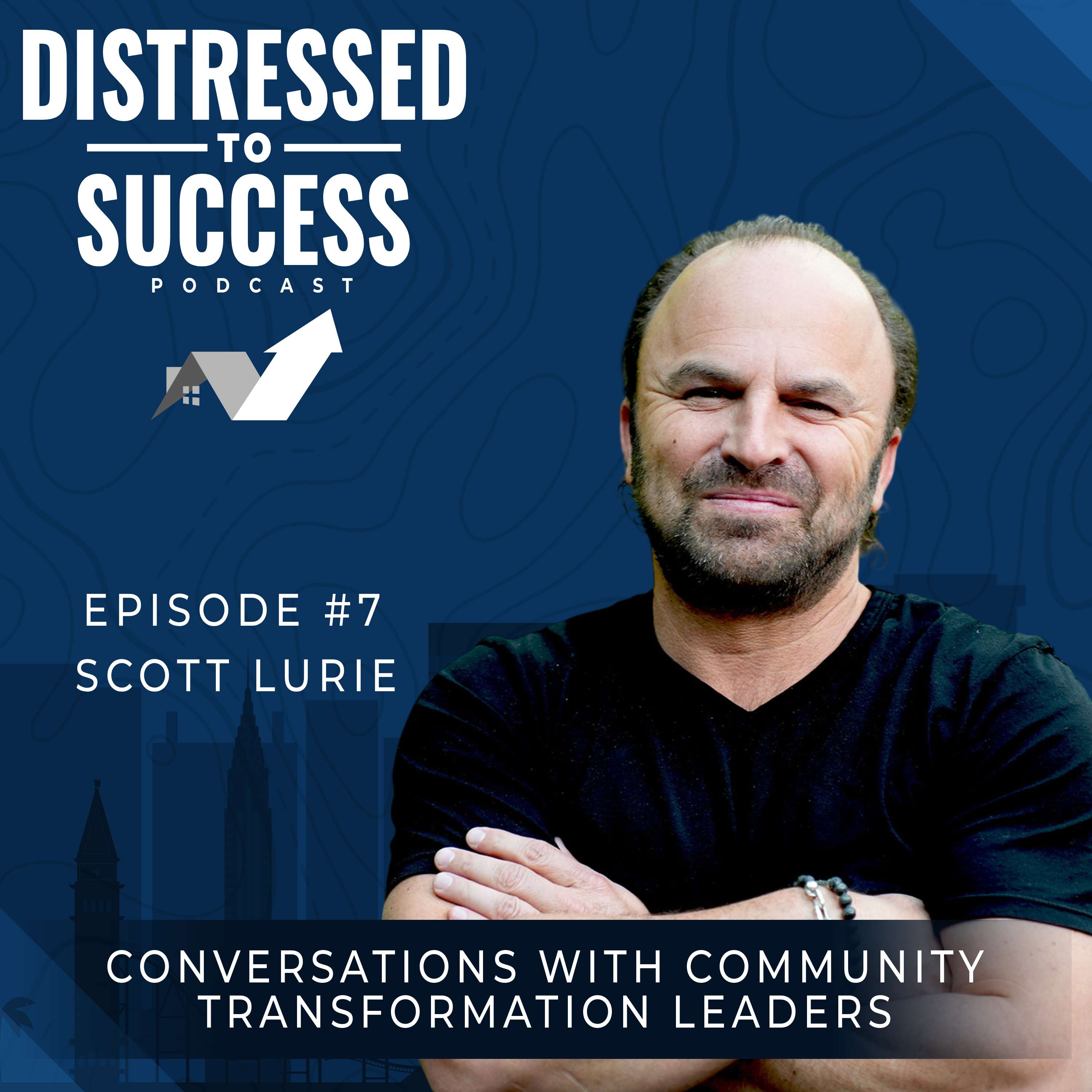
[00:00:31] Speaker B: This podcast is for informational purposes only and does not constitute financial, legal, or investment advice. Please consult a professional advisor before making any decision based on what you hear on the show. Welcome, everybody, to another episode of Distress to Success, where we talk about professionals who are helping reinvent blighted communities in a profitable way. And with me today, I was lucky enough to snag some of Scott Lurie's time. Scott's owner and founder of F Street. And. And I won't give. Give all of the glory or I won't take all the glory away from you, Scott. I'll let you kind of, you know, dive into all the things that F Street does, but some hard money lending.
When we met previously, you have a lot of experience in some very unique acquisition strategies that I maybe have heard about. You know, kind of like you hear about myths, but you've actually done it, which is awesome. And so I'm excited to hear more about that. But anyway, thanks for. Thanks for hopping on.
[00:01:30] Speaker A: Yeah, it's great to be with you. Thanks for having me. And excited to be here today.
[00:01:33] Speaker B: Yeah. Well, guess maybe start with a little bit of your background, Scott, and I guess how. How you got from maybe the. The start of. Depending on how far back that goes. The start of like when you decided to dive into real estate in this fashion to how you got here.
[00:01:49] Speaker A: Yeah, sure. So I, I started in real estate in August of 2003. I only knew of wealthy people that were in real estate, only people that were successful, and they all had some connection back to real estate. And so I started my journey in August of 2003. I was the first franchisee in the state of Wisconsin with the We Buy Ugly Houses brand and started in Milwaukee, owned the franchise here and ran that franchise through February of 2008, successfully flipped a lot of homes, wholesaled a lot of homes before wholesaling was done remotely. We would do that, you know, by putting a house under contract, finding a buyer, walking them through it, and then selling it. The old fashioned way and during that time, you know, built up a decent rental portfolio that ultimately concluded with me leaving HomeVestors in February of 2008 and going on my own, which created F Street, which was a brand of various different real estate entities that focused on multiple things in real estate. Today we manage a syndication network that buys and builds multifamily and industrial assets throughout the country. And then we have our Evergreen Fund, which is a private credit fund with about $130 million in it today. And we use those funds as a hard money, direct hard money lender.
And that's, you know, our business.
So we cover three verticals all in real estate. Real estate has been good to me over the last 22 years and continue to obviously keep me excited and engaged every day.
[00:03:29] Speaker B: Awesome.
Awesome. Well, I guess.
And you get your three different verticals and before we dive into some of your, I'm going to call success stories, you're just really unique, like acquisition strategies, strategies you've, you've implemented. But on the, let's say the commercial, you know, industrial side, can you, can you explain a little bit more about what you do on that side?
[00:03:56] Speaker A: Sure. So in the residential side, we buy what I would call value add opportunities in multifamily throughout the country.
We, we find or identified markets. We were pretty active from 2015 to 2022 where we were taking Generation 1 residence inns, converting those from hotels to multifamily units.
We have six different projects in five different states in that category. We also build in multifamily. So we build ground up class A multifamily market rate apartments predominantly in our market, which is southeastern Wisconsin. And then the industrial category, we buy value add or opportunities where there's opportunity to improve the physical structure or to improve the lease economics through a maturity or through a renegotiation with tenant.
And we do that all over the country. We're in 12 states for our industrial portfolio and we build industrial Class A 36 foot clear assets throughout what I would say the greater Midwest region.
[00:05:04] Speaker B: Awesome.
Well, cool. Well, I do want to dive a little bit into some of those acquisition strategies you and I talked about last time. But I guess you'd mentioned that you'd bought at least a property or multiple properties out of bankruptcy.
And I guess I had a curiosity. I'm sure other folks listening in want to learn a little bit more. So how does that work? How do you get into the realm of even knowing of those type of opportunities and how does that acquisition end up playing out?
[00:05:38] Speaker A: Yeah, well, the bankruptcy court is actually a friend to buyers, if you view it that way. Right. It holds a seller, it holds a borrower, or it holds somebody, whoever, that owner of the deed is accountable to something. And that's usually the best part of what we find in these bankruptcy transactions or transactions that have court orders involved, because there's usually what they call a receiver. So somebody is appointed a receiver on behalf of typically the lender. The receiver then works traditionally with the US Trustee or somebody in the bankruptcy court to ultimately either find an exit, which is sometimes court ordered by the receiver, excuse me, by the judge, through the receiver, through the third party, which is usually the buyer. And so what happens in those scenarios? Or we've, we've done two large transactions, both over 250 units in the bankruptcy court, both had receivers involved. And what it does for a buyer, so long as you can manage that process, so long as you can understand the process and be respectful to it, is it holds everybody accountable. It's the best type of transaction, in my opinion, only because you have court dates, those court dates have action plans. The action plans have a purpose which ultimately culminates from a receiver who is appointed by the courts to sell the asset to somebody. And so usually those scenarios are pretty distress.
I'm reflecting on the ones we bought in May of 2012.
We bought 290 units.
The borrower, or the owner who was a borrower, the reason he was in bankruptcy, he was in default on his note, but was basically a slumlord and had countless what we would call Department of Neighborhood Services or city code violations that were mounting to suffocation status. And past that, he wasn't paying his taxes, they weren't paying the water bills. The overall health of the 290 units, which is a lot of people's livelihoods. And when you put a couple in there with two kids, you're dealing with almost 1,000 people living in that unit. There's a lot of lives at stake. And so the cities really frown and put a lot of pressure on the, the owner. And then the owner through bankruptcy gets it through the receiver and the receiver ultimately wants to solve the problem. A receiver is not intended to drag on a transaction. It's not intended for them to continue to carry on a deal. The receiver wants to find a buyer or find a process and then ultimately finish off the transaction. And so what happened in that case is we became a buyer, we were tipped off to the transaction through a broker.
So the broker network still remained important.
The broker network brought us a transaction, said hey, it's involved in the bankruptcy court.
And most people run away at that point. I don't want to deal with that. I'm not. And I've always marveled at why that happens.
And it's usually because people just don't understand the process. The overall process is really easy. Uh, it's very simple.
The solution is a disposition of the asset. At the end of the day, some a transaction is going to occur. Very rarely does the borrower find a million dollars where does or have more money to stabilize the asset. Usually those behaviors are so negative that the only solution is a disposition. And that's where we were able to acquire those assets. We went into them with a material amount of value add dollars because we had 290 units that were in deplorable condition.
But ultimately it worked incredibly well. And those transactions are, they take a little bit more energy, they don't take more effort.
And you just have to show up and be part of the system. And we had to, in one of the cases, had to testify in front of the federal bankruptcy judge. In the other scenario that we acquired 232 units, the receiver did the entire transaction and we never had to engage. We just had to submit an offer to the courts. The courts then through the receiver ultimately allowed us to buy them. So the transactions work. They're very date and specific to a order from a court and the judge doesn't like to be crossed in those scenarios. So you just need to be respectful of the process and make sure you get to the finish line.
[00:10:09] Speaker B: So you may have answered my first question, which is, so how did you find that? But it sounds like just through traditional, you know, broker relationships and they caught wind of, of this scenario and they brought it to you. Or is there any, like, did you have relationships with receivers directly or, or how did that happen?
[00:10:26] Speaker A: Yeah, so in this, in the scenario that I just referenced to you, the seller sold other assets that were not part of this bankruptcy, but he had other assets that were being disposed of. And the broker said, hey, would you look at this one that's in bankruptcy. And so you, you know, when you, when a property's in bankruptcy, you technically you have limitations, right? Those limitations preclude you sometimes from listing them for sale. They preclude you from doing various actions without approvals from the courts. So this asset was actually not marketed widely. And so we felt we had a competitive advantage at the time.
And the broker who was selling the other assets for the seller in this case tipped us off to this and we ended up ultimately buying it.
[00:11:13] Speaker B: Got it, Got it. Interesting. So as far as, you know, involvement and yes, having the courts, you know, with different processes. Right. Ensures there's an end date. But how long was the process from the time that you got involved till I'll say the closing? Right. The end of that transaction, disposition, where you now could actually go start doing something with that asset.
[00:11:35] Speaker A: Yeah. So it was about 90 days. The courts ultimately control that schedule and they, in this scenario, in the one that I was just referencing, there was a lot of lies, there was a lot of people living there in deplorable conditions with the city very urgently pushing for a sale because of all of the violations. So the courts, you know, we gave them a bona fide offer, they accepted the offer.
The offer was executed by the receiver.
So it happens fast. Right. You don't get. The receiver's not always looking to get the last penny out of the deal. They're not looking to over negotiate the deal. So we gave the receiver an offer. The courts allowed him to sign the. Ordered him to sign the offer. The offer was then signed and then ultimately the receiver signed the deed, which is what happens. And then we become the owner. So about 90 days in that scenario.
[00:12:24] Speaker B: Okay, now you mentioned, I think there's another, at least, at least one other larger multifamily acquisition through that. As far as like the process of how it was introduced to you. Right. And the timeline, was that all similar or is it very different from case to case?
[00:12:42] Speaker A: Yeah, that one was actually two years earlier. That was in January of 2010. We acquired it. And then the reason that deal was that was they all had a lot of similarities. Right. Over levered, poor management, no cash, deplorable conditions in that building. The vacancy was really high. It was about 30% occupied. And the other units, I mean, it was just basically a rundown, really hard project to manage. And so the receiver had a management team in place. They were not qualified to manage it. The vacancy was out of control. So they were having a lot of squatters and a lot of other issues and calls for service to the police department.
So you have a lot of these unique isms that happen to each case. They're all somewhat different. There were two different, two different sellers at the time.
You know, a transaction that got overinflated. It was in a rougher part of the city.
We owned a bunch of units already surrounding it. So the receiver contacted us and said, hey, come buy this. And we ultimately wrote them an offer that day and closed relatively quickly. Only because the transaction value was lower and the opportunity was more urgent for the receiver because he wanted to get out of the management.
[00:13:57] Speaker B: Interesting, interesting. But when you make those offers, right? So you know, you get, you come across these opportunities and you make those offers. Do you have, is it standard closing, closing in the fact that you put an offer, right. Contingency to due diligence, right. Plus, you know, bank financing, right. Is that all, like, taken into account and normal, or is it, hey, the only time it's really realistic is if you've got, you know, cash in hand. And so a real offer is, hey, proving that you've got the ability to close. And then like you said, your differentiator was the ability to add the value, add dollars right into proving those properties. I guess. How is there anything different as far as making an offer on those type of assets and closing versus a normal multifamily scenario?
[00:14:45] Speaker A: 100%. I mean, the whole difference there is the courts want certainty. So any contingency you add, they frown upon. So if you take the second deal, which I mentioned, we bought 232 units, we paid $9,000 a door for them, and I took them as is, whereas, and I said, I'll close in 30 days. So I had to line up, you know, 2 million bucks to buy it in cash within 30 days. And I put hard earnest money down and really didn't look back. I mean, if you want the truth, you know, I, I remember nights coming home and wondering, what did I just do? But going past that, I said, there's only one option here. Succeed. I bought them, right? The values, right? 9,000 of doors, right?
So what I'll tell you is, um, the, you know, most real estate investors have paralysis which prevents them from ever becoming successful, right? They're worried about, you know, get rid of the basics, right? Yes. You want a solid foundation. Yes. You want a solid process.
You know, how does. You could take the scenario, it was 70% vacant. How are they going to meet their cash flow? It was poorly managed and there were squatters and the tenant rent roll was dysfunctional.
All of that is solvable problems in my mind. And so I took it as is.
If somebody else were to come in, they probably would have put 10 other contingencies in there. And I was, I have built a reputation on being a closer. And so as a closer, you get what those courts missions are, right? If you're going to go buy from the courts, they want one thing. They don't want two things. They want a surety that when the Judge says, slams the gavel down and says, sell it to Scott. That Scott closes and produces the money. That's all they care about. He doesn't go to bed saying, geez, I just passed up a great real estate deal to Scott. He doesn't care. They don't think about, hey, could we have gotten an extra 50 bucks for this person? They don't care. They want certainty that the case will be closed, the asset will be disposed of and the transaction is out. And, and that's how they view their job. And that's their job. So you walk in as a confident entrepreneur, you walk in as a confident real estate investor and you hand him a piece of paper and says, here's my number, here's my day of closing. I have no contingencies.
And then if someone else walks in and says, hey, here's my offer, I need a 60 day due diligence. I need to go devaluate.
Even if my offer is, is $500,000 less, they'll take my offer because they'll say uncertainty warrants the price reduction to be sold to Scott. And so listen, I bought those units for 9,000 a door. 232 units. I just sold them in 2021 for 45,000 a door. We cash flowed them for many years. It was a great investment. I would do it all over again a thousand more times. So did I, did I have some moments of breakdown and questionable days? Of course. But that's what makes entrepreneurs successful. That what makes the win. The win.
[00:18:00] Speaker B: Yeah, yeah, I think, well, and you, I think you nailed it with, you know, there's real estate investors or I'd say investors. Right. I think those that are doing real estate at any level understand what you said, but maybe folks just getting, you know, involved or, or looking at real estate from a very different perspective where, you know, it's got to be perfect. Grade a right, 95 occupied, right. In the perfect market, doing all that. And then they expected, you know, I'm only looking for the deal that's going to get me, you know, gross cap rate of 15 plus. Okay, good luck. Right. I mean that's, you can't handle.
[00:18:34] Speaker A: That's why they sit on the sidelines for years. Nothing can get done, you know.
[00:18:37] Speaker B: Right. But if you're, if you're, I mean the value add comes, right, you're, you know, you're earning your return on your investment, right. And, and what you're going to make by, by being that solution, right. Solving those problems and so don't look at them as problems. I kind of look at those things as opportunities. Right. And how do you benefit from, from those situations and scenarios where maybe everyone else is kind of running away. Right. How do you run to those scenarios? Sounds like that's exactly what you guys do.
[00:19:08] Speaker A: That's what we do and continue to do. Those are the deals you run for.
[00:19:12] Speaker B: Awesome.
Well, I guess shifting a little bit only because I want to, I don't want to, I don't want to run out of time and want to learn a little bit more about you guys.
And we've, we've worked with this as well, but hoping you can kind of describe it in, in some more detail for the audience. But obviously utilizing TIFF financing because one thing that I thought was great in our previous conversation, Scott, is, is when you take on multifamily projects, right. You're doing market rate. Right. You're not necessarily. And we've, we've interviewed other folks and, and these are great programs, but there's certainly a lot of, of handcuffs and hands being tied and taking advantage of, of like LI Tech, you know, low income housing tax credits. Right. Historical tax credits. Right. And those are all ways of making something, you know, profitable, but definitely comes with handcuffs associated with those of what you can and can't do and all the reporting you got to do and it's, it's, it cannot be fun sometimes. But utilizing TIFF financing is kind of one of those, I'd say perks. Right. That you can get from communities. Right. Cities, counties. Right. Depending on the area you're developing in. But can you kind of explain how TIFF financing works and how you've been able to implement it into some of your projects?
[00:20:24] Speaker A: Yeah. So tick TIF financing starts with what they call a TID or tax incremental district. Right. And so a municipality, a village, a city, a community can create a TID or tax incremental district to offer TIF tax incremental financing to spur whatever that is that they're looking to engage in. Traditionally, it's housing.
And let's use that as just the baseline is that a community is looking to build or have built in their community class A multi family dwelling, new apartments.
And so what happens in TIF financing, the reason communities use it, the challenge is that what TIFF or TID was created for was always for, but for.
[00:21:19] Speaker B: Right?
[00:21:19] Speaker A: It was always, when it was originally created, it was for but for X something the TID will support those transactions. And so if you Fast forward to 2026, right. We're in January, there's a significant disparity in most markets between construction costs and. And rent achievable rents or affordable rents. Right. To make it affordable. So if you look at a community, let's just say the rent is $2 a foot. Let's just say that that's the baseline for whatever community it is. And to build that market unit is, I'm going to just say 245,000 a unit, right? And so when you have the 245,000 a unit and your maximum rent is $2 a foot, there is a disparity in what a developer like myself would say, I can build these apartments and earn a marketable return to achieve a result that my investors and my partners and myself deem credit worthy or with merit to go and invest. And so that disparity is breached or is, is, is, is brought down through what is called a tiff. And the tiff is in lieu of me paying taxes. So let's say I've got a $40 million multifamily dwelling assessed value, the city will give me back 95% of the tax every year for the longest term is 27 years. But for whatever the term is. And there's. It gets complicated under what we call a developer agreement. But the, the if on my P and L, I have to spend $400,000 in property taxes and the city gives me back 95% of that, that goes into my ultimate NOI, right, my net operating income of the asset, which gets me my ultimate value that I can create, which makes my investors, my syndication, myself, the banks, all of the parties involved say that that is marketable.
Most TIFFs today are what they call PAYGO, TIFs or pay as you go.
There have been historically, before the developer community abused it was upfront tiff. And that was used for what was intended to be used for, but for was really riddled with greed and nonsense that now only most communities only allow for a paygotif.
And so what it does is it really takes your noi or takes your user expense category and it reduces it to get you to a cap rate of X and a cash on cash return of Y and an IRR of X that allows you to create a market. If you didn't have it, you'd be looking at, you know, deplorable. Call it 5 to 6% cash on cash and you'd have cap rates that wouldn't make sense and you'd have disparity where the only way to achieve the dis or to reduce the disparity is to rent an apartment for $2.40 a foot instead of $2. And that most of the time materially harms the community. Right? Because ultimately it's not affordable. And keep in mind, these aren't affordable houses. This is not lihtc. This is not low income tax credit housing. This is not intended for that. This is market rate. But you can't sell if the market's $2. You can't expect to get 220 or 240 because it just doesn't happen. You can't make up your own revenue numbers because the community has only so much median income. It only has so much disposable dollars. It only has so many, so much dollars that people will spend on housing that that changes community by community. And so the TIFF established through a TID really bridges that gap, which for a developer, we only will build multifamily if we get a tiff. That's the only place we, we can and will achieve results. And so what we do is we find pro development communities that are supportive of TIFF and we spend our time there without getting too much into the micro because I think it's kind of hard to micro talk, but if you look at Mike Milwaukee, city of Milwaukee, where I live, the city of Milwaukee has been anti TIF for 25 years.
Okay? They've taken a position that they won't do TIFF for multifamily. And the reason they won't is because there's a massive political understorm that happened 25 years ago and still happens today. Where why would you give wealthy developer assistance? And you see this at why did. Why? The argument goes all over the place. Why do we give any major League baseball billionaire or major League or NFL team money subsidy? They're billionaires. What do we need to give them money? And the answer is, if you don't want to give it to them, they're going to go somewhere else.
So what happens in Milwaukee is we don't build in Milwaukee today because we can't make the numbers work. So we build in the communities surrounding Milwaukee and they all are pro development and they get all of our development dollars, they get all of the new housing, they're getting all of the new stuff. Milwaukee still gets them, but. But the issue is in Milwaukee, you have to charge $3.50. The new building that just went up in Milwaukee is now charging $4 a foot.
So from affordability standpoint, very few people can afford it.
And I can take that exact same product when I Say product, it's not a post tension building but a podium building that has the same amenities. And I can drive five miles west of the city and I can put it in the suburb right there and you get the same amenities and it's $2 a foot.
And so what happens is you're seeing, you see people moving out of cities or non tiff markets and they're moving into markets where TIFF is because it ultimately creates affordability.
That's ultimately what happens. And if people can argue against that all day long and I respect the other side of it and when the city says we don't do that, we, we don't argue, we just don't develop there, no problem. We only develop in developer in pro development communities that offer tiff.
[00:27:55] Speaker B: Got it, Got it. I guess to translate some of that, right. And you can correct me here where I'm wrong, Scott, but at least when you say you know, $4 a foot versus $2 a foot, right. It's like okay, for a thousand square foot, you know, apartment, right? It's $4,000 a month, right. In Milwaukee versus right. Go to go to suburbs is $2,000 a month, same exact construction. There's significant savings in that scenario.
[00:28:19] Speaker A: Think about that. That's costing someone $24,000 in your scenario. That's $24,000 after tax dollars. So round that up to $45,000 of salary dollars of pre tax dollars.
It's a real number. It's a it. And so when you start going down the the path, right, it's real money. And so communities that get it, we work in those communities all the time, really support development and they, they're getting the, in my opinion, the people that are, are hard working, that have great jobs, that are going to spend money in their communities, are going to fill the restaurants, that are going to fill the parks, that are going to engage in their libraries, that are going to be part of the civil, civil communities, they're going to do everything. And when you go into these cities where you have $4 a foot rents, you know, you create a huge disparity and you, your absorption remains really, really slow.
[00:29:15] Speaker B: Right, right.
And then I guess the other kind of probably oversimplifying this isn't a direct like use of tiff, but I wanted to kind of boil down to like maybe the single family rental folks out there that are a little not quite sure what we're talking about. So imagine like the $100,000 property that you can get $1,000 a month in rent, right? And then you're paying $3,000 a year in taxes, right? And so that was a 12 gross cap, you know, pre taxes, right. But it's a 9 gross cap once you pay your taxes, right now you're down at nine grand a year that you have to pay with. And in a TIFF scenario where you say 95% of that, right? So it's not exactly $3,000 that's put back into your cash flow, it's 95% of that, right? So now you're back up to 11.8 ish. Right. 11.9 net cap. That's, that's significant for the single family renters out there going, wow, from a nine to an almost 12, that's a big jump. Right? And that's, that is what TIFF financing is essentially allowing you to do is add that now aggregate that over 100 units, right. In a multifamily, that's a significant dollar amount that allows you to attract more investment dollars, right. And put together a package. And that's, Am I oversimplifying that too much or is that essentially how it functions?
[00:30:29] Speaker A: No, I think you're just missing one last connection to it. And I think the connection is what it really does. Let's use your scenario. The single family developer, right? Because I, or the single family owner, I owned 100 single family homes. I, I, I grinded for 100 homes. I loved it.
So what I always say to everybody is if you're, if you take the pledge from day one that your NOI's life, right? And you're going to then ultimately assess value to your, to what you create in terms of your personal financial statement or your global cash flow statement, or your net worth, right?
If you take $300 a month times 12, that's $3,600. And if you put whatever cap rate you want on it, how much value are you adding to your life, right? So for each $300 or for each $3,600 at whatever value you want to put on it from a cap rate, do the math and do that across one home, then 10 homes, then 100 homes, and you're talking about 30,000, 300,000 3 million.
And all you're doing is either shifting the tax bill to the tenant, you're shifting the lawn care to the tenant, you're shifting the water bill to the tenant, you're shifting the operating expense to the tenant. And if you can do it on both sides of the P and L, right. If you can generate $50 more a month in rent $600. And if you can save $300 a month doing something that's 30$600 plus $600. Now do the cap rated math again. Once you connect those dots right, once you put all that together, it's what are you creating in terms of net worth? And that net worth number is really what's important to you. Not today, not in five years, but in 10 years. That's the number that you really have to be focused on.
[00:32:13] Speaker B: Right, Right. So it's, yeah, it's multiplying that by multiples. Right. It's not.
[00:32:18] Speaker A: Right. The multiple is the multiple that you have to really be focused on.
[00:32:22] Speaker B: Right. Right.
Awesome. Well, I appreciate that. Now, I guess you mentioned Scott and the, the fund that you guys operate from, from a hard money, you know, lending standpoint, I don't know if you want to dive into both sides. Right. But you know, maybe start with like, what, how does it work for say on the, the borrower side? Like, what kind of, you know, structure. How does that work? And then if you, if you can or want to dive into the fund structure side, like, well, how does, what is that offering to, how do you, how do you structure that for, for investors on that end?
[00:32:57] Speaker A: Yeah. So the borrower side's pretty easy, right? What, what borrowers get paralysis under always is an is, is overanalyzing capital structure, not buying low enough, being aggressive, trying to force deals in the deals and then not figuring out the capital stack. And they, they, they don't get it right. And you can't, you can't instill that into somebody. That has to be a really a code of discipline. And so from the borrower side, we deployed last year $145 million. Okay. We did almost 400 loans.
We, we had a, almost a zero default rate last year in 2025, which is phenomenal for our underwriting team and for our overall performance.
The borrowers that come to us understand that we require 10% down. We require so low cash into a deal, but we require skin in the game. We fund 100% of the repairs and we can close in 10 days.
So if you want to go to the federal bankruptcy court and buy a deal for $9,000 a door and sell it for $45,000 a door, you're going to get to the point where they're going to say, show me the money, right? And I'm going to say, here's the money, here's your proof of funds. And what happens is they're going to close and they're going to win. The other people that fail are going to try to figure out how to get the lowest rate possible because it's such. And they lose sight of what's the short term number. Right. Hard money lenders are high interest rate lenders that close fast, that act on the asset. So we have an unbelievable underwriting process. We look for borrowers that are qualified borrowers that have done deals. We do first time borrowers with 20% down. We, we look for people to have skin in the game and be efficient and those borrowers do very well.
Our largest borrower did over 60 transactions with us last year. They bought over 60 pieces of property with us last year alone. That's five a month. So when everyone says what's going on, his net worth probably increase with the 60 houses that he bought from us and stabilized, probably $5 million. So his, his paralysis is he, he doesn't have one. His paralysis is he works 24 hours a day. He's working towards a goal which is for his family to be stabilized and enjoy life in 10 years. Right now he's just running through walls.
So he continues down that road. He continues to make things happen. He, he's buying every day. We're working with him. When we have opportunities, we're selling them to him. He's just that type of borrower. We have other borrowers that do elite work and they move fast and they're efficient. We have other borrowers that use the burst strategy, that use our capital to buy. They understand how to refinance, they know how to make improvements. They understand noi. Most people don't understand noi. So they just don't get real estate. And I never understand that. They understand noi. They understand what DSCR means. They understand how to improve that to get to a point where under a DSCR loan you can get max cash out. So you're fully levered. That was one of the tricks I did. I built $150 million portfolio in my first five years and I had $0 in it. I had 100% leverage. But I was never irresponsible. I didn't need to be irresponsible. I was focused on it. So our good borrowers understand all of those terms. If you don't understand them, figure it out and understand them. If you want to be successful, you got to know the deal.
There's so many people I know that send us contracts for deals and I'm like what are you buying? And they're like, I don't know. Or they'll Say, did you read this contract? You know you're paying closing costs. No, I'm not. Well, you sign the contract that says you're paying closing costs. I didn't mean to do that because people don't pay attention to the details in these transactions. Contracts matter. Real estate matters. You got to know what you're doing. And so we look to partner with real estate folks all over the country.
If you have a deal and you're a borrower, we'd love to talk to you.
Pause.
[00:36:51] Speaker B: Is it safe to. I'm sorry, go ahead, go ahead.
[00:36:53] Speaker A: No, no, go ahead.
[00:36:54] Speaker B: I was going to say, is it safe to assume that, you know, the use of your program is better looked at from a short term solution on a great deal.
Right. That needs the quick closing scenario, but you're also not looking to be the long term solution for that scenario for 30 years. Right. As a, you know, it's hard to get something cash flow net positive and pay an, at 15%, you know, plus interest rate.
[00:37:19] Speaker A: Yeah. And so just to answer your question, our average loan's 300 days. Our average loan is 300 days. We have borrowers that pay off in as fast as 30 and go as long as two years. The people that take two years are the worst borrowers we have. They don't make sense. They're losing money. The borrowers that are executing out of the 300 day cycle are doing incredibly well. And we're proud of them and we keep doing business with them. We, we, we have people like, you know, in your life, whether they're in real estate or they're in, they're your family that are, have these crazy idiosyncrasies that just make them fail. Right? It's like, why are you doing that?
Why did you not move on the transaction? Why are you not responsive? Why do you go dark for three days? Why is your head in the sand half the time? And the answer is it's a character flaw. Right. So they shouldn't be in this business, they should be in the sand business or they should be in some other business. Because this business requires speed of execution all day long. And so 300 days, average loan. Those guys are making tons of money, feeling great about it. And yeah, we, we encourage you to pay us off. We want to close, we want to get you to be the owner. We want you to pay us off. And those people, there's so many outlets out there to pay us off that once you have the widget, you crush, you just keep going through the walls. It's Great.
[00:38:32] Speaker B: Awesome. Now to kind of switch gears to the, say, the investor side of the equation. Can you.
[00:38:37] Speaker A: Yeah.
So the investor side is really a.
[00:38:41] Speaker B: Unique.
[00:38:44] Speaker A: It'S a unique skill set. So we, I have been very successful in raising money. In 2025, we raised $100 million, $60 million for our syndication network where we buy assets. So we've raised $60 million of equity that I've placed into those deals.
And in the private debt side, I've raised just over $40 million in 2025, 2026. We've already raised $5 million this month alone in January. And I've got 10 more days.
It's a skill.
Not everyone has it.
You have to be very disciplined to take the oath. The oath is I will always do what's right by my investors no matter what. There is zero exception. And the problem is when people get pushed, right? They that I will not make an exception becomes an exception. And then the lawsuit starts filing and people become put themselves into a pickle.
And those pickles are never fun because you can't recover from those.
So I started the business in 2009, raised 700 grand from a few of my friends. Today we have $130 million.
Every day we're raising money, every day we're deploying capital. We have a 95% retention rate in our fund. We pay a very simple business. I told my investors when I first started, we're going to keep it simple. I'll pay you 10%.
We can all do the math, right? It's pretty easy. We can all do the simple calculation. Most of us can do it in our head. And so that's our business. Since 2009, I've paid the same rate. I've only paid 10%. I've always paid 10%.
It works out really well. It's easy for me to sell it to you. You want to invest 100 grand, I'll pay you $10,000. I'll pay you $833.33 every.
On the last day of every month, on the last business day of every month. With 17 years history was never a failure. Okay? 17 years, never a failure. I have paid the money due.
So now we're paying 700, $800,000 a month of interest to our investors every month.
We never miss. There is, there is backdrop on backdrop on backdrop, on safety, on safety, on safety, on safety. That assures that my investors never, never miss a payment ever. And they haven't in 17 years. I have a 17 year track record. And so it's not about me. Right. Forget me for a minute. What it really is about is if you are going to be part of a syndication, if you're going to be the entrepreneur, the only thing you really have is your word. The moment you breach that trust, the moment the first excuse flies, right. I was traveling. Investors don't care.
The first time you say, oh, the bank, they don't care. The first time you say any excuse related to you breaching your trust with them, you immediately are kicked in the knees, Right? And now you just have become a sinking ship. Because when you ask them for more money, they have a pause in their head. When you ask them to give a referral, they have a pause in their head. My investors that I put on my referral network, call it, 10 of them that rotate will only say the same thing because there's only been one solution. How many times has Scott missed a payment?
Ask all 10 of them. What do they all say?
Zero.
Every month he's done what he said he's going to do. So when that call gets lobbed in and I meet that person through what we call a 506C or through our. Through our general solicitation, when we get that and the calls, when John Smith calls Bob Smith and says, bob, what's your experience with Scott? He says, unbelievable. Impeccable. Zero. Zero issues, zero excuses, zero problems. That's what makes us successful. We do exactly what we say we're going to do, and we have backstops to make that happen. And so the. The word to your network, to your people, is become a person of your word. If you can only do that, you'll always win. But you can't. When I tell people I will promise you to pay you every month on the last business day of every month, that happens. I assure that happens. There is no excuses. I don't have an opportunity to make an excuse. We pay.
That's it.
[00:42:57] Speaker B: Interesting. That's very cool. And as far as the. So it's a 506C, right? For the listeners that are like investors looking to place capital, it's only available to accredited investors. Then is that.
[00:43:10] Speaker A: That's right. So we raise money through what they call general solicitations of the sec. So we file what they call a form D. A form D lets us know that we have an Evergreen fund, which is our F Street Investments fund. We. We then require. When you. When you do general solicitation, the only difference between B and C is that under C, you have to have a third party do the Verification under B, you can raise your hand and say you're accredited. And so it's just a little step in the process.
We have a 99% acceptance rate through that process, through our investors, we add, you know, 20 to 20 new investors a month to our business and we continue to add. So we just did a syndication where we sold out in 40 hours.
Our raise for our most recent acquisition of a sale leaseback.
We've got a really great portal and a process and we always are looking for new investors and always adding them to our business.
[00:44:13] Speaker B: Excellent, interesting. So as far as what the offering that investors get, right, it's as straightforward as a 10%. Right. It's not.
[00:44:22] Speaker A: There's two options. There's a straight 10% current pay and we were asked for by an investor to go to compounding. So we now have two offerings. One is a compounding offering where your money compounds and the other is a current pay and that's at their sole discretion.
[00:44:41] Speaker B: Compounding is in like a dividend reinvestment program, like a drip program.
[00:44:46] Speaker A: It's a little bit different than a drip. So there's tax implications to drips that are different than our program, but they're all of the same. They do get a 1099 at the end of the year. If you are investing through a self directed retirement, qualified retirement product, that's all deferred. But if you were to invest in a compounding program, you would be issued a 1099 Int. So some people view that as phantom income. We view it as income. It's just in your account. With us we have a portal. The portal shows all of your investments as well as all of your documents and tax documents.
[00:45:24] Speaker B: Excellent. Well, Scott, before we end and I want you to put me and make sure everyone understands how to get in touch with you. I have a little section called Carve outs. Right. And for those that are listening in for the first time, I totally stole this concept from another podcast I listened to. But random things that you have listened to, bought, heard sayings, etc. That you think the audience would highly benefit from. And I'll give you a minute to, to think on it. Why? What I, you know, I guess communicate mine for the week, but mine for the week is actually a book that I've been listening to. I'm not quite done with it, but it's called the Coddling of the American Mind. And, and for those that you maybe haven't heard of it, think of it as what's a good analogy. I think they actually use this in the book for a long time, right. Peanuts and peanut butter were recommended, like keep them away from children. Right. Well, that actually ended up backfiring because people got more allergic to, I think it was like four or five times more people got allergic to the peanuts. When you take it entirely out of the ecosystem, right. Not in the class, nobody can touch it. Right.
And doctors eventually figured that out. And so one of the recommendations that pregnant women get today is eat peanuts. Right. It actually reduces the chance of having peanut allergies. And so the book is about, you know, something similar like over protection of, you know, children in our society over the last 20, 30, 40 years. And what is that? What could that result in? And is that the right decision? And as opposed to letting kids and our youth actually be exposed to some level of risk right. Throughout their lives, as opposed to the first time they're seeing any sort of risk is when they go off to school. And that's not the right time to be introduced to, to risk. So anyway, that's the book in a nutshell, I guess. Scott, do you have any carve outs from your end.
[00:47:31] Speaker A: When you, so you mentioned that at the beginning of the podcast we're going to talk about carve outs and I, I, I'd like to, you know, I don't, I, I'm, I'm more of a present day passionate guy about just people being honest, truthful and hard working towards themselves and towards our communities. And so I see, you know, the world has evolved, our real estate industry has evolved and there's been a lot of bad actors and bad outcomes that have taken investors, unsuspecting investors, by storm. And you know, I challenge all of our community, specifically the real estate community, to continue to be good people, to continue to make good investments and continue to do what they say they're going to do and work hard.
We've got an unbelievable team here at F Street and everyone comes here every day and gives this team 100%. And I encourage everyone to continue to give 100% to their work, their lives, their families, their communities, because it's important to the outcome for all of us. And I hope, I feel like we're in a dark day in our society still, but I do think there'll be a brighter day at some point in the near future.
[00:48:40] Speaker B: That's awesome. I appreciate that. Thanks, Scott. For anybody that wants to get a hold you for any of the topics that we talked about today, how can they do that?
[00:48:48] Speaker A: Yeah, thanks a lot. So our, our, our lending network is the hard money co CEO.com the hard money co.com if you're an investor. We have an investor facing business called f street f street.com my email is scott f street.com I'm available on social platforms as well. Although I'm not the poster, I'm more of the voyeur. I like to live in the world but our marketing team does post for us so we continue to be out there. But I'm available Scott street.com the hard money co.com and f street.com so love to hear from any of you. If you want to chat about real estate, syndication, borrowing, challenges, pitfalls, life, I'm always around and love chatting with people. So really appreciate you having me on the show today. It's been a great conversation.
[00:49:41] Speaker B: Excellent. For those that didn't catch all of that, it'll be in the show notes below. Definitely click down there. Scott, thanks again for joining us. I know I learned a lot. I'm sure listeners enjoyed it as well. Thank you again and we'll be in touch. Good luck everybody.
[00:49:55] Speaker A: Cheers. Thank you.