Episode Transcript
[00:00:00] Speaker A: I began working in the nonprofit space really fueled by love for volunteering while I was in college, did a little bit of education policy work here in Atlanta, and then found my way into the capital campaign consulting space. Convergent Company is a national fundraising consulting firm and we focus on helping nonprofits of all types access capital to advance the outcomes that are delivering value in their communities. The idea is that really, regardless of what a nonprofit is, we want to present the rationale for a funder to think about an investment that's going to deliver a very identifiable value for them in their community. Now, it's a social roi. Most of the time nonprofits are not allowed to issue dividends, but we want to change that mindset so folks are not giving away money. They're investing their resources in something that's going to deliver a value that means a great deal to them.
[00:00:54] Speaker B: This podcast is for informational purposes only and does not constitute financial, legal or investment advice. Please consult a professional advisor before making any decision based on what you hear on the show.
Welcome everybody to another episode of Distress to Success, which is podcast really highlighting professionals who are helping reinvent blighted communities in a profitable way.
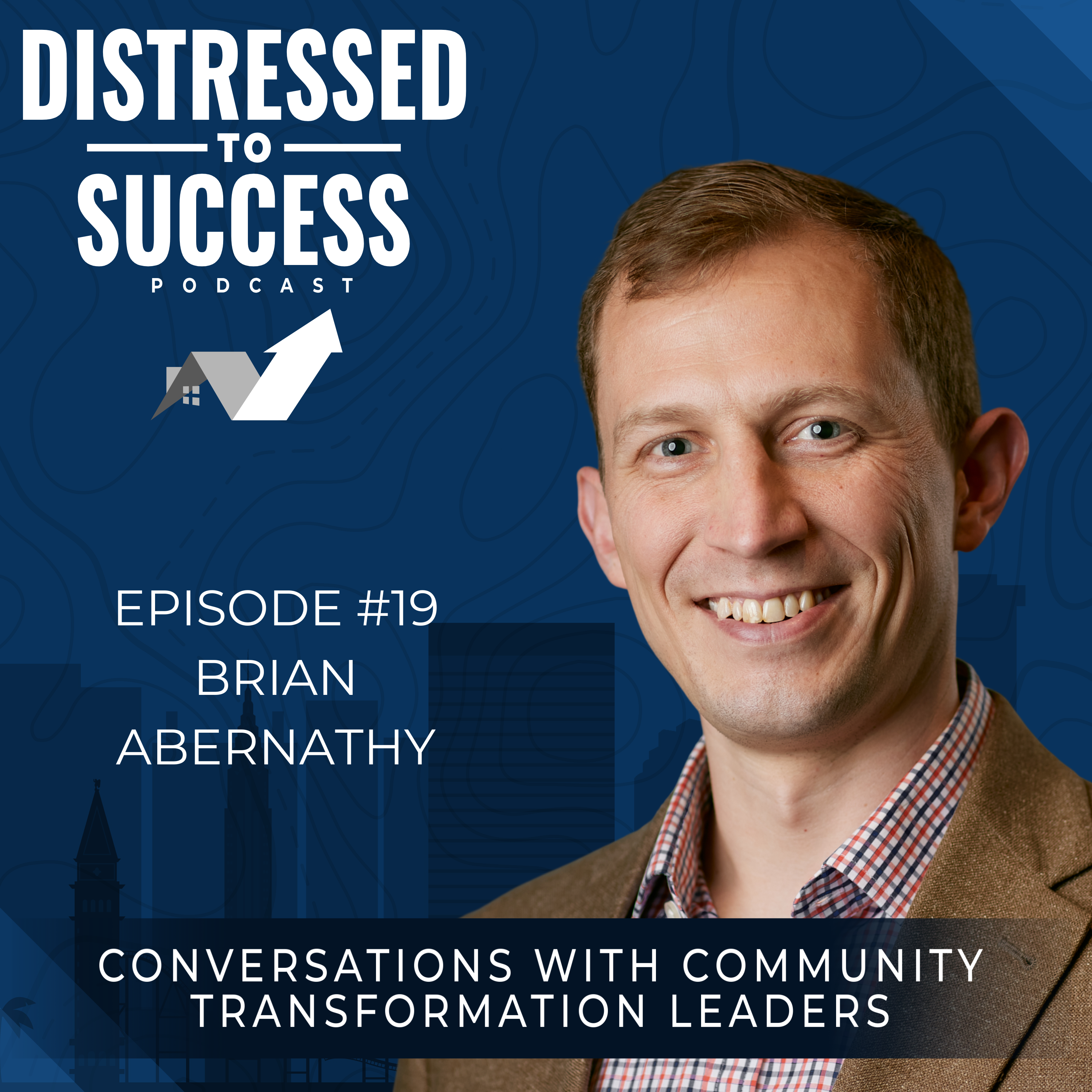
With us today, I was lucky enough to snag through an introduction, Brian Abernathy. And Brian is the general manager of Convergent. And we're going to dive into what Convergint does because it doesn't tell you by the name or to give it justice of all of the cool things that they do. But let me start with just. Brian, welcome. Thanks for joining us.
[00:01:37] Speaker A: Yeah, excited to be here and get to share a little bit about the really fun work we get to do for communities all across the country.
[00:01:44] Speaker B: Yeah. And for the listeners that have listened to previous episodes, maybe have heard Convergent mentioned on Mike Morfield's episode. Mike was, is from the, the thriving metropolis of Fort Madison, Iowa. But, and I say that with tongue in cheek because it's not a giant community, but such a cool project and seeing an asset of the community, what could be an asset of the community and, and making it reality. And that episode was all about a, essentially an arena and a restaurant and just a, A, a location that could be a, a place for the community to come together and really be. Become a destination as opposed to kind of a drive through or, or flyover community that, that I think is, is so common out there. But one of the things that, that Mike had mentioned there is, is working with you guys, Brian, and, and converging and helping that project come to reality. So maybe let's just start there and just. Well, actually, I'm gonna take a pause. I get so excited about it.
Let's give us a little background on. On you and how you ended up with Convergent and then a little bit about what Convergint's all about.
[00:02:53] Speaker A: Yeah. So I'm a Atlanta, Georgia native, born and raised here, which I think is increasingly rare here in Atlanta.
But after college I began working in the nonprofit space. Really fueled by love for volunteering while I was in college and started out doing youth outreach, did a little bit of education policy work here in Atlanta and then found my way into the fundraising and capital consulting space.
Capital campaign consulting space and roundabout over a few years in that industry. I found myself here with Convergint and so convergint and rdg, a Convergint company, is a national fundraising consulting firm and we focus on helping nonprofits of all types of access capital to advance the outcomes that are delivering value in their communities. So RDG is our corporate chamber, economic development focused arm. And then Convergent serves a wide array of nonprofits and other types of community improvement efforts all over the place. So it's been.
I learned very early on in my career, I'll say that the thing that I loved was finding ways to unlock potential and capacity.
And I didn't necessarily love executing on all of the different annual dynamics of nonprofits.
So it's been very, very rewarding to get to be a small part of projects like Fort Madison and so many others around the country and know that I'm able to use the talents and skills that I've got that our team has and help achieve things that really others are doing a lot of the hard, critical work. We're just getting them the resources to be able to go out and do that. And they may not have ever been able to do that otherwise. So we, we're not often identified in those projects, but we have our fingerprints on some very cool things all over the country, which is just a ton of fun to know.
[00:04:49] Speaker B: Yeah. And I guess I want to learn a bit more on those projects exactly how you guys work. But for those that are listening going, you know, what, what, what is Brian talking about or Brian's are talking about? And, and what, what I thought was so cool when Mike was talking about you guys, Brian was, I think it's pretty well known, right. Of nonprofits raising capital on projects, whatever that purpose is.
I had always assumed that that has to be self driven.
You need to go raise that capital. And when he mentioned working with you guys to help in that endeavor could open up a lot of doors. And I think the types of projects that come to mind fall squarely within, I'll say, the purpose of, of distress to success, which is, you know, trying to find these projects of potential or blighted, blighted areas of communities and really, and really turning those around. And, and the reality is, you know, a lot of times there's a, there's a, there's a funding gap, right? Because somebody's got to take that final risk, right? Banks aren't going to, you know, are going to say, hey, yeah, I'll give you 100% of that capital, go make it happen.
They always want to make sure that they're secured, right. And there's minimal chance of loss, right. And so, you know, that they will fund up to a certain amount, right. And then it's really, you know, upon the sponsor, right, Whoever was developing it to come up the rest, whether they are lucky enough to have the remaining, let's say 20 to 40% of capital that's required or they go raise it right, through investors or some projects involve a non profit branch, right? It's like, hey, this is going to be a, an improvement on the community. We can get more people behind it, you know, raise capital into that, into that nonprofit piece. And that's really where you guys come in, right? Is if the project is one that has that nonprofit component and has a significant capital raise and that, and the sponsor maybe doesn't have the network in order to make all of that come together, that's where you guys shine. Is that the right understanding?
[00:06:49] Speaker A: That's it.
You're spot on with that dynamic of, of what it takes capital wise to make a project happen. And we love the example of Fort Madison because you had really visionary leadership from Mike. You had some key corporate partners there that wanted to see their marina revitalized and they kind of ceded some capital, but recognized that there were some public grants and other things in the mix there as well. It was, I think, if memory serves, about a $13 million project. But then there was this piece that they didn't have covered. And so they brought conversion in and we went out and validated the objectives that they had with potential funders in the community and actually planted a consultant on the ground with frequency in the community who went out, engaged folks, made the direct fundraising solicitations, followed up with folks to answer their questions, help them feel confident about writing a check.
And not necessarily in that case, they had this in place already. But in a lot of cases it's a, what's the venue that, you know, whoever it is out there and community member can write a check to, That's a tax deductible dynamic. So we end up working with a lot of community foundations as well as venues to receive funds that then can be issued out to a municipality to close the gap on those capital projects. And what's awesome about it is that that little piece of extra funding is the difference maker in idea and reality. Right. And so you can't do 25, 30, 60% of a project in some of these cases. And so if you can't close that final funding gap, it just sits there and communities miss out on the value that could be present. And if that last little gap of funding were secured. And so in a lot of our projects, that's where we step in and help organizations, communities, cities, whatever it is, go out and find and secure that last little slice of capital.
[00:08:55] Speaker B: Awesome. Well, now for those that want to understand more of that, for Madison example, Right. You can go listen to the episode with Mike Moorefield, but help us help me, I guess understand a bit, Brian. Unlike some of the other projects that you guys have worked on or are working on working on today.
[00:09:15] Speaker A: Yeah. So one of the fun things about our portfolio is we are not sector specific.
Certainly chambers and economic development 501C6s are the most significant portion of our work.
But we beyond that work with all types of other nonprofits. And so thinking of the distress to success theme, we helped the Boys and Girls Club in a small town in Kentucky, raised the capital to retrofit an old National Guard armory that was a kind of cold war era concrete building. A difficult thing to tear down, but presented some very unique value for them, Helped them raise the capital to retrofit, operate that facility and have some endowment funding on hand for deferred maintenance and just caring for that long term.
We've helped YMCAs put new community amenities up, community and technical colleges, four year universities, honestly almost everything you can think of across the philanthropic landscape. We've got team members that have experience and relevance to step in and help those non profits elevate their fundraising. Sometimes it's a capital campaign, sometimes it's major gift strategy or an advancement infrastructure audit.
But we get to put our hands in some pretty cool projects. We've been over the past year part of a cancer center initiative, a charitable medical effort, several housing projects, higher education, independent private K12 schools.
So there's kind of this full spread of different types of Organizations leadership network. Cultivating and investing in leadership for future generations of, of a community.
So it's, it's kind of a all of the above approach to helping lead communities through pretty impactful projects.
[00:11:15] Speaker B: Got it. Okay. So as long as a, as long as it sounds like, right, as long as the project has a nonprofit branch and there's a need for, you know, capital to bridge that gap, then it's something that would quote, unquote, qualify. Right. For engaging, converging and helping in that endeavor. Is that accurate?
[00:11:36] Speaker A: Yep, that's pretty much it.
If you've got the. Every now and then we'll get the, you know, the high school soccer team that reaches out that needs to raise some money for uniforms. That's not quite the right lane for us.
No, no disrespect to the importance of those programs because I got kids that have to raise money for uniforms too.
But most of our projects are multimillion dollar initiatives, so kind of the larger scale for sure.
[00:12:02] Speaker B: Okay. Yeah, I was gonna say that's a very, very large net. And so there's gotta be some way of building a box around that. So is there like a typical minimum capital raise or anything like that that makes it a little more fit in the box, if you will?
[00:12:17] Speaker A: Yeah, usually the floor is around $2 million. There's certainly some projects we do that are below that.
But there's a, there's kind of a cost of fundraising paradigm to take into consideration there. And in certain cases there are smaller goals where the right scenario is there for the client, where we can still help them achieve that. But most of our projects right now are probably in the, I'd say the 10 to 20 ish million dollar range. Currently with, you know, the high end is up to I think 250 at the moment.
But then we've got several that are, you know, just, I say just, but just seven figure objectives.
[00:12:58] Speaker B: So those. So 2 million to 250 million. Is that, is that just the capital raise part of the project or the non profit capital raise that you guys are helping manage, or is that the total project size?
[00:13:10] Speaker A: So it varies actually. Different projects have different structures. So we have some projects where our goal objective is similar to Fort Madison, where we raise kind of that final piece of capital.
Then we've got others where we are looking at securing all of their capital need, or for certain types of organizations, what we would call a comprehensive funding campaign where we might be looking at capital, but then also growing their major gifts in annual funding along the way. That's much More historically thought of around larger institutional health care for your universities. Kind of the big, you know, hundreds of millions and billions of dollar campaigns. But the reality is those same practices are effective and accessible for even your, you know, kind of run of the mill nonprofit. And so we will scope to, in that sense, kind of whatever is appropriate and needed for our client organizations. Most of the capital we raise actually is not building capital. There's a lot of new program, startup, a lot of operational capital.
And then obviously there are avenues where physical and tangible capital infrastructure comes into play. But it's less significant in terms of the ratio of overall dollars that we're raising each year than people might think.
[00:14:31] Speaker B: So is it. So beyond just the initial capital raise, it sounds like you do kind of the ongoing capital allocation. I don't know you got a term for that, but is it.
Did I understand correctly that you also can help, I'll say, put together the full capital stack that includes the capital raise plus bank financing.
You help with all of that or just the capital raise piece of it?
[00:14:54] Speaker A: Yeah, we stick to the capital raise aspect. We have great strategic partners who are very, very well versed in building that capital stack. And so we come along them in some scenarios. We also come along clients in a lot of cases that already have that mapped out. But we specifically target what you might think of as philanthropic capital, whether that's individuals, foundations, corporations, whoever it is. It's that kind of, we don't like to say contribution, but that contribution type of capital. And the caveat there is we fundraise with what we call the investment driven model. And the idea is that really, regardless of what a nonprofit is, we want to present the rationale for a funder to think about an investment that's going to deliver a very identifiable value for them in their community. Now, it's a social roi. Most of the time nonprofits are not allowed to issue dividends.
But we want to change that mindset so folks are not giving away money.
They're investing their resources in something that's going to deliver a value that means a great deal to them. Maybe it's addressing access to housing or access to medical care or better education for kids or just a better pool for the ymca. Right.
All of those things deliver something that is worth the resource that's going to be contributed. So we always talk about investment versus charity or donation.
[00:16:28] Speaker B: Got it, Got it. And I think that's the right mentality. Investment. Right. There's going to be a return whether it's social. Right.
Or, you know, I'LL say it's. It can be a capital return to the community because it draws folks to the community. They spend money right at those facilities.
So it's, you know, beyond just the social feel good that you did something right, I think is a key aspect of that long term, you know, the longevity. Longevity of that project in general, I guess. Brian, this is an assumption, right? But I imagine, and maybe it's just the word isn't out enough yet, but I would imagine that you're getting way more applications for projects than you have bandwidth to support. Is that a good assumption?
[00:17:10] Speaker A: That's a very fair assumption right now.
[00:17:13] Speaker B: So beyond, you know, kind of the, the. The box, if you will, the net, which is pretty wide, right. You got to select the projects that you guys have bandwidth in supporting. So what is that selection process or how does that work as far as the application down to. Yes, this is something that you guys want to do.
[00:17:34] Speaker A: So we try to look at strategic verticals like I think any business would.
There's some markets where we're definitely the larger or largest player in terms of certain lanes of nonprofits, and then there's others where we see a lot of opportunity and we're not widely known. And so we do work very intentionally to press into these different areas where we want to grow, but also recognize that there are markets, chambers and economic development being the greatest, where we've got a great market share, and there's still so much more opportunity to serve organizations out there. And so we focus a lot on that market just because it's part of how we've become what we are as a company.
And then we also just very much believe that that investment mindset is going to help a lot of really valuable nonprofits that may be struggling with sustainability change their financial trajectory for future impact in their communities. And so there's some areas like Boys and Girls Club, ymca, Arts and Culture that we're very, very interested in, in growing in education being a big one of those as well.
And then interestingly, this public private partnership lane, similar to Fort Madison Marina, is a spot that we're seeing a ton of activity across the country right now of public sector leaders coming together, working across different avenues of leadership in their community to recognize amenities that are needed either to revitalize or ensure a future trajectory of vitality in their communities. But they can't fund it 100% with public dollars. And so they need to look at what are avenues to make this project work. We got four of those that were in various stages of conversation Right now, literally at all four corners of the country. So that's a space that we're, we're really excited about because I think it's going to make such a difference in these communities and also show a model for so many other communities to be able to do the things that could change their community that otherwise they might not have a pathway to.
[00:19:47] Speaker B: Got it, got it.
I don't know if you're, I'd say able or allowed to kind of dive into, you know, some detail, but I was, you know, I think three or four examples of the types of projects, you know, that are, you know, very different, but you guys have been involved in, you know, couldn't maybe help the audience, you know, better picture. Like is this, is this something that you know, would make sense for them? Do you, are you able to share some past examples or maybe current examples, three or four of them of, of that wide spectrum of things that you guys have been involved in and just some more detail on, on what the project was, what you guys involvement was, you know, what the capital rate or the, you know, the nonprofit piece was and, and so forth.
[00:20:26] Speaker A: Yeah, I'll speak with a little bit of maybe generalities around some of them, but we worked with an art center in Atlanta, county owned facility that needed some expansion of their programming. And so there was a really unique blending of county funding, institutional foundations, grant making, and then individual and corporate philanthropy to help bring that project together, which was a unique dynamic of timing those different revenue streams because appropriately so different higher capacity funders in different lanes want to know that others are committed.
And so timing and structuring. That one was particularly fun, I'll say legitimately in a very fun way. It was a great project.
We helped raise money to do a library. Right. To expand and enhance library services in a small town in the Midwest.
You don't think a lot, I wouldn't have thought a lot about raising money for a public library, but we've done that. Right now we've got a project that is philanthropic investment to fund an amphitheater in a public park to create a sort of uniquely tailored, missing size outdoor engagement community venue for a community.
We've got two communities we're talking to where public sector leaders are saying we need a performing arts center. We can't write the check as the county or the town for the performing arts center, but we want to see that happen. How do we bring others to the table to close that gap?
Another one that we're talking with right now, that's a waterfront development to take, I think probably fair to say underutilized and maybe a little bit worn out corner of waterfront to turn it into a highly valuable resource to attract people down to that waterfront to create community engagement. I would say probably some great talent attraction and retention dynamics. Just recognizing that with digital work a lot of younger talent wants to go work in a place or live in a place that they enjoy knowing that they can work pretty much anywhere.
So those are kind of the short list just bouncing around the top of my head. But I think we're going to see a lot more of all of those over the years ahead.
[00:22:51] Speaker B: For sure, for sure. I think what you're doing is in, I'll say, whether folks know it or not, it's in high demand. Right. As far as like there's a ton of communities and a ton of potential out there and typically the only thing stopping it is the funding mechanism. Right. And there's usually. Right. Somebody that'll provide a portion of it. The bank will always typically provide a portion of it. Right. It's just that gap. So anyway, I think what you guys are doing is just super cool.
Is there any, anything that we haven't touched on, Brian, that you think the, you know, audience would be.
Would need to know or should know about convergin as far as, you know, before they reach out? You know, here's. Here's some things to keep in mind.
[00:23:36] Speaker A: I would say the most, I won't say impeding factor, but the thing that tends to slow is clarity of multi.
Multi lane perspective on a vision. Right. So let me rephrase that in a way that might make a little bit more sense. Do you have the right stakeholders engaged in affirming the value of a project before you get out into the market with it? Public sector leaders, corporate leaders, key influential, kind of the matriarchs, patriarchs of a community, heavily philanthropic folks in the community. Right. Are you validating that there is a shared perspective of need for whatever the project is? What tends to slow a project or maybe even kill a project is just one voice for it that others aren't seeing the value. So get that community coalition, you know, whatever it is, whatever you want to call it, that cross sector set of stakeholders aligned.
That's where you really start to build consensus and create the kind of energy that's going to attract funding because you're going to need funding from all of the, typically from all of those different sectors for a project like the ones we've talked about to succeed.
[00:24:53] Speaker B: Okay. And that made me think of another Question, but he partially answered it. But like, when is the right time for folks to reach out? Is it after? It sounds like it's after. They really have most of the players, the community behind it. Right. The team basically made. Right. And then. And probably the bulk of the funding all squared away. And they really, they really just are looking for that last little gap. So when the. When basically the recipe is defined right, you've got the oven on. Right. And you've got all the ingredients. But the one. Is that. Is that the right time or do you guys get involved any sooner than that?
[00:25:26] Speaker A: Yeah. So we can certainly advise and love to have the opportunity to advise earlier on while that coalition may be getting developed. Just because we can give some guidance on fundability factors and how to set frame of reference for people around that table that, okay, there's going to have to be some checks written for this. It's not all coming out of, you know, a county budget, a or whatever the case may be.
But we like to come in typically to do a feasibility study. Right. And this is not different than most.
I'll say there's two types of feasibility. There's the market use feasibility study that if we build it, will they come dynamic, and then there's the will they write a check for it feasibility study. We're in the will they write a check for it study space.
And we take a plan that we like to say is 85 to 90% complete for what the project might be, a clear picture of the outcomes and the value that it's going to create in the community if it's completed, and a pretty good idea of the budget that may be the overall budget. It may be just the last piece that we need to close. But to show folks that, okay, they've thought about this, they're ready to put this cake in the oven, to use the baking analogy. Right.
We don't want to miss the party kind of dynamic. So we use that feasibility study to validate the plan.
Oftentimes we end up coming out of that and tweaking and adjusting some of the messaging so that it resonates better with a funder versus a developer or whoever else may have had their hands on that plan previously. We affirm the right leaders, the right influence that's going to go out and help galvanize support among key potential funders to get around the table for this project. And then, most importantly, we affirm the funding goal. So we'll come out of a feasibility study and give you a very. Give a client a very Specific high to low range of available capital.
And when we do that feasibility study and then go through and manage the full campaign, we got a pretty phenomenal field goal rate of landing in between that high, low range that we give.
And then we'd move from that study into campaign management at whatever scale is appropriate for the organization or community that we're working in.
[00:27:42] Speaker B: That's awesome. I guess brings up another question as far as how does Convergin, how is it funded? Is there a fee structure in taking on the projects? Is it funded totally separate?
How does Convergint fund all this great work that it's doing?
[00:28:00] Speaker A: Yeah, so we're flat fee for service.
The kind of governing body for the fundraising space, association of Fundraising Professionals frowns upon commission based fundraising.
And just personally we're generally raising money on multi year pledges. And so the idea that you're going to pay us a ratio of that when you haven't received the funding would be a poor business decision for our clients. So we're flat fee for service for the feasibility study and then monthly retainer on the campaign. And those are structured fees and level of our involvement very much tailored to each client's specific needs, what their team capacities are. You know, a four year university that's got an advancement office is going to have very different needs than, you know, a collaborative cross sector partnership that doesn't have any hired paid fundraisers on staff. Right. So one of the things that is very unique about Convergint is we can flex all the way down to that engagement with no fundraising professionals because we will actually be, we can actually be retained as professional solicitors. Most fundraising consulting companies stop at consulting, not soliciting. And so if needed, and actually in a majority of our projects, we are engaged to go out and proactively conduct solicitations on behalf of our clients. So functionally it creates a way to actually outsource fundraising process if needed.
[00:29:33] Speaker B: Got it. Okay. So you know, the flat fee, obviously there's a, which varies because obviously I'm sure the support required for $100 million project is very different than the $2 million project. Right. But that's probably why that floor is there. Because at some point it's like there's, there's a, there's a cost and then it starts to, to look prohibitive. Right. If the fee is more than, than the capital raise. Right. So. Okay, makes sense. Understood.
Excellent. Well, I'm gonna, I'm gonna. Before we kind of wrap up, there's one part of our podcast that I Totally took from another one of my favorite podcasts called Carve Outs.
And to give you a minute, I'll describe what it is and then I'll go first, Brian. But essentially it's, it's anything that, that you have come across that could be a quote book product that you've recently purchased that you're a huge fan of.
Mine actually has absolutely nothing to do with anything we talked about today. It was actually at my, my mom's house recently and, and they had a brio smokeless fire pit.
And it's, I guess, a lot of reasons I like it. It's American made. It's, you know, heavy gauge steel.
And I know my wife is not a huge fan of the smoke when the kids and I bust out the campfire to do s'. Mores. And so we were sitting around in my mom's house and fired this thing up and it was like kind of an aha, epiphany moment of, oh, this could be a way of actually being able to have s' mores and not have a smoke filled house. And so for anybody that doesn't have a fire pit or loves fire pits and looking for something that, you know, helps in that, you know, that realm, I ended up buying one. We're going to bust it out for the first time here over the holiday and excited about it. So anyway, there's my car vow. Brian, what's yours?
[00:31:36] Speaker A: Yeah, mine. The thing that comes to mind right away for this is not anything necessarily new, but it's, it would be the book of Proverbs. So for probably 20 plus years, if you're not familiar with the book of Proverbs, there's 31 chapters that just pretty well aligns with the number of days in a month. So the past couple of decades, I start my day in the mornings reading a chapter out of Proverbs. And it seems every day for 20 years, there's some new nugget of wisdom that I pull out that I feel helps me be a better leader in business, a better community member, a better husband, a better father, and just be smarter in things that I do every day. And some of my favorites are, you know, who would have thought that King Solomon wrote about social media? But there's a proverb that says he who meddles in a quarrel, not his own is like one who grabs a passing dog by the ears.
Hey, it's just smart to maybe not pull on everything that we see come across our feed. It might just save me some stress.
So that's just been a really life giving and encouraging practice for me day by day for, like I said, a long time.
[00:32:46] Speaker B: That's awesome. I guess one of the oldest books of wisdom that is still very applicable today. That's excellent. Yep. Brian, I immensely appreciate your time. And for anybody that's listening that would like to reach out to you in Convergent, what's the easiest way to do that?
[00:33:01] Speaker A: Yep. You can go to convergent nonprofit.com and there's a contact Us form there that will get you in touch with our team and can pass you straight along to me if needed.
[00:33:10] Speaker B: Excellent. Well, thank you again, Brian, and thanks everybody for listening. And we'll see you next time on Distress to Success.
[00:33:16] Speaker A: Thanks so much.