Episode Transcript
[00:00:00] Speaker A: But if you think people are homeless because they've run out of relationships, you can't ignore any aspect of who they are as people.
[00:00:07] Speaker B: It's a very different perspective than, like you mentioned, the, the standard, right, is the, the housing program or the, you know, the job, you know, program.
[00:00:16] Speaker A: And one of our churches built a relationship with him by hiding lunches in a dumpster. And so we were just not gonna, if, you know, we had everybody else indoors, we were not gonna leave him outside. And one night he said yes. And he's been housed for three years.
[00:00:33] Speaker B: This podcast is for informational purposes only and does not constitute financial, legal or investment advice. Please consult a professional advisor before making any decision based on what you hear on the show. Welcome everybody, to another episode of Distress to Success.
This is where we're talking to professionals who are helping reinvent I say, blighted communities in a profitable way.
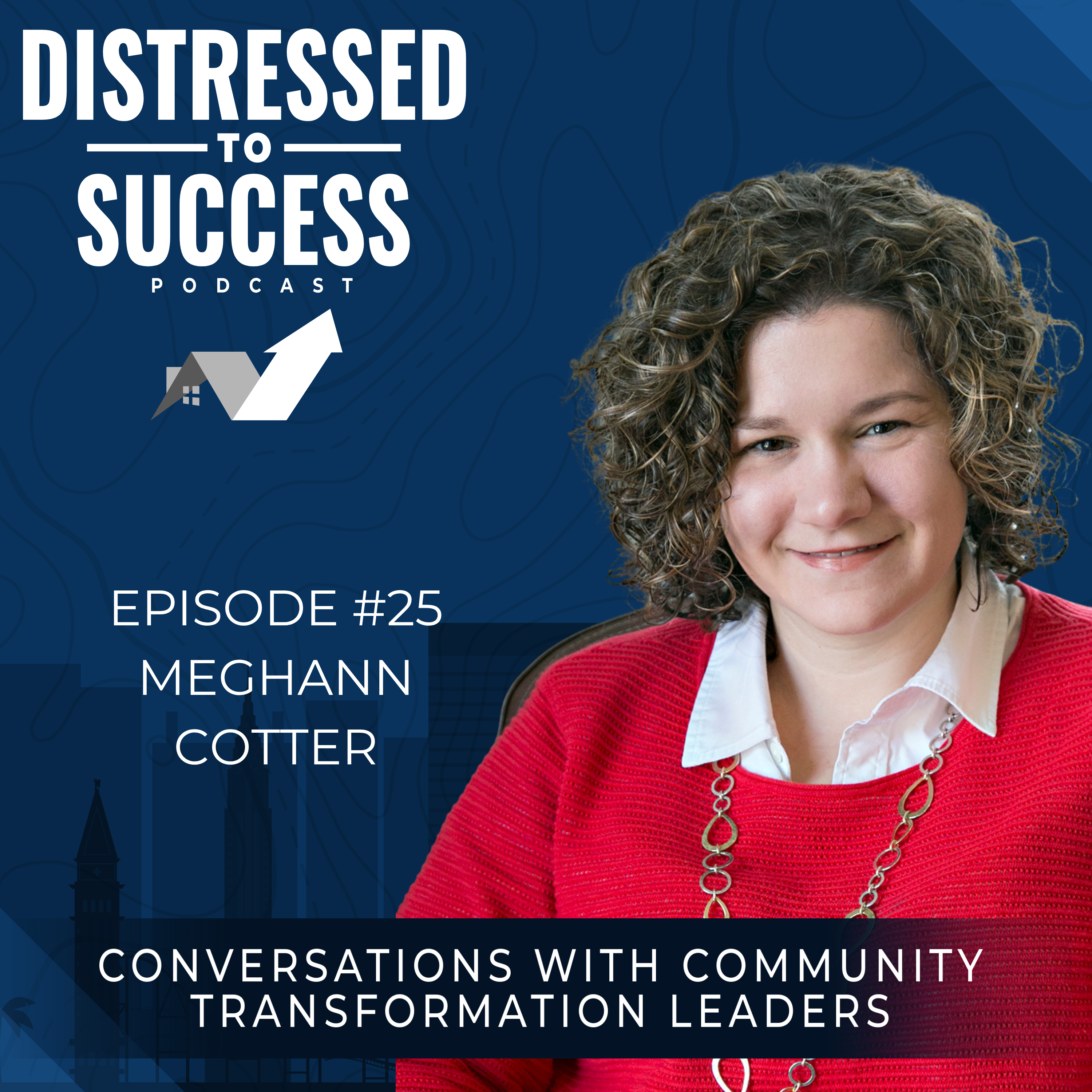
I was lucky enough to snag some time from Dr. Megan Cotter and she's the executive servant at Mica Industries in Fredericksburg, Virginia. It's a mouthful, Megan.
And, and really I was introduced to Megan by another friend in the space and, and really learned a little bit about, you know, the project Megan that you were working on with Jeremiah Community. And anyway, I'm excited to dive into it, but let's just start with, you know, thank you for joining us.
I'm glad you're here.
[00:01:27] Speaker A: Sure. It's my pleasure.
[00:01:30] Speaker B: Well, without getting into the really fun stuff and all the questions that I have based on our initial conversation help get us up to speed, I guess. How did you end up becoming an executive servant at Micah Ministries and give us a little insight into what led to the Jeremiah Community Project and just I guess a little bit of your background, how you got here.
[00:01:57] Speaker A: Yeah, sure. So I have always, I come from a very service minded family.
Caring for people on the margins has always just been a part of my life.
I was going to change the world as a newspaper reporter and that was the.
I went to college for that. I graduated. I worked at a news local newspaper here in Fredericksburg for a little while right out of, out of college.
But I always had this kind of tug for something more, something different. And was at a season of my life that I was looking for how I could do that beyond writing stories about what other people were doing.
And I actually went to look at a, a program or an opportunity out of the area and I got off the metro with my mother and she looked at me and said, Megan, you can do all these things in Fredericksburg, very much self servingly she wanted me to stay in Fredericksburg. But it was kind of a Mother Teresa moment for me in a way that Mother Teresa says, you know, there are Calcuttas everywhere and go find yours.
And so it was kind of this kind of turning point in my life where I said, you know, I really, you know, I love the community where I live and there are people who I could make a difference in their lives right where I am. And so I actually was working with. I grew up in what is now the Mica churches. There's a group of nine downtown churches that came together back in 2005 to care for the unhoused community in Fredericksburg. And I was helping them write some grants and do some things to get started. Started at the time. And so after that day with my mother, I came home and I poured my heart out in an email to one of the church pastors.
And he called me the next day and he said, well, Megan, we're looking for an executive director. And within a month, I had left my job. I had this complete different path in my life and came to work at MICA with a budget that was barely enough to pay my salary and I was the only employee. And.
And today we're almost a $4 million organization. I have a staff of 30. And so it gives you a little bit of an idea of how much has happened in the last 20 years.
[00:04:25] Speaker B: That's awesome. That's awesome.
[00:04:29] Speaker A: I guess.
[00:04:29] Speaker B: Tell me a little bit of that journey of.
It sounds similar to.
I spoke to a gal, had her on the show. She's from a little small community in, I think, southeastern Iowa who, you know, the four counties came together, created this, you know, the economic development, you know, leader, you know, and similar. Right. No budget. Hey, we've got enough together to cover your salary. Right. And then, you know, all the, the cool things that she was able to put together. And it sounds like, you know, going from, you know, very small, like no surplus budget to now you have 30 folks, 4 million dollar budget. You can do all these great things with that. That. Can you tell us a little bit about that journey and what that involved?
[00:05:12] Speaker A: Yeah. So, you know, in my worldview, you know, God calls people who are called not necessarily qualified.
And I was certainly at 24 years old, I was, I was a whole lot more called than I was qualified. And. And I think that was very much the story of the downtown churches that created the organization that I work for as well. But, you know, all they knew about the unhoused community In Fredericksburg was that there was a need. They were all each doing different things, but they believed that they could be more together than they could apart.
And I believed that, you know, whatever was nagging in my heart, you know, that I could help with that. And that was about all I had to start with.
And so we.
I really believe that our journey has been very much.
I look back at a lot of the things we were doing in the beginning, which were very much ministries that helped people survive on the street. I very much believe that they were incubators for all the other things we needed to learn and needed to do.
And so we had a winter shelter and we had a day center. And those were just places that people came on a daily basis from for relief from living outdoors. And what happened in those spaces is some pretty profound relationships that taught us that we needed respite care, that we needed income development, that we needed to be creative about housing solutions, that, you know, we needed to pay attention to the spiritual needs in their lives in some pretty profound ways. And so if you look at our organization today, you see all the different ways that we've worked to care for all parts of human flourishing, and survival is a part of that. But survival has led us to being really a whole lot more of a community than we are a program.
[00:07:17] Speaker B: Interesting.
I love the terminology you're using, calling versus qualifies. Right.
You had a vision, the ability to see all of these pieces of the puzzle, and you went about figuring out how to put those pie together and into what you refer a community, not these individual services. Right.
So what are. What are all of those. When you say community and all of those things that come together. You mentioned some of those. Right. Is there. Is there kind of like a menu of here's all the things that make up that community today?
[00:07:51] Speaker A: Yeah. So, I mean, we call it the bicycle wheel.
And really, because if you line up the different things that people need, it's the things we all need. It's the things that when we look at our own lives that, you know, we need a place to live. We need something to do. We need to be able to earn money. We need people who care about us. And, you know, it looks a lot like the social determinants of health, which is a huge aspect of just how the human service world is beginning to look at people as complete whole beings, rather than what we've done for years is look at, you know, that, you know, if you're. That there's different places to go for jobs and housing, whatnot we think the better we can kind of consolidate those things in one place, the easier it is for people with complex needs to be able to access those things. And so, you know, our menu of support really is kind of the conditions of human flourishing, and they're not unique to homelessness. They're the things we all need.
And it's just we've created it in the image of the people that we're caring for so that they can access it in a way that oftentimes is a lot more difficult.
[00:09:07] Speaker B: What.
What is. Like, what are some of the. I'll say, keys to you? The. The success that you had? Like, what are some of those moments, right, or epiphanies or connections that you made along the way that really helped those pieces of the puzzle, you know, come into place? Maybe easier or faster or it's fit better.
Are there any things that fall into those categories in your mind that. That, you know, it's like, hey, you know, you didn't know it going into it, but when you saw it was like, nope, that. That's a key, key component.
[00:09:44] Speaker A: So I would say, you know, for, you know, the first decade and a half or so of.
Of this ministry that we have developed, I think we did a lot of the traditional things, sometimes I call them the social worky things.
You know, we stepped into all the tangible needs.
But I think it was around 2018 that we really began to become aware of the. Really, the secret sauce to what we were doing was relationships. There is nobody that is walking through the doors of Mica Ecumenical Ministries in Fredericksburg, Virginia, that is struggling any different than people in our own families, our own friendship circles, our own communities do on a daily basis. But not all of them become homeless.
The difference for people who end up literally on the street is that they've run out of relationships, that the relationships have broken down. Sometimes the. You know, if you think about kids aging out of foster care, sometimes they never had stable relationships. You think about some of the senior adults, sometimes they no longer have any family left. I mean, there's all sorts of different reasons.
And that, to me, is one of the places that society has really broken down around. Its perspective on homelessness is we blame the people. We blame the.
We develop. We lean into our stereotypes, and we forget that they are just people who are struggling in the same ways that people in our lives do every day. The difference is how friends and family are able to step into their lives and support them. And I think that fundamentally changes the perspective on homelessness. I think it Changes how we respond. If you think people are homeless because there's not a house, then you're going to create a housing program. Great mission. If you think they're homeless because they don't have a job, you're going to create a job program. Great mission.
But if you think people are homeless because they've run out of relationships, you can't ignore any aspect of who they are as people, and you have to show up to them as friends and family do.
[00:12:03] Speaker B: It's a very different perspective than, like you mentioned, the standard. Right. Is the housing program or the job, you know, program what, along the way, right. I think if you were. If somebody else wanted to kind of repeat the success that you've had, right. And say, hey, we want to take the Micah ministries approach. Right. If you could package it up in a. In a.
In a box, right. And say, hey, you know, this is. This is this. These are the key components of repeating that success that you've had.
What. What would that look like?
[00:12:42] Speaker A: That's such a really interesting question. And I'm getting that a lot more these days because we're getting big enough that people are starting to notice what we're doing. We're doing some innovative things, and there's even a group of churches to the north of us that has even been kind of studying what we're doing and trying to repeat what we're doing. So I've had to wrestle with this a little bit, and I think, you know, the biggest mistake is to, I think to look at what we're doing as a, you know, as a program plan, like a logic model. A. You know, you've got to be able to get past the.
The infrastructure of the organization to really understand what it is we're doing.
And.
And the number one thing is, is to be able to see the people right where you are and spend enough time with them that you know what they need. Homelessness in my community certainly looks different than it does in your community or anybody else who's listening in their community.
And it's really important to be able to listen and learn from the people. A lot of times you got to start with something, and that something for every community, I think is different. For us, it was cold weather shelter and a place that they could get showers and mail.
For another community, it might be something different.
But whatever that conduit to relationship is being able to lean into whatever that space is and learn from the people within your midst and listening to them and really having relationship with them is, I think what's going to make people successful.
[00:14:15] Speaker B: So is it truly the people. Right. That make the organization that you built? It's really the. Yeah, you say relationships. Right. And I guess that's the key. Right. You can't have relationships without the people.
And so it's the people that are, I guess, in the program, but also administering the program are really the driver of that success.
[00:14:35] Speaker A: Yeah.
So like, to make it a little bit more practical, then just go have relationships with people.
The model that we follow is called Christian community Development.
There's eight principles that go with that. And I think if people need a model to follow, it's that.
And the important thing within that, like listening, is a key principle to Christian community development.
They call it relocation. I call it proximity. How are we in proximity? How do we share space as an equal with people?
Changes the dynamic of the, of the conversation. How do we approach people on the margins with the idea of reconciliation?
How do we redistribute resources in a way that equalizes? So there's all kinds of different, different strategies by which I think we can approach problems in our community.
And I think you can apply that with any community. But particularly for me, I think one of the biggest things that's missing in the homeless conversation is more of a community development approach where we actually see people on the street as a neighborhood in and of themselves and participate meaningfully in their lives such that we can create solutions that.
That really work for them.
[00:16:10] Speaker B: Got it, Got it. Well, one of the things that you mentioned the very beginning. Right. It was just highly impressive, you know, building the organization from.
From really no budget right now. You got a four and a half million annual. I'll say budget. I don't know if that's the right terminology, but program.
How did you. Where did that funding come from?
How did you build that community and find the capital in order to make that happen?
[00:16:37] Speaker A: Yeah, everywhere.
So much like a traditional nonprofit, we, you know, we panhandle for our salaries. Not literally, but figuratively.
So we do a lot of fundraising.
You know, we're not a heavy event driven organization. I think that's been a good thing.
We have deep relationships with donors and I think one of the things that has made us successful is the wide relationships we have with the faith based community. Community.
One of the things that I really appreciate about.
About my.
About the way Micah is structured is your traditional nonprofit doesn't necessarily have that platform.
And I say that when I need to get a message to people, I not only have my traditional nonprofit things like our newsletter Our social media. I have churches who have bulletins and pulpits and other relationships that I can get that message out there in a much wider way. And to me, the number one way that a nonprofit is successful is telling the story.
And so we have this wide audience of people that we're able to tell the story to. And that, in a really interesting way, has created a movement of sorts that has allowed us to. To really get people excited and proud of how people are cared for compassionately in our community.
And maybe even my example of that is for years, we never had an event until about five years ago, and we started something called Coldest night of the Year. And it's an event that is done all over the country in different cities, but ours has been. Even the first year we did it, we raised the most money and had the most people in the entire country.
And I think it's a testament. And we've done that now four years in a row.
We're headed into our fifth year and gonna hold our record.
But I really think it's a testament to how we've been able to get the community behind what we're doing and how we're doing it. And then in addition to that, we do all the traditional. We write grants, we get state and federal grants, we have local grants, we have private foundations, we have all sorts of different ways that people have come around this. And so being an organization that has an identity as the Church of Fredericksburg has allowed us to additionally have a platform of people that understand the mission in a really unique way and we're able to share our story, and then they share our story as well.
[00:19:25] Speaker B: Let's see how when you get. I see it over and over. Right. Is if you can get the community behind the purpose. Right. If you have a purpose and people can get behind it, it's amazing what can be accomplished from, you know, the Micah Ministries. In your example. I, you know, I spoke to a gentleman who, he was an electrician in a town, saw an old abandoned dock right. Essentially on the river and in Iowa, you know, but because he had the purpose of redoing it all. And now it's an amazing location that people can come to. And it wasn't just him.
[00:19:55] Speaker A: Right.
[00:19:56] Speaker B: It had to be everybody in the community to come come behind him and make that happen.
What, on that journey. Right. And the grants and all that that are obviously successful. Was that all done internally? Was there any, like, third party resources that you guys, you know, utilize that, you know, others could maybe utilize as well or anything? Like that.
[00:20:21] Speaker A: I mean, I think grant writing wise, I mean, I think, you know, I'm a good writer and I think that's served me well in this role, both from a grant writing and storytelling perspective.
You know, we brought in a consultant recently to help us with our capital campaign, but that's really the first third party resource that we've brought in in 20 years. I mean, other than that, I think the greatest asset we've had is being able to tell a good story, whether it's to a foundation to our community.
You know, I can't really think of anything like external that we've brought in. However, I will say, in our world, we're part of a couple different associations that, I mean, we're always learning, we're always trying to find new ways to and find peers in the industry that can help make us better.
We've been very involved in the national alliance to End Homelessness. There's a Christian Community Development association that we're heavily a part of. That's been good in how we approach this work from a values perspective.
We've recently gotten involved in the Stand Together foundation, which is another large community foundation, national foundation. And then we've looked. We're always trying to study what other people are doing and take what we like about what they're doing and build it into our model. The Community First Village in Austin, Texas has been a huge mentor for us as we work to build our own supportive housing neighborhood.
You know, and there's others and peers that we've created across the, across the years.
But you know, fundamentally it's been the relationships we have and having somebody to be able to pick up the phone and say, hey, I'm having trouble with this. You got any other ideas?
Has. That's really served us well.
[00:22:22] Speaker B: Having that community back to that community.
I think that's a great segue into, you know, the community that you're talking about, Jeremiah community. Right. And that the, the housing, I'm gonna say it's definitely a project. Right. It's. It's more than just a small project. So maybe let's dive into that a little bit. Megan, can you tell us more about the Jeremiah community?
[00:22:45] Speaker A: Yeah, so I mentioned it was around 2018 that I think we really began to shift our understanding of what we were doing. And it really stemmed from that understanding that people become homeless when they run out of relationships. And when you believe that as we came to, it means that you have to function a lot differently. You have to think differently about, you know, how what you're how you're approaching the problem.
And we had a pandemic, you know, there in the middle of it, that, you know, additionally kind of complicated that journey. But it also revealed new things to us, like, you know, what it was. We actually had enough money coming into our region for two and a half years that we were functionally a community where no one had to sleep outside.
And. And so we learned a lot from that.
Not only that most people who live outside will come in, but we also learned how very much, when people have small spaces and the ability to have on site support even when they're living in one place, the beautiful community that can come from taking an asset that oftentimes gets ignored when people live on the street, moving it indoors, giving people a key and their own space, and working to make that a healthy community rather than one that lives very haphazardly and in survival on the street.
And so we were inspired by a couple things.
During the pandemic we had, you know, at this point, I call him the parable of our city.
But we had a man named Jeremiah who was a graduate of North Stafford High School, which is just to the north of Fredericksburg.
He was an army veteran.
Somewhere along the way, he was affected by schizophrenia, and he ended up homeless on our streets for 27 years.
And one of our churches built a relationship with him by hiding lunches in a dumpster.
And eventually he would come into the community meals. We helped him get Social Security. And we made a lot of progress with him over the years.
But when we had everybody else in a hotel during the pandemic, he would not come in.
And so we were just not gonna. If, you know, we had everybody else indoors, we were not going to leave him outside.
And so we actually rented a house. And every night for six months we went and asked him if he would go into it. And one night he said yes. And he's been housed for three and a half years and so.
And so. And he's. He's doing very well and exceeded every expectation that we ever had. And so we kind of got, you know, you know, an ego about us and said, well, we can house Jeremiah. We can house anybody.
And we became really interested in what is kind of happening across the country right now, which is more of a neighborhood style of supportive housing, which sometimes it looks like tiny homes, sometimes it looks like modulars. It looks differently in a lot of ways. But the important thing is it minimizes shared walls.
Instead of putting people on top of each other, below each other, beside each Other, which can be difficult for people overcoming trauma and other behavioral, mental health issues and whatnot.
The neighborhood style of supportive housing allows people to be in community when they want to be, but also have their own space and have the support that they need right in the place that they live and not be affected by others. And so we worked for about eight years. Now we're getting to the point, we're actually about to start site work, but we worked for about eight years to find land, get it rezoned, pull all sorts of different partners together. And we're very close now to being able to.
To kick off Jeremiah Community, which will be a supportive housing neighborhood right here in Fredericksburg.
[00:27:00] Speaker B: And how.
I just want the listeners to understand the scale of this. We're not talking of a couple right. Houses.
Explain the size of this, Megan.
[00:27:10] Speaker A: Yeah, so we're approved for 189 units.
Within that is an 80 unit apartment building that will be built by a different partner. But the other 109 units will be small homes and duplexes.
And the duplexes are actually even created such that it minimizes the shared wall. The porch is on the side and, or the porches are on the sides and the mechanical things are on the shared wall. And so right now we're in the midst of a site plan for the first. For the first 80.
[00:27:46] Speaker B: Wow.
So what, the budget of this has got to be pretty massive, I would imagine.
I don't know if those are numbers you can share, but that's a different level of raising capital. Right. In order to fund this, is it all through donations at the end of the day?
What does that look like to make this happen?
[00:28:10] Speaker A: Yeah, so we're in the middle of a seventeen and a half million dollar capital campaign and that will fund the first 50 units. We're starting smaller because we just have a lot to learn about kind of getting this off the ground. But we're going to start with 50 homes, a community center and seven years of operating cost.
And that is really with the idea that, you know, we're working with folks that can afford about $300 a month and be able to live well. And so we've got to be able to keep rent low. And so we have to get operating costs from other sources rather than relying solely on the rent to be able to operate the community.
And so the, the, we have raised about 12, a little over $12 million towards that.
A lot has come from private sources. We've gotten some congressionally appropriated funds, Federal Home Loan bank of Atlanta, some larger Grants.
But most everything else has come from private foundations, goodwill of the community and otherwise.
[00:29:22] Speaker B: Wow.
[00:29:23] Speaker A: Wow.
[00:29:23] Speaker B: That's, that's an immense project to take on. It's really cool. What's the, what's the timeline look like as far as when you're hoping to I guess start digging with shovels and have the 50 units up and running?
[00:29:37] Speaker A: So we actually were, we're actually about to kick off more of the public phase of our campaign here in a couple of weeks. We're building a prototype of the first house and the builder partner that's working with us is actually going to build it in 72 hours and then we're going to have a big celebration here here soon.
But all things considered, we should be able to start site work in November is the goal. And then over the next year, ish. We will be getting the property ready, going vertical and you know, my personal goal, I'd love to see people moving in before Christmas of 2027.
I like the sound of that.
But you know, maybe even as early as 2028.
[00:30:22] Speaker B: That's awesome. So that's the first phase, right? Is there like a elongated timeline of like how you're gonna make all 189 units come together?
[00:30:32] Speaker A: Yeah. So the, you know, I think we will, we will probably start focus on the, that first phase. The for the next two, three years and somewhere in there we'll start kind of working on the, on the second phase. The second phase is heavily driven by the partner that I mentioned.
Support Works Housing is another supportive housing developer in Virginia.
And there's a lot of other supportive services that will be on that second phase. There's going to be a 10,000 square foot health center that'll not only serve our community but some of the neighboring communities around us that which are also lower income neighborhoods. There'll be a workforce development center, a chapel and some other things. But so I would say for us to, you know, the, for us the focus right now over the next two to three years is really going to be on that first phase.
Other partners will be coming in here very shortly and starting to do some things on that second phase. And so I think a lot of it, it'll end up happening in tandem but, but it, you know, some of that's up in the air right now.
[00:31:46] Speaker B: Very cool. Well, it's a very cool project.
Amazing concept, obviously. Amazing people, amazing person. You, Megan at the helm, helping bring everybody together. I'm sure it's. You're, you're like many leaders out there, right? It's you're just having to be in that position. It's really about the whole team. Right.
Such a cool story.
We're, we're kind of at the carve out stage of, of our episode Megan. And just as a reminder everybody, you know, some, some random thoughts and gems of knowledge that we can you know, share with the, with the audience and what might my takeaway that has maybe nothing to do with with this episode.
My gem of knowledge for the day is actually reading or listening. I guess I say read a book. I haven't actually read a book like a legit book in many years. Seems to always be listing but I have younger kids, I have a, a kindergartner and a fourth grader and, and was recommended to to listen to Anxious Generation which is a amazing book that talks about like the effect of what social media had on, on Gen Z and, and what parents right as myself can can do to to. To. Maybe not you can't prevent it entirely, but you can at least be prepared for some of that.
You know, introduce things at the right time in the right way and help folks learn how to adapt to that new, this new world that we have.
And it certainly opened my eyes not only to social media but now we're dealing with AI and what does that mean? Right? And where I think feel like we're we're in the same timeline with AI as what you know, parents were looking at with social media in 2007, 2008, you know, they really didn't know what it was going to do to the point where like my, my, I've kind of caught my 4th grader asking AI what she should wear for, for, for the day. Right. And on one hand it's like okay, that's kind of funny. But at the other hand it's like, you know, we gotta watch that because if it gets overboard and nobody's actually thinking, you know, to, to come up those answers themselves, boy do we have some scary scenarios with people really relying on a robot essentially to make those daily decisions for us. So it's been eye opening for me. Long story short, so highly recommend everybody that has kids or not to check out Anxious Generations. A great book, Megan. Hopefully I gave you enough time to think of a gem of knowledge from your end.
[00:34:22] Speaker A: Yeah, that's so interesting. I kind of think about AI that our generation probably thinks about it like our parents thought about the Internet. So we'll hope it's going to go well.
[00:34:35] Speaker B: Yes.
It's going to be a change no matter what. Yeah.
[00:34:41] Speaker A: You know, I don't have a whole lot of like, excitement in my life outside of the things we've already talked about.
You know, I'll tell you, I'll give a plug for the guy that founded Community First Village in Austin and is, you know, has written a book called welcome Homeless and with the less scratched out, essentially welcome Home. But it's a book of stories of relationships that he's had with people over the years of they started as a food truck ministry and evolved into what's now, you know, a pretty massive supportive housing neighborhood in Austin that is on CNN and, you know, 60 minutes and that kind of thing all the time. And it's really genuine, real book about a lot of the stories that really highlight into the humanity of people that live on the street.
And so until the day, I sometimes write my own book, I'd recommend that people look for that book. And it's really an easy read. It's very engaging and it just gives people a different perspective on homelessness that I think is really worthwhile.
[00:36:00] Speaker B: Welcome Homeless and by who again?
[00:36:04] Speaker A: Alan Graham, who is the founder of Mobile Lives and Fishes in Austin, Texas.
[00:36:09] Speaker B: I'll definitely check that one out. Sounds like a great one.
And I would implore you to write your book, your story and how you created this amazing organization. Probably many books you could write, Megan, but how it all came together would be an amazing story to to listen to. Megan, I immensely thank you for your time and education and insight into how you're able to bring this all together, how you're able to make Jeremiah Community a reality and definitely wish you and your organization excitement and luck in bringing that all together. Sounds like it's coming very soon, so thank you.
[00:36:48] Speaker A: Thank you so much. I appreciate it.
[00:36:51] Speaker B: Good luck, everybody. Again, the gems and knowledge and some of the key points will be in the notes below and we'll catch you on the next episode.