Episode Transcript
[00:00:00] Speaker A: I've been in economic development for 20 years now and I started with a development district here in Nebraska, working with the EDA Economic Development Administration funding. When you do economic or community development, collaboration and relationships is probably some of the most critical pieces to that.
What's really exciting about this is we'll have high school students from multiple schools, school districts coming in and utilizing it, whether it's on the manufacturing or the medical side. So putting high school students and adults in the same facility at the same time, and then the complexity of multiple school districts using the facility for dual credits or certifications, it's really exciting.
[00:00:54] Speaker B: This podcast is for informational purposes only and does not constitute financial, legal or investment advice. Please consult a professional advice advisor before making any decision based on what you hear on the show.
Welcome everybody to another episode of Distress to Success where we talk with professionals who are helping reinvent blighted communities in a ultimately a profitable way.
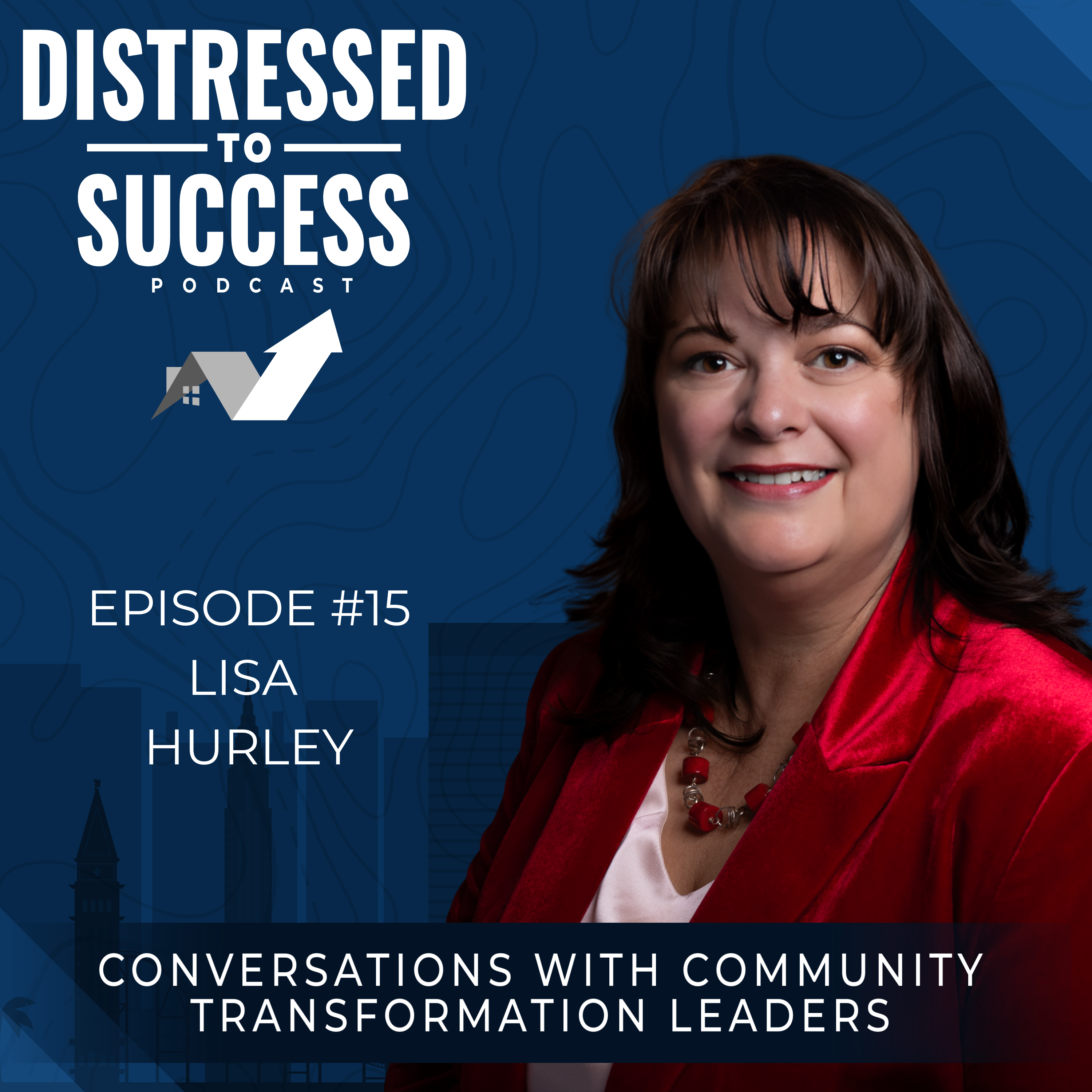
With us today, I was lucky enough to snag somebody that really has a lot of influence on the redevelopment of communities and Lisa Hurley, who's the executive director of the York County Development Corporation.
And it's the York county out of Nebraska. I think there's many York counties out there. But anyhow, Lisa, thanks for joining us.
[00:01:37] Speaker A: Thank you for having me on, Brian. I appreciate it.
[00:01:40] Speaker B: I'm very, very excited to dive into this is with I guess as much detail as we can in a 20, 30 minute segment. I'm sure we might end up having a series of these, but it's always awesome to kind of get insight into how things work.
Not necessarily the other side, but like on another big chunk of what typically has to go into making some of these projects a reality. And obviously you have that insight into, I guess all more of the pieces of the puzzle that all have to be put in place to make it happen.
I guess before we kind of dive into that level of detail, maybe just a little background. Lisa on and I guess kind of how you came into this role, you know what, what being the executive director of York County Development Corporations is all about and we'll go from there.
[00:02:31] Speaker A: Yeah, I can do that. So I've been in economic development for 20 years now and I started with a development district here in Nebraska working with like the EDA Economic Development Administration funding, the Community Development Block Grant funding.
And through that I went through the Economic Development Institute and eventually took my test with the International Economic Development Council to become a certified economic developer. But I moved to York in 2013, so I've been here 13 years now and it's fun. I kind of touch everything in the community from housing to talent to small business to industrial.
There's no one day that looks alike. I mean last week I was in D.C. this week it's small Business Economic development Week and tourism week.
[00:03:36] Speaker B: So lots of events, a little bit of your hands in, a little bit of everything.
[00:03:41] Speaker A: Yeah, it's fun.
[00:03:43] Speaker B: Jack of all trades, expert at none. Is that the right way to kind of think about it?
[00:03:48] Speaker A: Yes, yes and no. When I started, you know, you went maybe a mile deep on lots of topics.
Now because of the complexity of issues, you, you almost have to go many miles deep. I mean, electricity has changed.
Thirteen years ago, child care we weren't touching and now we are because for a business to have an employee, they have to have a bed to sleep. So they have to have a house. And if they have kids, they have to have either a good school or a childcare provider. And child care, for those of you who may not be familiar with it, it's really kind of a broken business model. They are. Child care providers don't make a lot of money and our parents are cost burdened with childcare expense. So it's a double sided sword.
[00:04:47] Speaker B: Yes, that's a hard one. And really the toughest part is it really is a very critical component. Right. Of our future.
It's just a, yeah, definitely a. I like big juicy problems to solve. We're probably not, we're not going to solve that one today.
That's definitely a big juicy one to, to, to look at, you know, down the road for anybody that, that likes to solve problems as, as much as I do, that's listening.
Well and I, I believe when we spoke before, Lisa, the York County Development Corporation had already been set up when you came on board. Accurate. So what are you able to provide any insight into, like how, how would one go about setting this up if they wanted to do so in, in a community they're familiar with?
[00:05:39] Speaker A: So I would say do your research, reach out to community members around you. You know, you may not have one in your community or your county, but somebody in your region or your state does.
One of the recommendations I give everybody is either committed a funding raise enough funding for three to five years to hire somebody that's experienced and have program costs because doesn't matter how experienced they are, if all of their money's going towards the salary, they can't do their job.
Or you hire somebody that's local and you have the training budget to get them trained within the Field. I mean economic development. I know people who have come from marketing, from the nonprofit world, from media, from government.
It's real estate. There is up until the last five years, there was no degree in economic development.
People just found their way to it and fell in love with the field.
I will tell you that the majority are set up as public nonprofit partnerships. You'll have some government funding in and you'll have some private sector funding going in.
And that is preferred over staff person at city or county.
The businesses tend to trust that a little bit more.
But you do have to have a very close relationship with the staff and elected officials in your community as well.
[00:07:25] Speaker B: So you mentioned funding available not only for the salary, but the programs. Right. Actually have an effect on community development.
I'm sure this varies wildly depending on the size of the community. But what, what are those types of programs? Like, what is the type of funding that needs to be available, you know, at really for that person to be able to utilize?
[00:07:49] Speaker A: Well, if one of your first things you're going to do is a strategic plan, your region may have somebody. Mine does. Nebraska Public Power District does strategic planning for free to communities within their their service territory.
There are plenty of organizations. You may spend 20 to 100,000 for that strategic plan. Depending on the level of depth that you're going in.
That strategic plan is going to give you your priorities.
So let's say you are going to hire somebody to focus purely on small business development.
You may want to set up some sort of investment plan.
So maybe you do a forgivable loan program up to 20,000 and you're going to do 10 of them a year. Maybe you don't. Maybe it's all just technical assistance.
So the strategic plan is really going to drive your budget.
Part of it is you need to put marketing dollars in. If you're looking at bringing in outside investment, whether that's families and professionals, individuals coming in, or that's businesses.
So marketing's not cheap. I mean, if you're going to do 10,000 a year, that that's not a law. If, I mean you can pay, you can spend over that on one ad in a newsletter that has digital outreach with it.
So if you decide you want to do a housing revolving loan fund, you may just raise $1 million locally and then you revolve that into projects and that becomes part of what the person does.
Working with partners on getting those loans approved and packaged and going out. So that could be a program.
We offer a tool on our website that provides data to small Businesses. So the website could. Depending on where you go, that's a fright. That's a huge. I mean, I've seen them for 5,000, I've seen them for 40,000 a year. So it just.
Some of this depends on what resources you're using and all the plans you're going. But the tools that we use for it to provide data to small businesses, I want to say that's like six or $7,000 a year for the modules I'm using.
[00:10:33] Speaker B: Okay.
[00:10:34] Speaker A: But I've had In the last 12 months, over 2,000 reports ran by my. And I'm a county, 14,500.
So 2,000 reports ran in the last 12 months by small businesses entrepreneurs.
Maybe somebody that hasn't even started their business yet, but they're in the brainstorming phase that has resulted in over a million dollars in savings to our small business communities on those entrepreneurs.
So you, you don't have to do everything yourself. There's technology that can provide resources that you can embed on your websites.
But that technology costs money.
[00:11:21] Speaker B: Right. You gotta have funding in order to add the tool. Right. So yeah, you have salaries, obviously, you've got marketing dollars. Right.
For multiple levels. And then you got, know, funding to actually execute on, on some of these, these programs. And I'm sure the programs. Right. That are out there vary wildly, but obviously the more capital available, you know, the better. And then is there as far as like finding the capital that to support these, you know, you have private donations, you have public funding to some degree. Right.
I'm assuming these are set up. Right. As I'll say a nonprofit off. It's a 501C3. Right. But then that makes them available to or ability to go get federal grants, etc. Is that accurate?
[00:12:09] Speaker A: Yes, we are set up as a 501C6.
And that gives me the ability to be able to advocate on legislation.
[00:12:20] Speaker B: Okay.
[00:12:21] Speaker A: A513, they have to stay completely neutral.
And my organization, whether it's at the.
We don't do it at the local level, but whether it's at the local, state or federal, we can take position.
Some people do have a sister 5013, so they can go after the grants. There are some grants I'm eligible for. It's a lot fewer than a 501.
[00:12:52] Speaker B: Got it. Okay. But 501 requires it to be neutral.
[00:12:57] Speaker A: Yep.
[00:12:57] Speaker B: Interesting.
[00:12:59] Speaker A: We do partner with our York Community foundation sometimes for grant opportunities.
So there's partnerships. I mean, when you do economic or community development, collaboration and relationships is probably some of the most Critical pieces to that.
[00:13:20] Speaker B: Yep, absolutely. Because ultimately multiple parties got to work together here, right?
[00:13:25] Speaker A: Yep.
[00:13:27] Speaker B: Speaking of which, I guess maybe we'll dive into some of the, some of the types of projects that you've worked on, you know, in the recent years or maybe still currently working on. But what are some of the more memorable, you know, projects that you, you may have or still working on that, that you think are going to have, you know, the, the most impact or, or maybe just the most memorable in general over the last few years.
[00:13:48] Speaker A: One of them, the name is Clutie K L U T E When I came to York county they were one building, they're out in the country and they had just shy of 40 employees.
They work in the electric supply system so they're actually building poles to help build out our grad and our substations and they just crossed 200 employees.
[00:14:21] Speaker B: Wow.
[00:14:21] Speaker A: I've watched this company, they're still family owned, but go from, you know, a small family owned company, one building that wasn't completely. And they've been under expansion constantly for the past 12, 13 years and they now have three huge buildings out on their facility. They have gone from no automation to a lot of automation and robots and it's been really fun to watch them grow and see how they evolve. And when you're in fast growth mode there's going to be some hiccups and pulling resources to the table for them.
They are one that I really enjoy watching.
Another one that I think is going to have tremendous long term growth is our York Regional Learning, York Regional Workforce Development center.
That's in partnership with our regional high school, our school districts and Southeast Community College. We will be building, we're starting small but it will be over 20,000 square feet.
It will have the allied Health services, so like CNA, med techs, radiology technician, your LPNs will eventually be able to get to the Associate of Nursing. So that will be on one wing along with our learning center which is other classes and then we will have our manufacturing and automation wing. So what's really exciting about this is we'll have high school students from multiple school districts coming in and utilizing it, whether it's on the manufacturing or the medical side, being able to do their lab time at the school, maybe do some classes there and be able to go back to their home community and work in the hospital to get their clinical hours. The same facility will also be open to, open to adult learners. So let's say you're, you didn't go on for any post secondary Education and you want to get your welding certificate or you want to get your associates in one of the many welding automation, whatever it is, you'll be able to do that here as a 20 or 25 year old, or you're in your 40s and 50s and you want to change your career, you'll be able to take classes here in York and be able to go work for one of our companies.
So putting high school students and adults in the same facility at the same time and then the complexity of multiple school districts using the facility for dual credits or certifications, it's really exciting.
We're hoping to break ground depending on winter. Winter, how early it comes.
We're just going to say spring of 27 because you never know how early or late winter's going to come.
[00:17:51] Speaker B: Yes, yes.
So on a project, I want to come back to Cootie because I have some questions there too. But on the project like this,
[00:18:00] Speaker A: how
[00:18:00] Speaker B: does it come to be?
Is it, I'll say, the brainchild of you and the economic development center? Is it somebody externally that came and said, hey, the community has these needs, right? We have a lack of expertise in these.
I don't know, I'll say career paths, right?
Or you know, we have, we certainly have a need, right? Or I'll just boil down, is it a third party that comes to the to you guys and says, hey, I have this idea, I need help, bring it to fruition. Or is this an idea that you guys had, you know, directly and then are putting all the pieces of the puzzle in place?
[00:18:37] Speaker A: I am going to say this has been very much a collaboration. We started back in 17 and this was already an idea for more like a career academy, which would be just high school students or an adult learning. But we put together a manufacturing partnership and actually in 2018, Southeast Community College did a manufacturing boot camp in partnership with this. But when we put that manufacturing group together, we were very strategic. We put the superintendents, we put the high school and the post secondary education people in the room, but we were in the background and we were trying to let the manufacturers lead the way on the discussion. It ended up being very beneficial during COVID because when you're working in the same industry, sometimes there's a little bit of hesitancy to work together because you don't want to lose employees to the other one.
But building those relationships has allowed us to identify those skills that go across every type of industry.
But honestly, this goes back farther from when SCC Southeast Community College was putting learning centers out in the communities, because as a college, they wanted a facility within 30 minutes or 30 miles of everyone in their footprint. And we were able to land one of those here. But we wanted it bigger. We wanted the manufacturing side added to it.
We weren't able to get it done. So we've probably talked about this well over a decade, but the vision of it, myself and our superintendent have seen across the nation a couple of examples at conferences where you bring the high school students and the adult learners together, the lifelong learners.
[00:20:55] Speaker B: Okay.
[00:20:55] Speaker A: And that took a little bit of pushing here. Our manufacturers loved it because they can work with the high schoolers, have them on the field, maybe bring their staff into the facility where. And they can't bring them into their.
Depending on their insurance and their state laws, they might not be able to bring them into their facility and have them actually work on those machines until they turn 18 years old.
[00:21:21] Speaker B: Okay.
[00:21:22] Speaker A: So this is an educational environment. So they'll be able to learn all the different types of welding. And there's many while in high school.
[00:21:33] Speaker B: Right, right. On the job training without having to go to the job, which is the best type of training, in my opinion.
So it was a community college that kind of had this concept of these local learning centers.
The initial attempt of trying to pair that with manufacturing, that didn't necessarily work out, but the, the percolating right on the back burner of that idea and concept, and you guys attending, you know, conferences across the country, seeing these other concepts, and then eventually having that epiphany moment of, oh, here's, here's how we can make it all come together. Right. And a decade later, you finally have a path that's moving forward.
[00:22:18] Speaker A: It's moving. Yeah.
[00:22:20] Speaker B: That's awesome.
[00:22:22] Speaker A: We've been in fundraising mode. We've been through the feasibility study over the last two years, and we will be moving to the architect and engineering phase within the next couple of months. And if we're really, really lucky, winter comes late and we can get the foundation done this fall, but it will probably be spring.
[00:22:45] Speaker B: It's a cool story to see the. The long term vision or the initial idea that was never forgotten, and then that vision eventually evolving into something that's much more. Right. And becoming reality.
[00:22:57] Speaker A: And, you know, 10 years later, it was kind of two ideas. Initially a career academy, which is high school, and then the learning center, which is adults.
[00:23:07] Speaker B: And trying to mesh that all together.
[00:23:09] Speaker A: Yep. Yeah, yeah.
[00:23:11] Speaker B: To pivot a little bit. Right back to the cloudy. Right. Which sounds like the amazing story of corporate growth. But curiosity like so how did. How did.
How did the York County Development Corporation, like, fit into that growth? Like, what did. How did you guys work with them in order to enable that?
[00:23:31] Speaker A: Lots of conversations.
We were able to.
On one of their expansions, we connected them with our development district that serves southeast Nebraska and got some revolving loan funds for them at a low interest.
So we helped them through that process. And then on another one, the state of Nebraska has a program called. It's a site and building development program.
And the local EDO has to be the applicant and the reporter. So review all the documents and report out to the state, draw down the money based on invoices, and pay it out to the company.
So one of the expansions we've done that. We've also worked with them very closely in our manufacturing groups, and now they are sending their employees through Dell Carnegie programs, and we've partnered with them. They're getting the base number of employees, and we're opening it up to the community.
So other businesses in the community, through our partnership, can do a Dale Carnegie program. Whether it's their basic skills focused on communication and stress and stuff like that, or it's their management program. We're doing the management one once a year. We just finished our first one, and then the basic one every twice a year, two or three times a year.
[00:25:10] Speaker B: Got it. Okay.
[00:25:11] Speaker A: And so they're kind of opening the doors to the community for community involvement.
[00:25:16] Speaker B: That's awesome.
So was it, you know, so you have a business, right? It sounds like a small business that was growing. Right. And then was it. Is Cloudy the name of the company? Right, Sorry, Yes. So did Clootie come to. To you guys and say, hey, I've got, I've got.
I'm making money here. We need to grow. I need some help growing. Or was it like you guys reaching out to them and saying, hey, here's ways we can help? Was it a mutual thing? How did that work?
[00:25:46] Speaker A: Part of being a local economic developer is having a business retention and expansion program.
So some of that, that surveys some of that, you know, a coffee meeting, a drop by, it's various touch points, and it's all about building the relationship.
So when they have an opportunity or.
A challenge, the typical swat, we're there to help, to help connect the pieces.
So I don't remember if they called on the first one or if it was just something that came up through a bre.
I mean, we check in regularly, and if they need something, they let us know. Or they.
I might get a call. We've Also seen somewhat of a succession, not a complete succession, but the third generation is now the CEO president. But Kim and Steve are still very involved. They're just kind of letting Jordan take over and lead the reins with their guidance.
So that's.
I can't say that they picked up the phone and called because it takes building that trust first.
[00:27:07] Speaker B: Right.
So it's, you know, sounds very much like a. Hey, you know, the, the, you know, Community Development Corporation was set up. Right. And part of it is this, you know, ongoing business retention and growth.
[00:27:21] Speaker A: Yes.
[00:27:22] Speaker B: Probably resulted in some conversations with those business owners over the years that eventually was like, hey, we could do this.
And probably got.
I'm definitely throwing all sorts of assumptions.
Probably got turned out, you know, 99 times in that hundredth time. It was like, oh, that sounds interesting. Let's try that. Right?
[00:27:40] Speaker A: Yeah.
[00:27:41] Speaker B: And, you know, the growth probably would have been there either way, but in my experience, working with outside parties that know how to make some of those. Make some of those things happen, that company grew, you know, exponentially faster. Right. Because of the resources that, that York County Development Corporation could bring to the table. Right. As far as connections and programs, et cetera. You know, ultimately, it sounds like training their, their new employees that are coming in the door. I mean, all of them, but a good, good chunk of them. Right. So they're better trained, more equipped. Right. Ultimately, better, better team members. Right. That help the, the business grow that much faster in the long run.
[00:28:21] Speaker A: And to that point, you know, in our meetings where we have our businesses and our educators, that has led to some interesting conversations over the years. And when you see businesses saying, we're seeing this, this and this initially, there can be a wall up because, hey, we don't teach that in school.
Well, school evolves. Education evolves.
We might not have taught cell phone etiquette at one point in time.
[00:28:52] Speaker B: Yeah.
[00:28:53] Speaker A: But schools tip.
[00:28:54] Speaker B: Are now you're confronted with the question, right.
You allow them, what is your policy? Right. It's definitely not a thing when I went to high school.
[00:29:04] Speaker A: Me either.
[00:29:05] Speaker B: I think when their cell phones were starting to become a thing toward the end of my high school. But it was a hard. No, just cell phones. Right. That's how they addressed it. Right. And you could only do that for so long.
[00:29:17] Speaker A: Another thing we do is manufacturing tours on National Manufacturing Day.
And so I've done in a broad number, but Clooties has. We've been there probably three times over the last 13 years.
So they get connected with students that way as well.
[00:29:37] Speaker B: Very cool.
[00:29:38] Speaker A: And so does Collins Aerospace and Cyclonaire and Corteva and the rest of them.
[00:29:46] Speaker B: Yeah, well having that connection is, is key. Well it sounds like a, I don't know a critical piece of the, of the recipe was you know the going back to the educational center right. Of you know, the idea and then it, you know, the idea percolating for many years and then going to these, these conferences where ideas can further expand. Like what are you doing? What am I doing? Right. Those conversations that exist.
[00:30:14] Speaker A: Absolutely.
[00:30:15] Speaker B: What are, what are some of those conference that, that take place right. At a state or national level that maybe folks that want to set something up like this that they could seek out in order to participate in.
[00:30:27] Speaker A: So I am a firm believer in being at the table.
So I, I do my southeast Nebraska development district, I'm on their exec committee. So that's at the regional level. And then at the state level we have the Nebraska Economic Economic Developers association which I'm also a board member of because be at the table and it impacts, I'm on the legislation committee as well.
And then at the federal level you have several options.
One that's near and dear to my heart is the National Rural Economic Developers Association.
And if you're in a rural area that is one you probably want to look into.
We do monthly webinars like I said we were just in auto DC fly in. So the real issues white paper, we have two events every year. Our regional workshop which is in Marysville, Ohio in June and that's very, very reasonably priced. And then our annual conference is in Salt Lake City in November.
They're just, they're a great cross pollination because you have utility people in the room and you have local economic developers in the room and then you have business consultants that are working with both of us.
So it's, it's unique from that standpoint. And then if you're in either rural or metro you got the International Economic Development Council which has many committees and I'm on one of those as well. But IADC is another one to look at. They have a lot of best practices out there. A lot of webinars conferences.
I would say if you're just starting, you've got to plug into your state and you have to plug into your state group.
[00:32:28] Speaker B: So basically you spent some time on Google, you know, seeing what if there are regional development corporations. Right. And state level. Right.
[00:32:36] Speaker A: And then yep.
[00:32:37] Speaker B: The rural one. If you're a small town, what is the, do you think there's any sort of. I'll Say minimum on the size or population sounds like, you know, where you're at is not huge race at 14,000, you know, which is not a, not a metropolis, you know, level city. Right. That supports this obviously is incorporating it as a massively successful way. But is there kind of a minimum size town or, or area like hey, if you can't capture at least this much, you know, general population, you know, make the net wider. So instead of a, you know, instead of a town, make it a region. Right there any. Were there any kind of regional or big there like that?
[00:33:22] Speaker A: Regional is big. No matter what your population is, you want to be in a.
Being part of a regional area.
In York county we decided 30 years ago to go York county, we, we have several communities under a thousand.
I have met at nreva a part time economic developer that was her community was probably around a thousand.
Here in southeast Nebraska we have a community that's, I want to say about 200 that just hired a part time economic developer. They're not able to be as impactful at that level unless there's a family in the area that really wants to see movement and can help kind of provide that seed funding.
Yeah. Because you got to have some safe money. And like I said, it can't be just a salary.
I would say communities my size, you should have an economic developer.
You know, our largest community is about 8,400.
So you should have an economic developer if you want to grow and you want your towns to be there in a couple decades.
[00:34:44] Speaker B: Right.
Which is a. I'll say hits me personally because I come from Montana, which is full of many small towns that were small when I was growing up and then today they're turning ghost town. Ish. Right.
They are part of it is probably natural. I don't know how you prevent it entirely. But also because they don't necessarily have any group like you know, a community development corporation that's ultimately looking to. How do you keep all this together? How you keep the. I think of one small town I, my mom still lives in but you know, lost its lumber store, lost its, you know, post office, lost its gas station. All these things that.
Because there, I don't believe there's anybody, you know, at a region, even a regional level in that part of Montana that is looking out for those things and how do you keep these things in place.
But it doesn't take, you know, a population of a million. Right. In order to, to make these things have impact.
[00:35:43] Speaker A: No, it doesn't.
It takes determination and the willingness to play the long game and to be at many tables and not to let the naysayers and those afraid of change stop the overall momentum. Because there are people that don't want to see their community change. And what happens then is they start going backwards.
[00:36:10] Speaker B: Right. Which is hard.
[00:36:13] Speaker A: It is. Because you don't want your community to die either.
[00:36:16] Speaker B: No.
You mentioned.
Are you from New York county area?
[00:36:25] Speaker A: I'm a transplant. I'm actually originally from Crete here in Nebraska and moved a couple of times and came here for the job.
[00:36:34] Speaker B: Okay. So somebody from the York County Development Corporation obviously sought out. Right. Hey, we need somebody else to come in here and take it over. And there's obviously avenue in order for newer community development corporations to seek out that type of help.
[00:36:51] Speaker A: Yep. There are.
For those that are kind of, you know, in between, looking for a new executive director or, or CEO president or just a business development person, there are many companies that will do a search for you.
[00:37:13] Speaker B: Okay. Okay.
[00:37:15] Speaker A: But a lot of times the executive committee on your state association might know of somebody that is looking for their next opportunity.
[00:37:25] Speaker B: So for anybody listening out there that wants to start their new one. Right. You definitely have many gates to go through, but there's your place to start, I guess. Before we kind of wrap up. Lisa, is there any. Any other.
I don't know. I'll say words of wisdom that you wanted to share with the audience related to starting or. Or, you know, keeping. Keep growing their, you know, community development?
[00:37:53] Speaker A: I would say don't give up. You know, community and economic development is a high burnout rate filled.
It can be very stressful when you have people that don't want to see change and it's got more political over the years than it used to be. But don't give up. If you have a passion for your community, whether it's a volunteer or it's a professional, keep at it.
You can start very, very small.
You know, you have an empty building downtown.
Ask the owner if you can do window displays.
You can start that small. And that requires nobody's permission and no official organization.
I mean, you can get a group together to go clean up your park or your courthouse square.
So there's things that you can do as a volunteer to kind of get momentum going, but stay passionate, stay dedicated. There's all sorts of authors, all sorts of resources, but stay engaged, don't give up and be at the table. Can't make an impact if you're not at the table.
[00:39:13] Speaker B: That's. That's a fact. Well, I hear. I heard don't Give up multiple times. So would it be accurate to say you, you've definitely had the thought of why am I doing this? A few times. But ultimately always, you know, are, are there because you're doing something that has purpose and impact in your community which talk about gratification when you see those things come to fruition, right.
[00:39:34] Speaker A: You know, the first manufacturing company I landed, seeing it open the door four years later and my, one of my son's friends, fathers getting a job there, talk about personal gratification. I mean that was just, that brought it full circle.
[00:39:54] Speaker B: Absolutely. But since you opened that door. So to understand correctly that you got an outside manufacturing company to come into the community, which is part of what you do, obviously, you know, created, you know, jobs locally which resulted in, you know, family. Right. People that, you know, you to get a job locally, you know, it's pretty cool. Huge impact.
All right, Lisa, so I talked about this the beginning, but we're going to dive into the carve outs here.
And just for the listeners, as a reminder, we're basically abandoning the whole topic about community developments. We're going to share some insight and in some of these carve outs that as a personal gems of knowledge. Right. For you all to hopefully take back to your personal lives. I'll give you a minute to think about and I'll go first, Lisa, but my, my carve out today is I start, I recently started, I'll say trail running. I, I don't know if running is the right word. It's, it's fast walking, running every once in a while.
But what it, what is certainly highlighted is I'm, I'm no longer in my 20s and I would, you know, the next day would be about as sore as I could be. And somebody else suggested these collagen peptides that, that you can, you know, just basically dump a scoop in your water. And my Lord, is it, is it made those, those stiffness soreness, you know, not entirely eliminated, but no longer like feeling like I'm 90, 90 years old for a couple days.
And so for anybody else out there that, that you maybe is a little sore after, you know, some, some significant exercise, you know, check out collagen. I'm not going to mention the, this is an advertisement. There's lots of companies out there definitely do your research. But I can tell you, you know, from my experience, it takes a few days, but it certainly certainly makes an impact.
So there's my carve out for the day, Lisa. Hopefully I gave you a little time to kind of think about what yours is.
[00:41:59] Speaker A: You did. And I'm actually changing mine from where I was going to go.
[00:42:05] Speaker B: Oh, you.
That's okay.
[00:42:07] Speaker A: Well, I have started when. When you travel for work, every once in a while you have a little bit of a break. You know, a half hour here, 45 minutes there, something like that, between meetings.
And I used to, you know, I've done the magnets, I've done the coffee cups, I've done the postcards, you know, for things coming home.
I have started recently using ChatGPT to see if there's any local artists. Not big ones, because I can't afford the big ones, but tell me there's a gallery where I get that within walking distance where I can pop in and out without 20 minutes. And I am trying to bring in what I'm calling travel art.
Whether it's a little bowl that's made by that I pick up at a marketplace or it's a photo or something like that, just to remind me when I'm at home of all the wonderful places I've been able to see.
[00:43:15] Speaker B: That's awesome. Yeah, it's kind of.
[00:43:16] Speaker A: Yeah.
[00:43:17] Speaker B: I've never.
I use CHAT GBT for a lot of things, but I've never used it for that, you know, specifically. But that's a really, really cool concept. You know, a sidebar here. You mentioned, you know, things that schools are not doing that, you know, but school needs to evolve. And I'm open. Pandora's box. But I'm realizing how AI is not implemented in our local schools here and teaching in any way, shape or form. In some ways, I feel like they're trying to dissuade use of it.
Like, that's not real. You can't use. And in reality, right from an employer's perspective, all I'm looking for is people that are utilizing these tool. It's a tool, right?
[00:43:59] Speaker A: It is a tool.
[00:43:59] Speaker B: It's a, you know, if you. Why spend 10 hours doing something when you can spend 5 minutes asking a tool that can give you 90? It's not a perfect solution, but can give you 90 of the solution, and then you can go fill in the gaps. And that's certainly a. A place that, you know, I'd say schools today are lacking most of them. There's probably some out there that are embracing it.
[00:44:21] Speaker A: But, you know, our education service unit, which covers, I think, five or six counties, they have somebody that is very comfortable using AI and she trains the teachers.
[00:44:33] Speaker B: Oh, wow.
[00:44:33] Speaker A: And the administration on how to use it. I mean, from recipe to a class plan.
So that's kind of been fun to watch that start to trickle in the last three years.
But I heard a saying many times over the last few weeks, last couple months, AI is not going to replace our jobs.
We're going to be replaced by people who know how to use AI better than we do.
[00:45:03] Speaker B: Yeah.
[00:45:04] Speaker A: So you've got, you've got to keep up on AI figuring out how to use it, however that looks, because it's going to continue to evolve. It's not what it was six months ago. And if you only touch it every, every once or twice a year or you're not using it at all, you are falling behind.
And I guess here's another nugget for you.
[00:45:29] Speaker B: I like it.
[00:45:30] Speaker A: So I have challenged my staff as they're becoming more efficient at their jobs with the use of AI let's go back to our strategic plan. And within their job description, what more can we do that's within our strategic plan?
[00:45:49] Speaker B: Ah, use more.
Make those go further. Right. Have more.
[00:45:53] Speaker A: Absolutely.
[00:45:54] Speaker B: Progress.
Well, that's.
That's awesome. Right. From what and I. And it'll be very interesting to talk to you in a couple of years and see what that has had. Well, I immensely appreciate your time today, and I'm sure everybody listening is. Is going, whoa, what is this all about? It's got my wheels turning. And certainly we'll have many questions for another day, but thank you again.
[00:46:23] Speaker A: Absolutely. Thank you for having me, Brian. You have a great week.