[00:00:00] Speaker A: The marina being of Eyesore, now a featured part of the community.
[00:00:03] Speaker B: They recognized this potential asset and all the potential that was there, worked with Michael to say, hey, he's one that can help bring it together.
[00:00:10] Speaker A: We designed the program as a nonprofit, would be the registered modular builder to sell the houses, but they would contract with Iowa Prison Industries to train the men, tools, transportation, deposit for rent things to help them get them on their feet so that they can continue the path they want to.
[00:00:29] Speaker B: This podcast is for informational purposes only and does not constitute financial, legal, or investment advice. Please consult a professional advisor before making any decision based on what you hear on the show. Welcome, everybody. I'm Brian Seidensticker. And this is another episode of Distress to Success where we talk with professionals who are helping reinvent blighted communities in a profitable way.
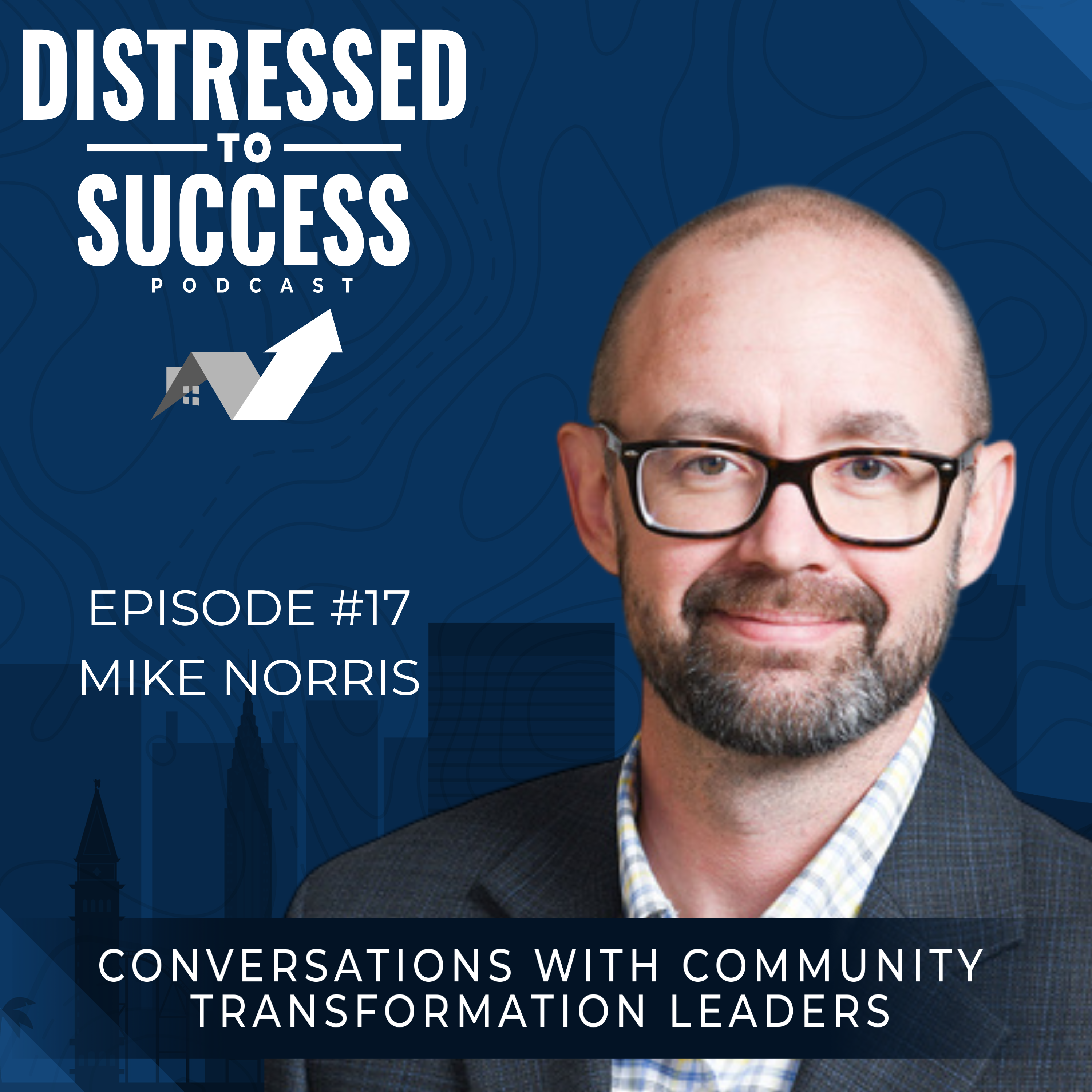
Today I was lucky enough to snag some time from Mike Norris. And Mike's the executive director of the Southeast Iowa Regional Planning Commission.
And for anybody that's listening that's wondering, what the heck does that do?
Stay seated and we'll dive into that here shortly. But Mike, I really appreciate you joining and welcome.
[00:01:12] Speaker A: Brian, thanks so much. Great to be here. Looking forward to our conversation.
[00:01:16] Speaker B: Yeah. Maybe before we kind of dive into your background, just kind of high level, what does the Southeast Iowa Regional Planning Commission do?
[00:01:26] Speaker A: Well, great question. And there's regional groups like us all across the country.
I would break what we do down into two parts. We're either running a regional program such as public transit, a housing trust fund, revolving loan funds, transportation planning. Those are all programs of ours. Or we're doing a consultative service under a contract. So the way we were formed was through four of our counties, came together under agreement, formed the commission, and then things kind of developed from there from the 1970s through today. So during that timeline, we've accumulated different programs, but really we were anchored early on by the Economic Development Administration as an economic development district. So we, we've grown since then.
So now we've extended into housing, transportation, planning, mapping, grant writing, grant administration.
And so in a way, we're kind of mechanics of local and economic development both to kind of plan for, to repair it and to design some of those things. So I think some of those themes will hopefully come out in our conversation today.
[00:02:45] Speaker B: Yes, yes. Well, yeah, before we dive into that, maybe help us better understand kind of how did you fall into this?
I'm assuming you didn't grow up with childhood aspirations of, of running this, but I guess how did you end up being in this space.
[00:03:01] Speaker A: Well, I attended the University of Iowa after growing up in a small town in central Iowa. And like a lot of people in college, I kind of hit a crisis where my initial plan was not working out. And fortunately, I realized that and was looking for a different direction. So walking on campus one day, I noticed a sign for urban and regional planning. And something about the word combination really struck me. And so I called the phone number. Okay, this is in the. In the late 90s. We're not doing, like, DMS or anything like that.
And had a meeting with them, and it just seemed exciting. And it fit kind of how I.
How I thought about things and things I was interested in. So I ended up being a geography major and really looking into planning. So I got internships in Iowa City. And then things just kind of started falling together and feeling really like I was in the right spot. So ended up getting a master's in urban and regional planning. And I applied a lot of the things that I noticed and enjoyed growing up to kind of fuel, you know, what I would do in the future. So, for instance, when I was a kid growing up, you know, I always liked alleyways. And I thought, you know, why do we have alleys? And how are they designed this way? And also noticed, like, different uses. I grew up next to a college.
Downtown was a short walk. And so some of these early observations coincided with some of the, you know, regional planning, economic development principles. So, um, so I tend to be a person that's a bit of a dabbler, kind of a inch deep and a mile wide. And so that personality style really fits. Regional planning. We do a lot of different things.
Sometimes we specialize, but I get to kind of float around and get into economic development or, you know, redevelopment, public transportation.
It's just super fascinating. And so every day is like a new learning experience for me.
I started here as just a planner. My first office was in a closet, and I loved it.
I had all my toys around me. And after seven years, I had the chance to become the executive director. So I've been director for 16.
And since that time, we've set up a nonprofit housing corporation, were managing the regional Port Authority, started the housing Trust fund, and got, you know, got into a lot of these themes that we're going to talk today about today. So it's been a fascinating journey.
I'm still energetic after almost 25 years doing it.
And it's just been. I'm just really grateful for, you know, for this industry. It's a great fit.
[00:06:01] Speaker B: Well, yeah, I guess you definitely need to have the right mentality and personality, right, to be, like you said, a novice of, I'll say many trades, expert at none. Right. And really be able to. Some people love to really dig into one thing and some people love to kind of touch a lot of things and let the others dig in. I'm much more in the mindset as you, Mike. I like to kind of be somewhat involved in lots of things and let the experts dig into the. My new details.
Well, I think, you know, how I was connected, you know, with you is. Is Michael Moorefield. And for those, you know, listening like, where's that guy come from? There's another episode out there, you know, go, go check it out. About Michael's really cool development project in his community and developing the Marina and. And so forth. I know you guys were. Were a part of.
I want to, I guess, kind of dig into that a little bit just to understand how, how that connection came to be, what your role in that was and how ultimately, how can others looking to do the same thing connect with, you know, if they're in your region, you. Right, but, you know, somebody similar in their area. Can you dive into that story a bit?
[00:07:14] Speaker A: You know, you know, like a lot of things in our lives, you know, networking is so important.
Meeting people through kind of random, random things or mutual interests. I actually met Michael through a program organization that I helped found called Homes for Iowa. And what that program is about is training incarcerated men and building trades while they construct a single family house.
And we do that off site. We move it in one piece, 24 by 50.
And Michael was looking for development options and so mutual acquaintances, we connected. He ended up buying three of the houses, developing those, you know, now that program is trained over 600 men. We delivered 175 homes all over Iowa.
But that initial relationship sparked many other conversations.
And so getting back to the Marina, you know, he. He was just an enormous catalyst. His energy, his determination.
We played a very small role, but we helped organize, you know, some of the thoughts stack, some of the public money together, you know, brought some of that money to bear. So it's kind of the ideas and the technical assistance that we brought to that project. But now the early relationship with the Homes for Iowa program, if anybody's interested. Www.homes4ia.com Great, great program there. Maybe another podcast, Brian?
[00:08:53] Speaker B: Yeah, well, yes, yes, that sounds like a great one. And anybody listening, we'll put that link in the notes to go there.
[00:09:01] Speaker A: So.
So that initial spark with, with the housing Development led to the marina. Now it's spun off into a downtown project he just completed in the city of Keokuk. Fantastic. Sixteen units, about two and a half million. Dol brought it back from the brink, and now we're moving on to redevelopment of a former hospital and office building into residential.
And so working with someone like Michael, who has energy, he's got capability through his contracting, a lot of imagination and innovation, it allows us to kind of identify his needs and the community's needs and try to sew these things together through either funding ideas or just kind of, you know, imagination. Like, how can this really come together?
Test those ideas, you know, pick out the best ones and move on. So, yeah, it's just a great connection with him, and he's. He's really making a difference here in the region.
[00:10:09] Speaker B: Yeah. You know, definitely thinks outside the box. Right. And for. For those that want to listen to that episode, it's really fascinating how it was a.
You know, the marina area was. It was almost an eyesore, right. This kind of. And he had. He or, you know, somebody in his group had this epiphany like, you know, this could be one of our greatest assets of the community. And when he turned it around, ended up being a draw. Right. From other communities to come to that area, because it was now one of the nicest places to. To go have dinner. Right. Or hang out or have meetings.
[00:10:43] Speaker A: Right.
[00:10:43] Speaker B: And anyway, that's a very cool story, but what was the authorities, the planning commission's role in how that project ended up coming together?
[00:10:57] Speaker A: Yeah. So a couple different specific roles. And I want to go back to what you said about the marina being eyesore, now a featured part of the community. And I'll bring up asset mapping.
It's a real common human tendency to focus on the negatives. Right.
Pay attention to what you talk about with your friends or your family tonight. Are you talking about the things that didn't go right today or the things that were just amazing?
So in community meetings, it's really common to really focus on the problems. But the special thing about the marina was it was really created out of talking about the opportunity, which is the Mississippi River. And this stretch of Mississippi river is pretty special. It's more like a lake than a river. It's a mile wide. There's gentle bluffs, there's islands. It's a major Mississippi waterfowl flyway. We've got unique infrastructure that's become tourism with swing span bridge. The largest hydroelectric dam in the world at one point is down there.
And people recognize, why do we have such a mismatch of this existing marina and this wonderful natural asset? And so that's really where it started as an asset mapping exercise to recognize that. And then, you know, come at it from, how do we leverage that asset? So regional planning, specific role. We wrote a couple grants for that. We wrote a private grant from an industry foundation that went into the project and also a state of Iowa tourism grant.
But then in the background, we. We provided some just consultation and, you know, thought, you know, to the. The. The mayor, the city, and to Michael about how some of these things can fit together.
You know, how can a nonprofit work with a private entity when the city owns the property? Right.
Spinning out, you know, some of these thoughts, you know, trying to create really clear explanations for these ideas that can get a little complex.
That's. That's something I've really tried to become really good at, is simplifying the complex situations and projects into digestible chunks because we're not decision makers. But if we can bring those explanations and a B choices to the decision makers, they can operate with more speed and make better decisions than if they didn't have that explanation. We've taken a lot of time to try to.
To try to give them. So. So I'd say those are our main roles, but I can't under undersell the role of private donations and private capital in that project. So it's really a super unique combination of Citi, you know, owning the land, accessing some public money through FEMA to repair, you know, flood damages, and leveraging that with so much private energy and donation. So is really, I would call it just a great model of a private public project that we were able to support a little bit from our side.
[00:14:13] Speaker B: Yeah, I'll say the development done the right way and the fact that it was something that the community wanted.
[00:14:21] Speaker A: Right.
[00:14:22] Speaker B: They. They recognized this potential asset and all the potential that was there. Right. Worked with Michael to say, hey, he's one that can help bring it together. But then at the end of the day, you also need a whole lot of other help. And that's kind of where you guys came in to say, hey, these are programs that we could bring to the table to help that idea get off the paper and start swinging hammers and ultimately made it into reality. And obviously it's had a giant impact, which is just such a cool story. Right. And I'm sure those, you know, happen all over. And that's what we want to talk about here on the show, I guess, kind of moving. Moving over to some of these other things that you mentioned. Mike, you said, you mentioned you guys also run the Port Authority there. Is that standard for the Regional Planning Commission to do that, or how did you guys end up in that role? And what does that entail?
[00:15:17] Speaker A: You know, I don't really know if it's standard or not, but it seemed to be a good fit. And, you know, port authorities were enabled, legislatively enabled in Iowa due to some legislators in Lee county. And that's where this Port Authority is located. So it's got a legacy in that county.
And, you know, early on, they had some, you know, success doing studies and preparing, but then, you know, they really hit some doldrums.
And so as personalities change and people turned over and they noticed regional planning was doing more things, they came to us and said, hey, you know, would you be willing to manage this under contract? We said, yeah, let's take a look at it. So, so we came to terms, and we've done that for about 12 years now.
And we started with. With planning. They didn't have a strategic plan, and it appeared that. That the group didn't have a kind of a comprehensive understanding about what a Port Authority could really do under Iowa code. And so we started with some fundamentals, and we had to learn ourselves, too, right? It's not like we walked in being experts at that. So we learned together.
But they made it a priority to learn about, hey, what can we do? What are the opportunities? So we spun that out into a couple strategic plans, and we're getting ready to renew our strategic plan. But in 2019, there's a couple key things that we put into the plan. Number one was supporting job training and economic development.
We have a heavily industrialized region, over 25% ish, maybe trending up from that, is engaged in manufacturing of some kind, either chemicals, food, durable goods.
So that's a really important part of our economy.
And so job training to replace retiring workers and to also just make the workforce more resilient for that industry is very important to our counties. So that was number one, and number two was broadband. We had a lot of unserved and underserved areas concerning broadband. So people were just kind of scratching and clawing to get any kind of Internet service they could.
[00:17:43] Speaker B: So
[00:17:46] Speaker A: how that manifested into actual, you know, tangible results was, number one, we ended up purchasing a building with the Economic Development Group. So we have the public ownership benefits. They provided the capital. And we've done that for about seven years now. And so we're Incubating a company in there right now doing some warehousing. And so that project is rolling. So check that one off the strategic plan. The second one with broadband.
Everybody remembers Covid.
We were at home, we needed the data.
It's hard to get the data sometimes.
And you know, Lee county experienced that very acutely with both school kids and working, you know, working from home.
And ARPA money came out and broadband money came out at the same time. So while this was kind of percolating, we formed a coalition with the economic Development Group and a local teleco that was very forward looking In Iowa. We have a lot of local telecommunications firms that maybe serve, you know, 20 to 30,000 people each. So this is coming out of the old mutual telephone days where you had all these little co ops pop up, so a lot of them still remain.
So with that combination, we did another plan. What would it take to build out Lee county in total, right? Everybody gets a fiber drop to their home.
So we had that on paper. And meanwhile, ARPA money comes out. The county calls regional planning, says, hey, we want to do a little strategic plan on how to spend this money and help them do that. And they wanted to put 30% of their ARPA money from the federal government for pandemic recovery into broadband. And so then the wheels started churning, right? We turned to our coalition, worked with our board, and we put together a public private partnership where CEREPO would be the investment vehicle for the ARPA money.
And then we would bring down state money and the telco would build it, we would own part of it, and they would lease it back from us. And so that was the very beginning. So we did 120 drops, and then we completed, completed a fiber transmission backbone that created a big loop around the county.
So this is really important because it sets the stage for phase two.
We did some more planning. We became established broadband intervention zones, which unlocked more state investment.
And so the total result of that broadband effort originating from the strategic plan in 2019 was $54 million in private investment and about 4,000 new fiber drops in one county. So just laying out that story from the Port Authority. It's a story of partnerships, planning, and a little bit of luck along the way.
[00:20:51] Speaker B: Yeah, well, it's talk about a complex, highly impactful project, right, That I know. I'm always, I've always been one of the curious as to how do those things come about, but I guess I just got a little insight into how those projects do come to reality.
Maybe another episode we might be on Quite a bit here, Mike. But I guess, sake of time, I'm going to kind of pause and talk about a couple of these other things that you mentioned since you threw them out there. But you mentioned a housing trust of sorts. Can you tell us a bit about that?
[00:21:25] Speaker A: You bet.
The state of Iowa has a housing trust fund program where the state appropriates money and then they funnel that money to nonprofits through a certain structure. And so I think right now there's 28 certified local housing trust funds in Iowa. Most of those are regional, which would mean multi county.
And you know, going back 15, 16 years ago, a housing trust fund did not exist in our region. And so regional planning, the board authorized us to work on that. So we've, you know, established the C3, you know, did all the requirements and then started to roll out that program.
And so it's a fascinating, fascinating way to do housing because it's state money, which has fewer strings than federal.
And really the only limitation is it's limited to serving and benefiting people at 80% of the median income.
You can do a whole bunch of stuff. They leave it up to you. And so we've, we've developed our program to include upper story housing in our downtowns. We have acquisition, you know, demo, new construction, you can do acquisition, demo rehab, and that's for resale. Of course we do down payment assistance for single family, and we have larger financing programs like for LIHTC or, you know, substantial kind of adaptive reuse projects. So through that we've also been able to leverage federal money and federal home loan bank money, and we partner it with private financing. And this is how we kind of, or why we spun out our housing development corporation, because we could see that we could leverage private, private capital from our local lenders with the housing trust fund money. So, so let's say, you know, you want to do three single family infill units. Well, we can, we can fulfill the 80, 20 underwriting standards by kind of using that forgivable loan from the housing trust fund as that, as the 20%.
Right.
So then we're, we're leveraging private money, enabling the trust fund to do more since we're not using all their money.
And so it's not only equity, but it's the buy down because we're developing in, in places where you just can't do kind of what I'd call a full economic project. Right.
You have to buy the cost down to make it saleable in that area. So, so the housing trust fund does two things it's, it's equity, but then it's also the buy down so that income qualified folks in that neighborhood can purchase the house and make it go.
So that's really been a great thing for the region.
Over 15 years we've done probably 500 projects.
And so that amounts to about 2% of our housing units in the region.
And we've brought in about $9 million.
So we've pretty much tripled the amount of housing trust fund money from the state we brought in, you know, based on leveraging some of those outside funds.
[00:24:49] Speaker B: Wow. Well, so how does, let's say developer or how do they determine whether a project they have in mind is something that would work for work with the housing trust on.
[00:25:04] Speaker A: We try to do a lot of upfront discussions now. First off, a lot of developers just don't want to mess with the income qualification. Right. It's just, it seems too hard, it's too complicated. They want to be fast and flexible, which, which is fine.
Others, you know, they want to check it out. And so, so we have a lot of upfront conversations to try to transfer that knowledge so that they have as complete of an understanding as possible.
And then ultimately our board decides what projects they're going to fund.
So developing the relationships, exchanging the knowledge. We want to see things through their eyes, but we want them to see things through our eyes too. So we each have as complete of an understanding of each other's perspectives and requirements as possible.
[00:25:57] Speaker B: So is it, it's separate, but sounds like you work with or in conjunction
[00:26:02] Speaker A: or
[00:26:04] Speaker B: in maybe as an alternative to what I consider like a low income housing tax credit LIHTC project, is it in addition to, separate from all of the above, what's the difference between a LIHTC project, which is the old federal program and the housing trust qualifications?
[00:26:23] Speaker A: So in terms of like, like a regulatory index, if we want to say that LIHTC would be like a 10, a lot of regulation.
Housing trust fund would be like a two.
[00:26:38] Speaker B: Okay.
[00:26:40] Speaker A: And as we know, LIHTC is a, is a, is a creature of section 42 of the, of the tax code. Right, Right. So highly regulated, a lot of people involved, high barrier to entry, but also high, you know, high benefits. Housing trust fund, low barrier to entry, smaller scale benefits. Now, now they can work together. And we've done a couple of projects where we've provided housing trust fund loan capital as local match for home funds, which is very low interest capital for the LIHTC developer. So, so this, in our case, the state requires a local Match.
So, so the developer has some choices. They can either go to the communities and say, hey, we need your capital for this local match.
They could maybe assign it to, you know, a tiff, like a TIFF increment rebate. Right. Or they could come to us or they could fund it themselves. So we've kind of become the best option because we're learning at a very low rate and making it easy for them. But why would we do that? Well, we've seen some great LIHTC projects that are adaptive reuse, like an old school, a university closed in our region.
And so they're reusing some of those buildings for that. So those are clear wins for the community.
Creates new units, new investment and all those things are good.
But for the housing trust fund, we're not granting all the money out. We can, we can grow, we can grow the organization by getting that loan capital with some interest and fees back. So then we're constantly expanding, doing more projects. So then we're, we're just more multiple and more impactful at that point.
[00:28:34] Speaker B: Right. So it looks more like a low interest rate loan type structure. Is that the right way to think about the typical structure?
[00:28:43] Speaker A: Yeah, so, so housing trust fund, we've got kind of three types of products. We've got a forgivable loan with the five year retention.
We got a deferred loan which is, you know, no interest, no payments until the house sells. And that's what we utilize for our housing rehabs or down payment assistance. And then we just have the pure loan program which would be like for your LI tech and other kind of spin off development projects.
[00:29:11] Speaker B: What, and what percentage of the project does the, does the fund, the trust fund loan typically cover?
[00:29:22] Speaker A: So on a LIHTC project it's going to be pretty small.
You know, let's say we're loaning 250,000 on a $20 million project. Right. Not pretty small, but where we are, it's, it's needed.
If you move to another kind of a project, let's say an infill new development project will pay for 20% of the project. Up to 40. Up to 40,000.
Right. So, so if you do a $200,000 house, we'll inject, we'll inject 40 into that.
[00:29:57] Speaker B: Are they able to work with, I'll say traditional lending along with the trust fund and the trust fund can help bridge that gap a hundred percent.
Wow. Okay, so it will take essentially a second position to help that project be a reality.
[00:30:11] Speaker A: Right.
[00:30:12] Speaker B: But for those that are listening and Kind of wondering how do I put all these pieces of the puzzle together? I know and talk to even have been the developer. That's in the scenario where, you know, the, you know, the lenders typically will have like their box of what they're willing to do. Right. They go through the process and then ends up the clever, let's say 70% of the overall cost. And if you don't have that other 30% of cash available, it's a, it's a stopping point.
[00:30:38] Speaker A: Right.
[00:30:39] Speaker B: You can't proceed further.
[00:30:40] Speaker A: Right.
[00:30:40] Speaker B: But at least in your region. Right. And, and I guess just, you know, for the, for those that are interested in this, you're gonna have to, you know, connect with your local, you know, planning commission and see if they have a housing trust fund to work with, but they can help bridge that gap. So if you only have 20% of the cash available, then the fund might be able to help bridge that 10% that's missing in that scenario. Is that the right way to think about that tool?
[00:31:04] Speaker A: Absolutely. Spot on.
[00:31:06] Speaker B: Okay, excellent. Excellent.
Well, I guess I do want to dive a little bit into the nonprofit housing structure that you mentioned as well. And I think that's separate from the building the houses, you know, and training the, I guess sounds like previously incarcerated, you know, folks to learn who trade. Are those the same or different? Every two subjects or one?
[00:31:29] Speaker A: Yep, yep. Two separate. So. So we're kind of talking about three different nonprofits. We got the trust fund, we got the incarcerated training and job building, and then we got the housing development. So on the housing development side, our communities, you know, we're talking about, man, it's really hard to get houses built in our older neighborhoods.
And it's, you know, you kind of know why? Because it's, it's expensive to build and the houses in the neighborhood are worth, you know, like a quarter of what it would cost to build. So who's going to, who's going to move there?
[00:32:04] Speaker B: Right.
[00:32:05] Speaker A: And a lot of people just kind of stop there. So, so we, we set up this little C3 to, to try to, you know, set some value anchors in the neighborhoods.
You know, worst case scenario, we've, we've built a house and we've sold it, which is good enough.
Best case scenario, maybe it inspires some of the neighbors to improve their homes because there's something a little bit nicer around.
Even better case is that we've set a value anchor for other people to do the same thing. And now you've got an appraisal comp. Not Only for underwriting, but for purchasing too.
So we, we've done, I think we're on our 13th project and we've used a variety of. Of funding sources to do that. We've done a state tax credit to do this. We've used the homes for Iowa products.
We've done three with area trades classes and, and built a variety of. Of styles.
One of the first ones we did was a pure craftsman style in Keokuk, Iowa, right across from the park demo lot.
It's got the brackets, the wide trim. You know, really wanted to say, hey, we don't want this to look like an affordable house. You know, sometimes when affordable housing is built that you just look at it like, wow, it's a cheap house. Yeah, we wanted it to look like, oh, this is, this is something different. Right? This is, this is kind of a landmark in the neighborhood. And so, so we've been able to do a variety of things partnered with cities. We've actually bought some lots off of tax sale investors as well.
[00:33:44] Speaker B: Okay.
[00:33:46] Speaker A: So really just trying to, you know, keep our determination up and scratch and claw and try to find these, these projects that we can do.
And you might. But the, really the, the hardest thing and we're still trying to, to kind of crack this code is how to. Has a. How to systemize or, and scale.
Creating a system and scaling, that's, you know, kind of getting into it. Okay, that's not too bad. But then it just gets harder as you go to try to Try to do 2x or 3x of what you're doing and have a replicable, scalable, you know, with a easily understood system.
Maybe, maybe we'll get there. But the thing we have to do is keep trying.
[00:34:36] Speaker B: Yeah. Yes, it's.
[00:34:37] Speaker A: Yeah.
[00:34:38] Speaker B: I think real estate in general is very difficult, you know, to scale, especially if you're doing those types of projects. And so is the, is the nonprofit structure, essentially, it takes on that project start to finish.
[00:34:50] Speaker A: Right.
[00:34:50] Speaker B: It's not necessarily a partnership with a local developer or is. Is. Is there a, a co development, you know, type of structure that, that you work with?
[00:35:00] Speaker A: Well, I think, I think that's our next evolution is to do some, you know, private nonprofit partnerships where, you know, we could imagine it as, okay, we have, we have a new LLC and we're both equal or we're some type of, you know, equity partner. Right. In an LLC doing this.
We could also imagine it as there's some great contractors in the area that want to contract, but they don't want the risk.
So if all they have to do is build and they don't have to worry about, you know, when's this project going to sell? I think we can get more work done because we can figure out a way to handle the risk, you know, through these different funding sources that we can tap into. So I think that's our next evolution.
And there's a really, a really growing interest in scaling some of these projects, not just doing one at a time on a lot, but acquiring, you know, three to six to a block and really concentrating impact. So when that mindset shifts with area leaders and in the cities, that can unlock other resources that maybe weren't available before.
Excellent.
[00:36:16] Speaker B: Well, it sounds like that's a future evolution of the program, is that partnership. And so anybody that's listening that happens to be a developer in the southeast Iowa region definitely connect with you, Mike.
Hopefully that's okay. I mentioned that.
[00:36:32] Speaker A: Absolutely. Yeah. Yeah.
[00:36:34] Speaker B: Okay. So let's talk more about this.
I'd say really cool program of, you know, the epitome of solving so many different things at the same time. But yeah, so it's, it's training previously incarcerated men.
[00:36:49] Speaker A: Right.
[00:36:49] Speaker B: It's providing, you know, the solution of actually building houses at the same time. It sounds like you built hundreds of these.
[00:36:55] Speaker A: Yeah.
[00:36:56] Speaker B: So just tell me more about that pro. I guess this is probably another episode. So we'll do a high level overview and then we'll circle back on the next episode on the detail.
[00:37:05] Speaker A: Yeah, absolutely.
Well, the, the idea really came from South Dakota in the mid-90s.
You know, the housing authority and the governor's office kind of came together to do exactly what you described. They wanted to train incarcerated men. The rural areas of South Dakota needed housing and the state Housing Finance Authority had capital to stand it up. And so, so they did that experiment. And it's grown so in the, probably around the 2015 range.
Our planning commission connected with Iowa Prison Industries and Prison Industries is always looking for opportunities to rehabilitate incarcerated individuals.
And we came at it like, hey, will you build houses for us now? Previously, IPI had, you know, done different things adjacent to that. They panelized walls, they had a great cabinet shop. They'd make trim.
But they hadn't talked about this larger system. And so again, you know, the old, the old barriers of things, you know, scale and systems came into play. So we spent about four years kind of planning this and trying to get state support for it. And so we designed the program as a nonprofit would be the mod, the registered modular builder to sell the houses. But they would, they would contract with Iowa Prison Industries to train the men. And they're, they're actually incarcerated while they're doing this, their minimum security.
So IPI would train the men, build the houses, source all the supplies and then eventually move the houses. So then that nonprofit would be kind of the public facing entity. We'd have board members from across the state, from the Home Builders association, you know, from trades groups, lending, real estate.
And I, I'm a board member and still am.
And, and so it's, it's been going now since 2020 and, and we're growing. The state's been, and the, and the governor have been just tremendous supporters.
So now we are moving our own houses.
We have our own in house moving crew, We've got apprenticeship programs, we hold job fairs for the men. And so right now we're trying to become profitable as a nonprofit. You still have to make money just to put that out there.
And we're going to start a foundation that will benefit the men exiting the program. So they are paid and they're paid the highest wage in the correction system in the state.
But when they leave, it's really, you know, focusing on their development and recidivism. So we don't want them to recidivate. And so through the foundation we want to give them, you know, you know, for guys that have really done a great job in the program, been safe, been on time, you know, really contributed, you know, tools, transportation, deposit for rent things to help them get them on their feet so that they can continue the path they want to. So it's really been a great experience and it's just tremendous to see the growth in the program.
[00:40:26] Speaker B: Yeah, it's awesome.
And I'm going to save a lot of my questions for our next episode, but I guess high level for developers right in an area, it sounds like there's a couple ways that they can work with that program. One is, you know, hiring, you know, these folks, you know, in their trade, which is a huge demand right now. But then also is there an opportunity to essentially work at the program and I'll say buying the houses and a development that they want to work on.
[00:40:59] Speaker A: Yeah, absolutely.
You know, we sell to anyone if an individual wants to build their own house. Yes.
Private developer, you know, for, you know, pretty much any kind of project. Yes.
Non profit, like a habitat or a community development organization also. Yes. So we're, we're kind of an all, you know, all sources type of a group. We, we want all these win win scenarios to happen.
Communities need the housing.
We have men that, that really, you know, want the training and want a different direction in life. So.
So if we can match that up with employment, we're doing our job.
[00:41:43] Speaker B: Yes.
[00:41:44] Speaker A: Yes.
[00:41:45] Speaker B: Well, it sounds amazing. Well, we'll dive into that in more detail in the next episode. But for now, Mike, if anybody that's listening would like to get in touch with you, what's the easiest way to do that?
[00:41:56] Speaker A: Yeah, just drop me an email.
My email address is mnorris n o r r I
[email protected] and I work for the Southeast Iowa Regional Planning Commission.
[00:42:12] Speaker B: And for anybody listening, that email, Mike's email will be in the. The notes below. So definitely check that out. Well, Mike, I immensely appreciate your time today and educating me and listeners in what the Regional Planning Commission does, all the programs that you're associated with and. And also the ways that developers and those that care about communities can work with you in finding those solutions to projects that they just don't know how to get off the ground. So thank you again, Brian.
[00:42:45] Speaker A: Really, my pleasure. I'm grateful for your time and to be on and to share, and I thank you so much.